Solar Orbiter Cracks the Case of the Sun's Magnetic Kinks
By flying through a solar switchback and fingerprinting its particles, ESA's probe has settled a decade-long debate about where these structures are born.
By The space-quantum Desk
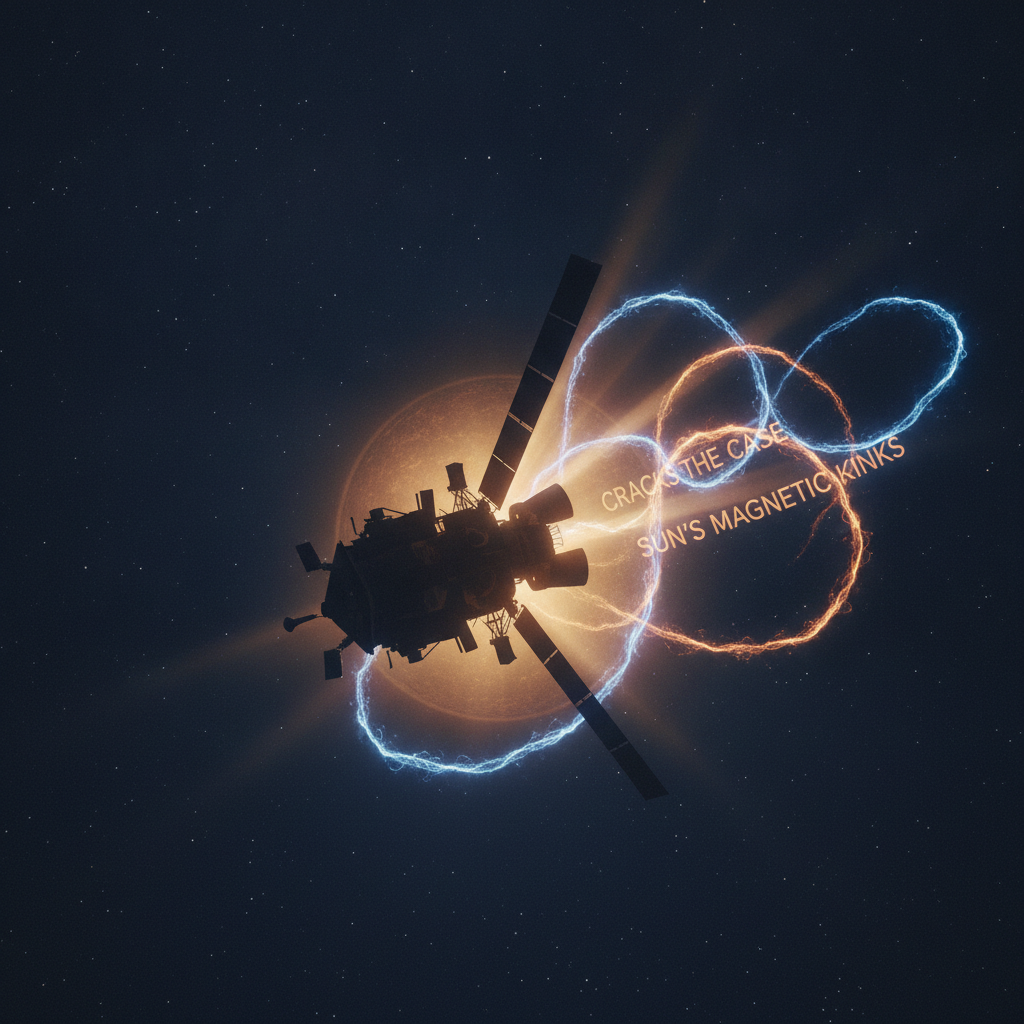
ESA's Solar Orbiter has done something no spacecraft managed before: it flew directly through an S-shaped kink in the solar wind's magnetic field — called a switchback — and traced the structure back to its birthplace on the Sun's surface. [1]
The key was particle chemistry. Using Solar Orbiter's Solar Wind Analyser instrument, researchers sampled the plasma inside the switchback and found a specific mix of charged oxygen and carbon particles that could only have formed within hot magnetic field loops at the surface of the Sun. [1] At the time of measurement, the spacecraft was roughly halfway between Earth and the Sun. [1]
That chemistry pointed directly to a process called interchange reconnection — what happens when open magnetic field regions, whose lines stretch out into space like highways, collide with closed loops that curl back to the Sun. [1] When they meet, the lines snap and reconnect, releasing plasma previously trapped in those loops into the solar wind. [1]
The finding also resolves a long-standing argument. A rival theory held that waves and turbulence were responsible for switchback formation. [1] The results are published in Nature Astronomy. [1]
What looks like a quirk of solar geometry turns out to be a diary entry — proof that the Sun writes its atmospheric signature into the particles it sends our way, and that we are only now learning to read it.
Beyond the physics, the stakes are practical. The solar wind ties Earth to its star, and every improvement in reading that wind's structure brings sharper forecasts for the space weather events that threaten satellites, power grids, and the growing stack of infrastructure humanity has placed in orbit. [1]