South Korea Is Coming to Build America's Ships
HD Hyundai and Kiewit are planning a new Gulf Coast shipyard. It's the most concrete sign yet that Washington's shipbuilding crisis has a Korean answer.
By The Defense Desk
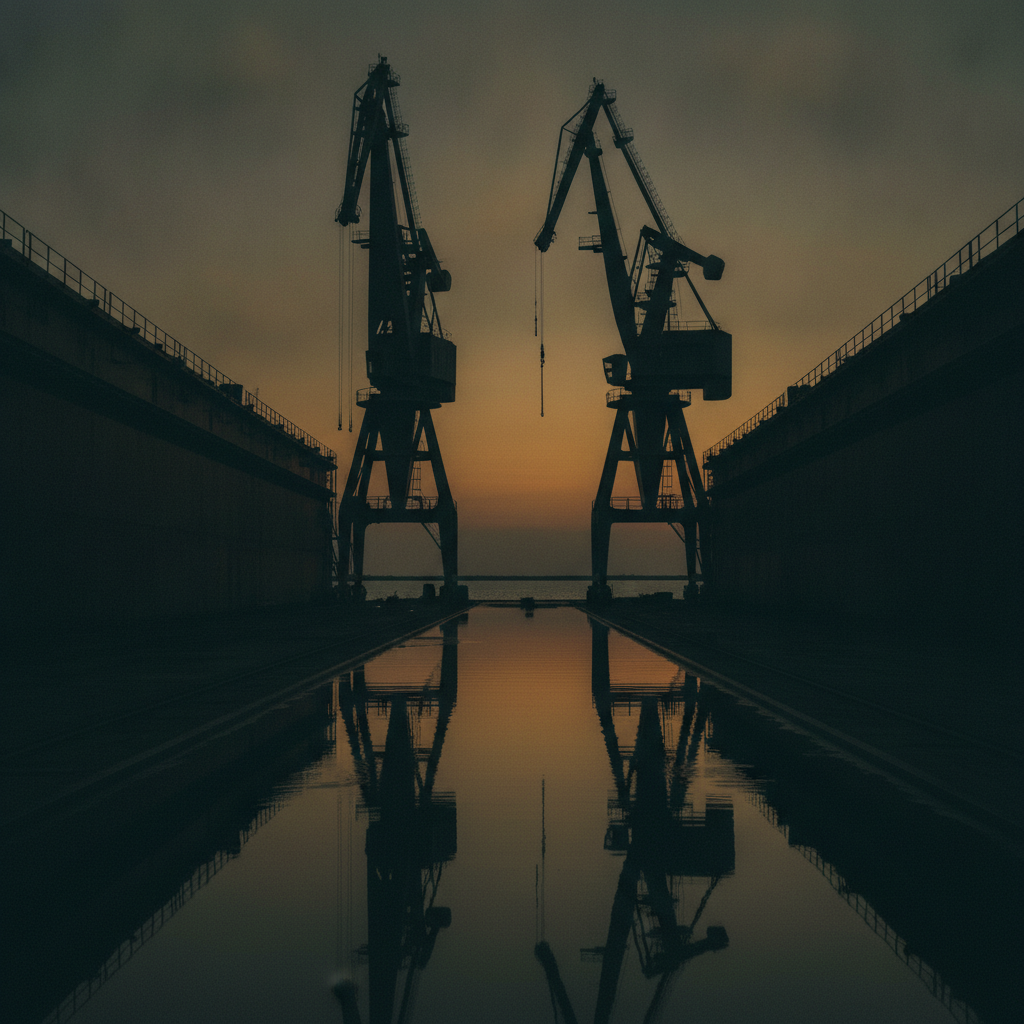
The announcement landed quietly on a Thursday morning in October, but its implications were anything but modest. HD Hyundai — South Korea's largest shipbuilder — and Kiewit Maritime Co., an affiliate of Kiewit Corporation, a North American construction and engineering firm with a track record of building bases, shipyards, and other national defense projects for the US military, revealed plans for a joint venture called HD Kiewit Shipbuilding LLC, targeting the construction of a brand-new shipyard on American soil. [1] The goal: build US Navy auxiliary vessels and commercial ships at a scale and speed that domestic yards have struggled to match for decades.
The two companies say they plan to break ground in 2027 on an existing industrial site, with full operations expected by 2029. [1] The yard is projected to support up to 3,000 full-time jobs. Though the precise location has not been disclosed, a reference to "deep water and unrestricted access to the Gulf" in the joint press release points firmly toward the Gulf Coast region. [1]
What makes this moment worth paying attention to isn't just the ambition of the plan. It's what the plan reveals about how the strategic logic of allied industrial partnerships has shifted — from diplomatic gesture to concrete construction timeline.
The deal didn't emerge from a vacuum. In July 2025, South Korea committed to investing $350 billion in US projects that President Donald Trump hand-selected — among them, $150 billion specifically earmarked for US shipbuilding — as part of a tariff negotiation. [1] HD Kiewit Shipbuilding is the most tangible downstream result of that agreement to date.
Hannae Choi, executive vice president and head of corporate planning division of HD Korea Shipbuilding & Offshore Engineering, framed it in terms of partnership rather than pure commerce. "Building on HD Hyundai's shipbuilding technology and shipyard operating capabilities, we will contribute to strengthening the U.S. shipbuilding industry and expanding shipbuilding cooperation between the United States and South Korea," she said in a statement. [1]
That kind of language — measured, alliance-forward, careful to emphasize contribution over competition — is precisely the register a foreign firm must adopt when it wants to build ships for the US Navy. The politics of domestic industrial sovereignty are real, and the framing of this venture reflects an acute awareness of them.
HD Hyundai is not arriving in the US defense industrial base as a stranger. The firm signed a memorandum of understanding with HII — the largest US naval shipbuilder — to "explore opportunities" to work together on both military and commercial shipbuilding initiatives. [1] That MOU translated into action: in August, the two companies launched a pilot program to deploy intelligent mechanized welding equipment at HII's Ingalls Shipbuilding division. [1] HD Kiewit Shipbuilding, then, is less a cold entry into American waters and more the next step in a relationship already being tested on the shop floor.
Kiewit's role in the venture is equally well-suited to the brief. Kiewit Maritime Co. is an affiliate of Kiewit Corporation, a North American construction and engineering firm that has a track record of building bases, shipyards, and other national defense projects for the US military. [1] If HD Hyundai brings the shipbuilding methodology, Kiewit brings the credentialed infrastructure muscle — the kind of trusted-contractor status that makes a Pentagon contract officer comfortable signing on the dotted line.
There is a certain logic to pairing one of the world's most productive shipbuilders with one of North America's most experienced defense constructors. Each fills the gap the other cannot easily bridge alone — technical pedigree on one side, institutional trust on the other.
The production model the venture is proposing draws on tools that modern Korean yards have spent years refining. The joint press release cited "digital twins, automated production systems and robotic welding" as core elements of the facility's design, describing them as tools intended to "improve productivity, quality and safety throughout the shipbuilding process." [1] For a US industry long criticized for slow throughput and labor inefficiencies, that technology stack represents something the Navy has been asking domestic yards to adopt for years — and largely watching them struggle to implement.
The yard is also designed to produce ship blocks and modules, not just complete vessels. [1] That distinction matters: block construction is the method that allowed Korean and Japanese yards to dramatically compress build times on complex commercial and naval vessels. Rather than assembling a ship entirely in one location and sequence, the block model allows parallel fabrication of major hull sections — which are then joined. The approach turns shipbuilding from a linear process into something closer to industrial manufacturing. Whether a new American yard can replicate that rhythm at scale, with an American workforce, is the central operational question hanging over the announcement.
Scale and intent, of course, are not the same as execution. Building a shipyard is one of the most capital-intensive and logistically demanding industrial projects a nation can undertake. The gap between a press release and a commissioned vessel is measured in years, regulatory hurdles, labor pipelines, and supply chains that don't yet exist.
Still, the structure of the HD Kiewit venture is designed to work around some of those obstacles from the start. By targeting an "existing industrial site" with existing deep-water access, the companies are avoiding the most time-consuming phase of greenfield development. [1] The 2027 construction start and 2029 operational target are ambitious, but not implausible given that foundation. For context, a comparable greenfield facility would typically require a longer runway just to clear permitting and site preparation.
The Navy's auxiliary vessel requirements — the logistics ships, support craft, and sealift assets that underpin any sustained blue-water campaign — represent a more politically accessible entry point for a foreign-linked yard than surface combatants or submarines, which carry stricter domestic-sourcing requirements. Building auxiliaries first, proving the production model, and expanding the relationship incrementally is a playbook that aligns with both the venture's stated scope and the broader political constraints it must navigate. [1]
What's being built here is not just a shipyard. It is an argument — made in steel and concrete — that the allied industrial base and the American defense enterprise can be structured as a single, coherent system rather than parallel tracks that occasionally exchange technology licenses and letters of intent.
HD Kiewit Shipbuilding is, at this stage, a plan with a timeline and a logo. The harder question — whether a Korean-designed, Gulf Coast-built production model can actually move the needle on American naval capacity before the Navy's logistics gap becomes a crisis — won't be answered in a press release. It will be answered in 2029, when the first block comes off the line. Or it won't be answered at all.