SpaceX Goes Public at $2.1 Trillion
The largest IPO in stock market history closes a chapter on SpaceX's private era — and opens one defined by orbital AI and Starship.
By The space-quantum Desk
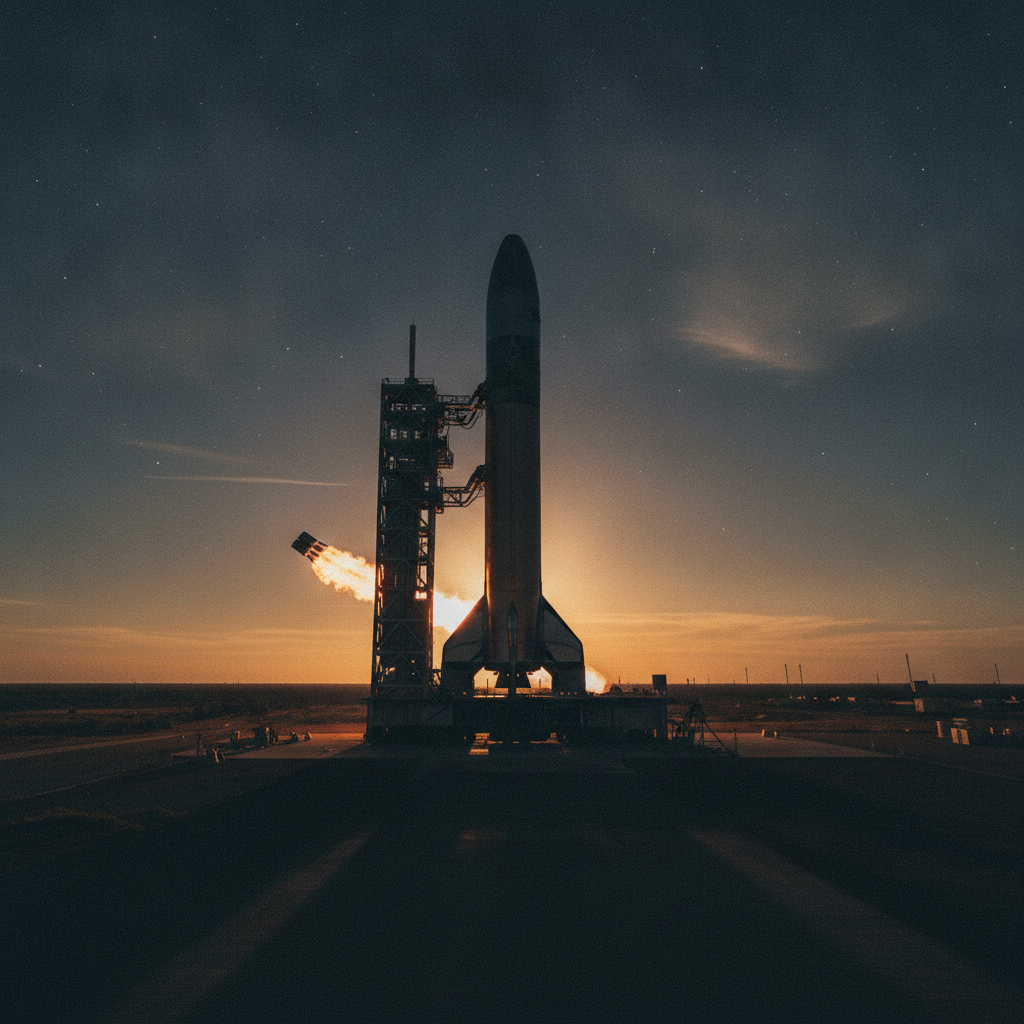
On June 12, SpaceX sold nearly 555.6 million shares at $135 apiece, raised $75 billion before expenses, and ended the day trading at $160.95 — a 19.2% gain that handed the company a market cap of roughly $2.1 trillion. [1] The listing on Nasdaq was the largest IPO in stock market history, surpassing the $29.4 billion Saudi Aramco raised when it went public in 2019. [1] The number stands as a monument, but the more interesting story is what the company plans to do with the money.
SpaceX had signaled its intention to go public as recently as last December, after stating for years that it would remain privately held to focus on long-term ambitions — human missions to Mars chief among them. [1] The shift in thinking was blunt: going public, the company said, would enable it to pursue new opportunities such as orbital data centers. [1] That framing — space infrastructure as AI infrastructure — has since become the axis around which SpaceX's next chapter turns.
The prospectus filed with the Securities and Exchange Commission on May 20 made the financials legible for the first time. [1] SpaceX posted $18.7 billion in revenue in 2025 but recorded a net loss of $4.9 billion, because of investments in both AI and Starship. [1] In the first quarter of 2026, revenue reached $4.7 billion while the net loss stood at $4.3 billion — a ratio that signals the company is still deep in build-out mode. [1] The prospectus stated: "We intend to use the net proceeds from this offering to fund our growth strategy, including the expansion of our AI compute infrastructure, enhancements to our launch infrastructure and launch vehicles, increases in the scale and capacity of our satellite constellations, and any remaining amounts for general corporate purposes." [1]
What makes this moment genuinely strange is the layering of ambitions. A rocket company, a broadband utility, and an AI compute platform have been quietly converging inside the same corporate envelope — and the IPO is the first time the public has been invited to hold a share of that convergence.
The orbital data center pitch is the boldest plank in SpaceX's post-IPO strategy. Chief Executive Elon Musk has argued that data centers in space, launched by the company's Starship vehicle, would be more cost-effective than terrestrial data centers in meeting demand from artificial intelligence applications. [1] SpaceX has proposed a constellation of 1 million data center satellites and has already merged with xAI, the AI company Musk also led. [1] Whether the economics ultimately work at that scale remains an open question, but the infrastructure thesis — that space becomes a substrate for compute rather than merely a venue for communications — is now baked into SpaceX's public valuation.
Starship itself is still a work in progress. [1] If Flight 13 goes to plan, the company may attempt an orbital test flight on Flight 14, with the first Starship launch from Florida slated for Flight 15. [1] Shotwell also said she expected the company to begin launching Starlink V3 satellites on Starship later this year. [1] The cadence matters: Starship is simultaneously SpaceX's heavy-lift workhorse, its data center delivery vehicle, and its Mars ambition — a single platform carrying the weight of every bet the company has placed.
Starlink, meanwhile, is the business that makes the rest of the portfolio legible to investors. The broadband constellation now serves more than 10 million customers worldwide, giving SpaceX a recurring revenue base that no other launch provider can match. [1] The company had already become the dominant provider of launch services globally before the IPO; Starlink turned that launch dominance into a consumer business with network effects. [1] The option to sell an additional 83.3 million shares — raising another $11.25 billion — suggests the company intends to keep that flywheel turning. [1]
The tension Shotwell articulated at the Nasdaq event is real, and worth sitting with. A company born from a founder's willingness to accept near-certain failure is now accountable to quarterly earnings calls — or at least expected to perform the theater of accountability. The question is whether the culture that built the rockets survives contact with the spreadsheet.
Shotwell addressed that tension directly. "Our horizons are very long term. I do not want to focus on quarterly earnings," she said. [1] "I'm not saying we're not going to do right by our investors, but what folks that invest in SpaceX, SpaceXAI, need to know is they need to know that what we're doing is very futuristic and we should be thinking about the future as well as the current quarter." [1] It is an unusual pitch for a newly listed company — but SpaceX is an unusual company.
Musk himself offered a more personal frame at Starbase, Texas, where the company held its own celebrations. "I gave SpaceX less than a 10% chance of succeeding at all," he said. [1] "I said, look, we're probably going to fail, but we should give it a try, because if we don't, if there's not a new company that enters space, we will never be a truly spacefaring civilization." [1] The company he started in 2002 in California, dismissed by many in the space industry at the time, has now executed the largest public market debut ever recorded. [1]
What the IPO does not settle is sequence: it is unclear whether the AI compute ambition will fund the Mars ambition, or whether Mars remains the emotional north star that justifies the rest. The merged entity of SpaceX and xAI, the proposed constellation of 1 million data center satellites, and the Starlink V3 rollout are not a single coherent product roadmap — they are several large bets running in parallel. [1] The $75 billion raised provides runway, but the runway leads to several different destinations at once.
That ambiguity is, in a sense, the point. The company has always moved faster than the narrative written around it — and the IPO simply extends the invitation to a broader audience: join the bet, or watch from the sidelines as the next chapter gets written.
At the Nasdaq event in New York, while the stock ticker still glowed green, Shotwell noted that earlier in the morning the company had conducted another Falcon 9 launch of Starlink satellites. [1] The point was clear: the IPO was the ceremony, not the work. The work, as it always has been at SpaceX, was already underway.