Stryker Bets $400M on a Robot That Fits Any OR
CMR Surgical's modular Versius system is rewriting the economics of robotic surgery — and Stryker wants in before anyone else does.
By The Robotics Desk
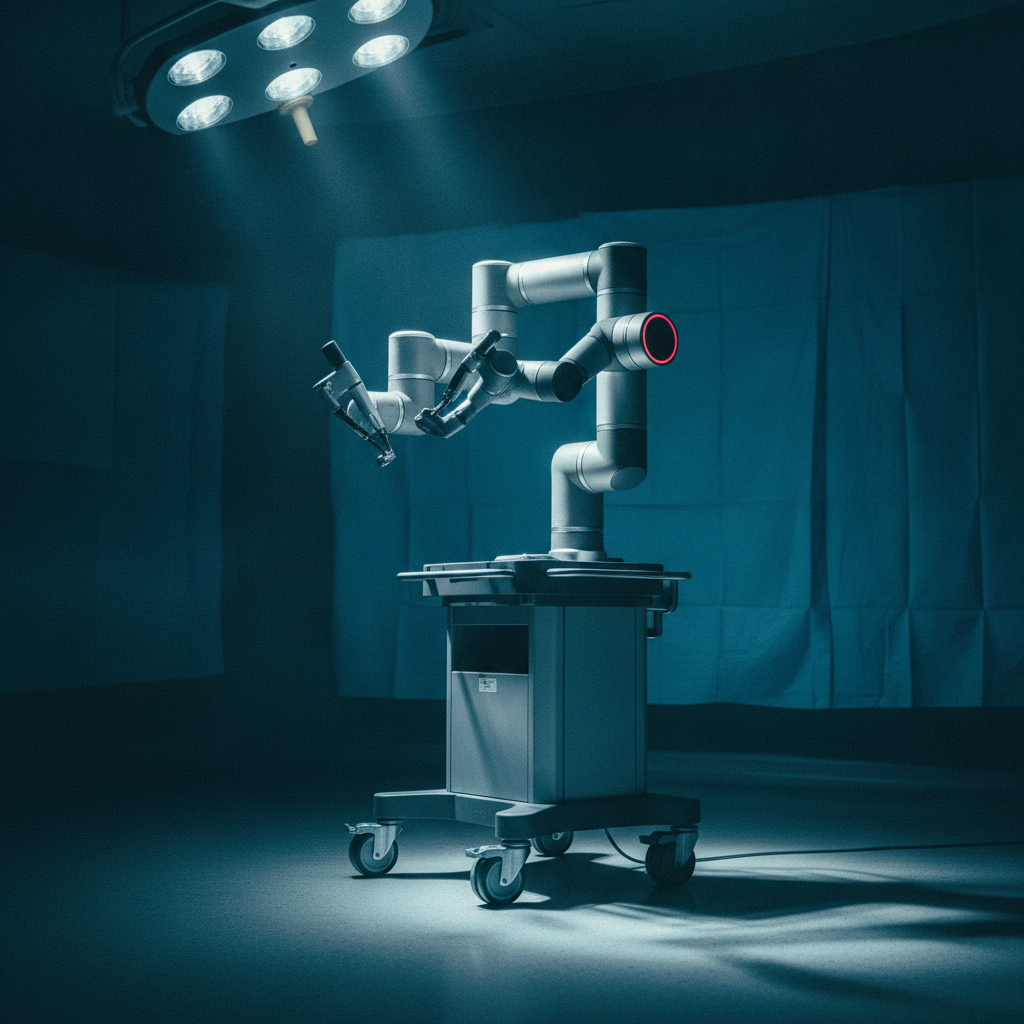
Most surgical robots arrive with a catch: a dedicated operating room, a seven-figure capital commitment, and a facility-wide reorganisation to justify the spend. CMR Surgical built Versius to sidestep all of that. The Cambridge, U.K.-based company designed the system to be compact and modular, so it doesn't require a dedicated OR — a constraint that has historically kept robotic-assisted surgery out of smaller hospitals and ambulatory surgery centres. [1] Now Stryker has invested about $400 million into CMR Surgical, with an exclusive option to acquire the company's remaining equity, signalling that the modularity argument has landed. [1]
The deal lands at a moment when the surgical robotics market is sorting itself into two camps: legacy platforms optimised for volume at flagship academic centres, and a newer generation designed for the realities of under-resourced, over-scheduled hospitals. The question is whether flexibility alone can compete with entrenched incumbents — or whether it requires a distribution partner with the reach and customer relationships to force the issue.
Stryker's entry is deliberate and, by the company's own account, slow-cooked. [1] Stryker will serve as the exclusive U.S. sales agent for the Versius portfolio; CMR Surgical retains control of product development and commercialisation outside the United States. [1]
Pierce framed the move as an extension of capabilities Stryker already owns rather than a departure from them. "Soft-tissue robotics is a high-growth adjacency and a natural extension of Stryker's strengths in endoscopy, visualization, and enabling technologies," he said. [1] That framing matters: it positions Versius not as a standalone bet on surgical robotics writ large, but as a product that slots into an existing commercial infrastructure — one built on relationships with the hospital systems and ambulatory surgery centres that CMR has been targeting since Versius launched.
Versius has been adopted in hospitals across more than 30 countries and used in 45,000 cases worldwide. [1] The procedure range is broad: general surgery, colorectal surgery, urology, gynecology, and thoracic surgery. [1] In the United States, the Versius Plus system has earned FDA 510(k) clearance for cholecystectomy, and CMR has filed a 510(k) submission for benign gynecological indications. [1] For a robot that only recently entered the U.S. regulatory pipeline, 45,000 cases is a number that carries weight in conversations with hospital procurement committees — it represents a clinical track record, not a pilot programme.
Track record, though, is only part of what moves a capital committee. The other variable is operational fit — whether a new system demands that a hospital restructure schedules, retrain staff, and dedicate square footage it may not have. Modularity is a promise that addresses all three objections at once, which is why it keeps appearing in CMR's positioning and why Stryker's distribution muscle makes it more credible.
CMR's case for Versius rests on a specific theory of adoption: that the bottleneck in robotic surgery is not surgeon appetite or patient demand, but operational inertia. The company argues that Versius can help healthcare providers grow robotic adoption within existing operating room workflows — no dedicated OR required, no wholesale infrastructure overhaul. [1] The modular architecture supports flexibility across procedures, surgeon access, and sites of care. [1] In practice, that means a hospital can route the system between ORs depending on the day's schedule, rather than blocking a room exclusively for robotics.
The latest hardware generation, Versius Plus, extends the platform's ambitions beyond mechanical flexibility. Its vision system includes vLimeLite, which launches with two viewing modes — overlay and grayscale — and a choice of two ICG colours: green and cyan, depending on surgeon preference. [2] The surgeon controls ICG visualisation at the console, toggling between viewing modes and ICG colour using a thumbstick on the hand controller, even whilst an instrument is engaged. [2] The design philosophy is the same as the robot's mechanical architecture: put the controls where the surgeon is, reduce the friction of switching between states.
The Versius Plus console has an improved and bigger screen, allowing for enhanced visualisation alongside more powerful vision control and automatic brightness. [2] The wider surgical team also benefits from 3D HD visualisation output for the bedside. [2] Automatic video upload gives instant access to surgical videos without requiring manual recording and upload. [2] These are incremental refinements, but they point toward a system designed to reduce cognitive load across the entire OR team — not just for the operating surgeon at the console.
The tension in any platform bet is between the breadth of a system's ambitions and the depth of its execution in any single use case. A robot that promises to handle general surgery, colorectal, urology, gynecology, and thoracic cases must deliver meaningfully across all of them — or risk being perceived as adequate at everything and excellent at nothing. CMR's clinical record is a partial answer. Stryker's commercial infrastructure is another.
Massimiliano Colella, CEO of CMR Surgical, described the Stryker investment as "a strong endorsement of the technology, clinical experience, and global business we have built." [1] He added that "Stryker's investment will give us additional strength to accelerate innovation and the continued global expansion of the Versius portfolio, while its scale and deep customer relationships create a significant growth opportunity in the United States." [1] Colella also said: "We also look forward to welcoming Andy Pierce to our board of directors and benefiting from his more than 30 years of MedTech leadership experience at Stryker as we continue expanding access to robotic-assisted surgery globally." [1] The governance link is as significant as the commercial one: it ties Stryker's institutional knowledge to CMR's product roadmap before any full acquisition closes.
Stryker's exclusive acquisition option covers 100% of CMR Surgical's outstanding equity, subject to the agreement's terms, regulatory approvals, and customary closing conditions. [1] The structure is a familiar one in MedTech: invest, distribute, observe, then decide. The $400 million buys Stryker a front-row seat to Versius's U.S. commercial performance before committing to a full purchase. If the system sells, Stryker exercises its option. If adoption stalls, it holds a significant minority stake in a company with a meaningful international footprint and a growing procedure list. The downside is bounded; the upside is a fully owned robotic surgery platform built for the next decade of healthcare economics rather than the last.
The surgical robotics market has spent a decade consolidating around large, expensive platforms that rewarded scale and punished flexibility. CMR Surgical built Versius as a direct counter-argument — smaller, modular, designed to fit into hospitals that cannot afford to dedicate an OR to a single machine. [1] Stryker's $400 million investment is not just a vote for the product; it is a vote for the thesis that the next wave of robotic adoption will be won not in flagship centres, but in the hundreds of hospitals and surgery centres that still weigh every square foot and every scheduling slot. Whether Versius delivers on that promise at U.S. scale is now, effectively, Stryker's problem to solve.