The $2 Billion Gamble to Fly a Nuclear Reactor to Mars
NASA is building Space Reactor-1 Freedom, the first nuclear-powered interplanetary spacecraft. But the agency's own budget is trying to kill the idea.
By The Energy-Climate Desk
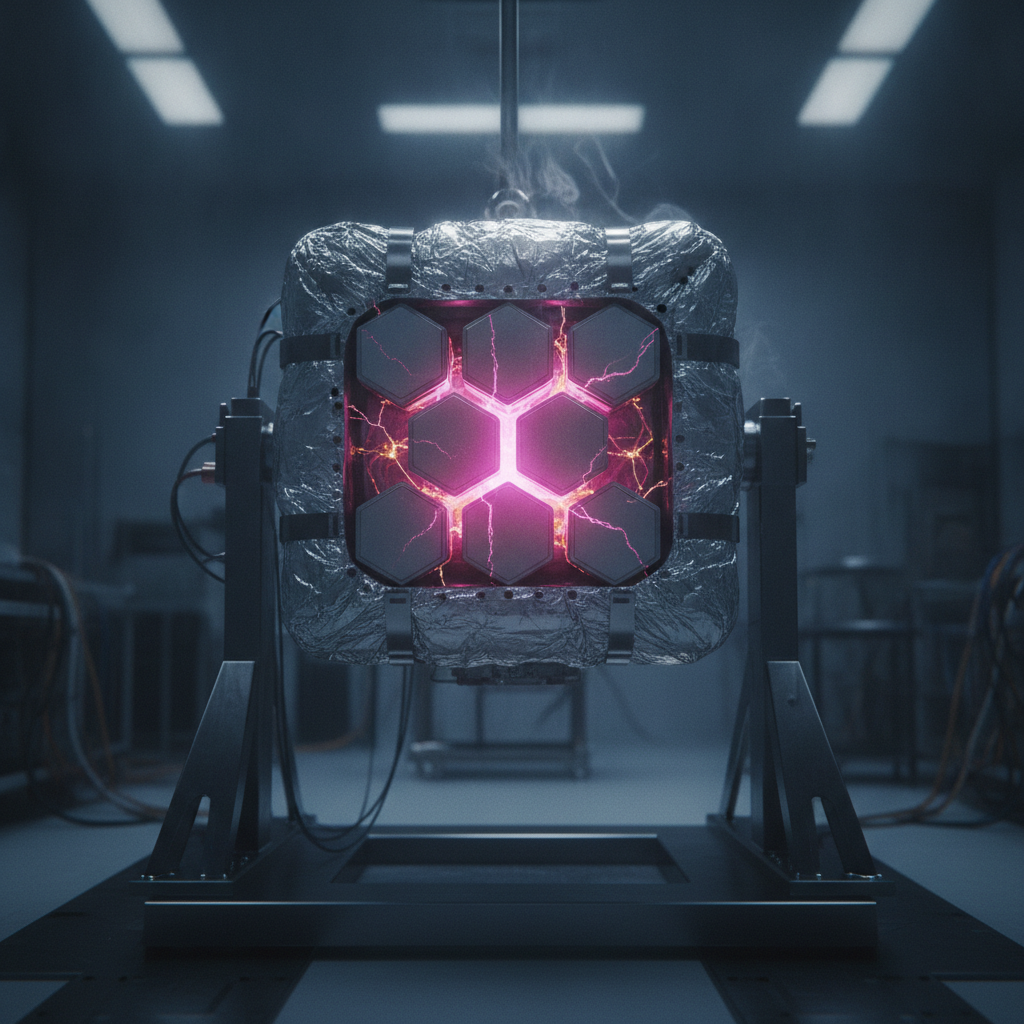
Just before the Artemis II crew began its historic slingshot around the moon this past April, NASA announced plans to build Space Reactor-1 Freedom — SR-1, the first-ever nuclear-reactor-powered interplanetary spacecraft, meant to fly an uncrewed mission to Mars by the end of 2028, arriving in 2029. [1] The announcement arrived at a peculiar moment: weeks later, the White House proposed reducing NASA's overall budget by about 24 percent, from $24.8 billion to $18.8 billion in fiscal year 2026, and terminating every nuclear propulsion program the agency had running. [2]
SR-1 is a $2 billion bet on a propulsion architecture called nuclear electric propulsion, which uses the neutrons produced in a self-sustaining, uranium-atom-splitting reaction to create heat and ultimately electricity. [1] That electricity ionizes a gas, and magnetic fields blast it out of the craft as thrust. [1] The approach, as Sebastian Corbisiero, the US Department of Energy's national technical director of space reactor programs, puts it, is "very low thrust, but very efficient. So you can use it for a long period of time." [1]
Concept art presented by Steve Sinacore, program director of NASA's SR-1 program, shows a craft that looks like a colossal fletched arrow. [1] The back houses the power-and-propulsion system. The tip holds a uranium-filled nuclear reactor with a capacity of at least 20 kilowatts — for context, a typical nuclear plant on Earth is about 50,000 times more powerful. [1]
The design is austere, functional, almost brutalist — a machine built entirely around the logic of deep space, where there is no atmosphere to cool an engine, no ground crew to service a leaking seal, and no turning back once the reactor switches on.
Idaho National Laboratory is building SR-1's reactor and, according to NASA, is on target for a late-2028 launch. "Procurement of major components is underway, and integration work on the power and propulsion element is advancing steadily," Sinacore told MIT Technology Review. [1] If everything holds, the journey to Mars will take about a year. [1]
Nuclear propulsion in space is not a new idea. The Soviet Union sent dozens of reactors into orbit, often to power spy satellites. [1] The US has started — and terminated — several programs over the past 75 years. DARPA and NASA selected Lockheed Martin as the lead contractor for the DRACO spacecraft in 2023, with BWX Technologies developing the reactor. [2] The project aimed to demonstrate a nuclear thermal engine in orbit aboard a United Launch Alliance Vulcan rocket, but it never got there. [2]
DRACO's nuclear thermal approach worked differently from SR-1's nuclear electric system. The DRACO engine would have heated super-cold liquid hydrogen to temperatures of nearly 5,000° Fahrenheit, boiling it and driving the resulting gas through a nozzle to generate thrust — theoretically offering twice the efficiency of the highest-performing conventional rocket engines. [2] That would have meant significantly less fuel a Mars mission would need to carry across the Solar System. [2] Nuclear electric propulsion, what SR-1 uses, offers another leap in efficiency beyond that — but at lower thrust levels. [2]
[1] Nuclear thermal propulsion testing "requires that engine exhaust be scrubbed of radiologics before being released," noted Greg Meholic, an engineer at the Aerospace Corporation, in a presentation. This requirement "could result in substantially large, prohibitively expensive facilities that take years to build and qualify." [2] These safety protocols weren't as stringent when NASA and the Air Force first pursued nuclear propulsion in the 1960s. [2]
The pattern is familiar: ambition collides with cost, cost collides with politics, and the program gets quietly shelved while the underlying physics remains as compelling as it ever was. What changes is the external pressure — and right now, the pressure is building from multiple directions at once.
Lindsey Holmes, vice president of advanced projects at Analytical Mechanics Associates, an aerospace company in Virginia, says the aggressive SR-1 timeline is being driven partly by China's and Russia's own deep-space nuclear ambitions. The two countries have spoken about plans to place a reactor on the moon's surface in the mid-2030s to power a jointly operated lunar base. [1] Whether SR-1 reaches Mars or not, its development should help NASA put its own reactor on the moon — the technology involved in the two projects is broadly similar, since the lunar surface, like space itself, is a vacuum. [1]
The White House's proposed budget for fiscal year 2026 is explicit: "This budget provides no funding for Nuclear Thermal Propulsion and Nuclear Electric Propulsion projects. These efforts are costly investments, would take many years to develop, and have not been identified as the propulsion mode for deep space missions." [2] NASA's Space Technology Mission Directorate would see its budget cut nearly in half, from $1.1 billion to $568 million. [2] The proposed cuts would also cancel the Space Launch System rocket, the Orion spacecraft, Mars Sample Return, probes to Venus, and future space telescopes. [2]
The budget proposal is not final. Republican-controlled houses of Congress will write their own versions, which must be reconciled before going to the White House. [2] NASA's 2024 budget allocated $117 million for nuclear propulsion work, up from $91 million the previous year, and Congress has added funding beyond what the Biden administration requested in recent years — a signal that Capitol Hill may protect at least some of these programs. [2]
Jared Isaacman, the billionaire commercial astronaut Trump nominated to lead NASA, told lawmakers during his Senate confirmation hearing in April that nuclear propulsion was precisely the kind of challenge NASA should own. "That's something that no company would ever embark upon," he said. "There is no obvious economic return. There are regulatory challenges. That's exactly the kind of thing that NASA should be concentrating its resources on." [2]
[2] The history is sobering: President Nixon canceled the NERVA nuclear rocket program in 1973 after the government had spent $1.4 billion on it — equivalent to about $10 billion in today's dollars — and NERVA never flew in space. [2]
Kurt Polzin, chief engineer of NASA's space nuclear propulsion projects, frames the tradeoff clearly. [2] A nuclear-powered mission can carry its return fuel without depending on a propellant plant that has to be robotically assembled on Mars before anyone arrives. [2]
Simon Middleburgh, co-director of the Nuclear Futures Institute at Bangor University in Wales, noted that launch itself will be a genuine test. "Going through the launch safely is going to be a challenge. You are being shaken, rattled, and rolled." [1] For safety reasons, SR-1's reactor will be switched on around two days post-launch, when the craft is comfortably far from Earth. Uranium is not especially dangerous by itself, but the waste products that emerge when the reactor is running are another matter. [1]
Most of the technology for SR-1 already exists. [1] The question now is whether NASA can hold its budget, hold its timeline, and hold its nerve long enough to point a nuclear-powered spacecraft at Mars — and actually let it fly.