The $500M Missile Ukraine Is Already Firing
Destinus's Ruta Block 1 has moved from announced program to active combat use — and it's just the beginning of a much larger family.
By The Defense Desk
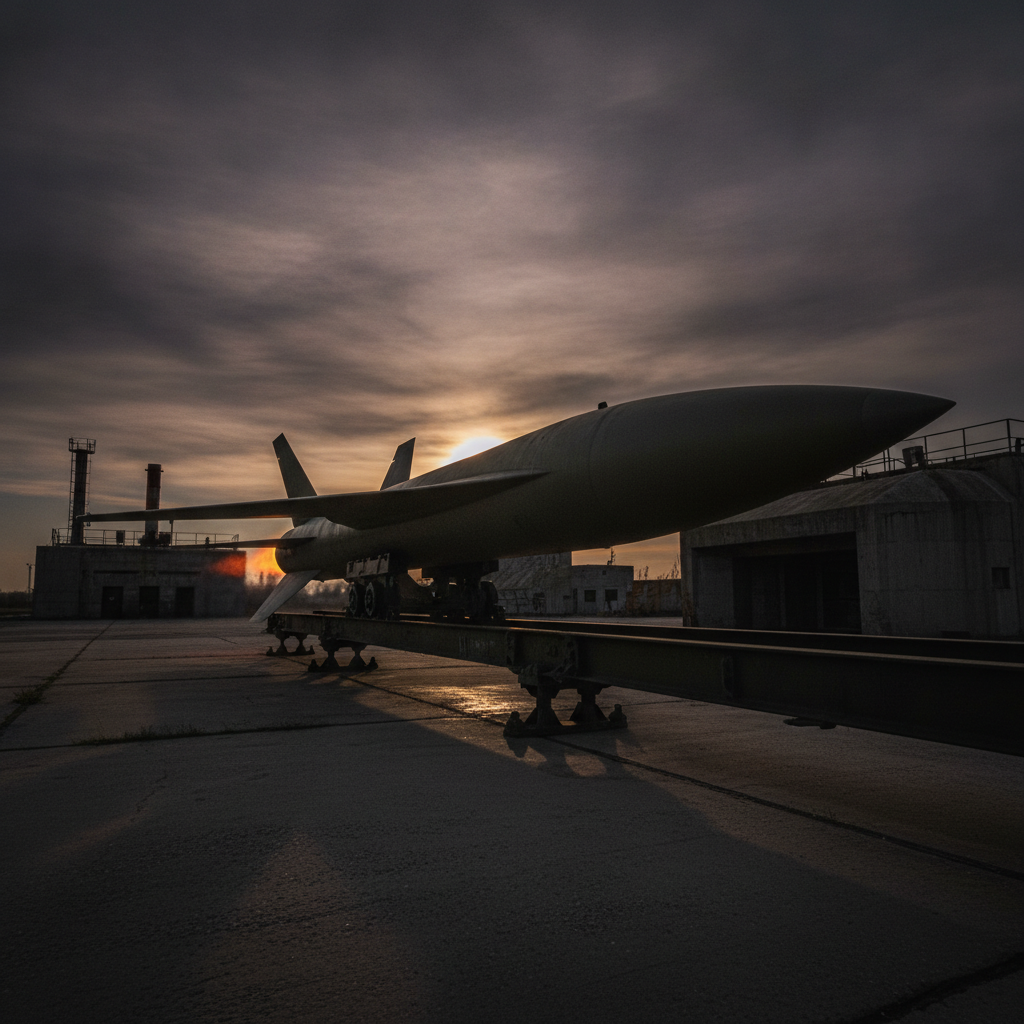
Photographs circulating on Russian Telegram channels show fuselage sections, internal components, and part of a tailfin assembly scattered across a landscape that could be almost anywhere inside Russia. The wreckage, consistent with the Dutch-produced Ruta Block 1 cruise missile, represents the first publicly available evidence that the weapon has entered combat use. [1]
The Ruta Block 1 is built by Destinus, a Netherlands-based company founded by Russian exile Mikhail Kokorich. According to the manufacturer, the missile has a range of more than 300 kilometers and carries a payload of 150 kilograms. [1]
The scale of commitment behind the weapon is significant. Earlier reporting indicated that Block 1 was already being manufactured in the Netherlands and had been delivered to Ukraine since at least 2024. [1]
What makes this moment notable is not merely that a new weapon has appeared on a battlefield already saturated with them. It is the logic behind its design — a philosophy that treats cost and volume as primary variables rather than afterthoughts.
Unlike larger and more expensive cruise missiles, Ruta has been presented as a mass-producible weapon optimized for deep strikes against military infrastructure. The missile is designed around affordability and production scale, enabling Ukraine to conduct sustained long-range precision attacks while reducing reliance on scarce, more exquisite Western-supplied weapons. Crucially, its turbojet engine is also manufactured by Destinus, so the company does not rely on the United States for this component. [1]
Ukraine has generally remained silent regarding operational use of many of its newest indigenous strike systems until well after they have entered service. Confirmation of the introduction of other long-range weapons often came first from Russian photographs of intercepted missiles or strike aftermath before official acknowledgment from Kyiv — a pattern that appears to be repeating with the Ruta Block 1. [1]
There is a certain irony in the way modern warfare now self-documents. The adversary's own open-source channels become the first confirmation that a weapon has crossed from development into deployment.
Russian military bloggers claimed air defenses intercepted the missile, though that cannot currently be independently verified. Whether this particular missile reached its intended target or was intercepted remains unknown. The imagery itself has not been independently verified, and the possibility cannot be ruled out entirely that the wreckage represents a previously undisclosed Ukrainian cruise missile design with broadly similar characteristics. [1]
For Ukraine, the Ruta Block 1 forms part of a broader effort to diversify its expanding arsenal of deep-strike capabilities, alongside long-range drones, indigenous cruise missiles, and missile-drone hybrids. As production ramps up, these systems are playing an increasingly important role in sustained attacks against Russian energy infrastructure, as well as command centers, logistics hubs, airbases, ammunition depots, and defense-industrial facilities far behind the front lines. [1]
Destinus is not standing still at Block 1. Earlier this year, the company presented the Ruta Block 2, which increases the missile's range to over 800 kilometers and boosts its payload capacity to 250 kilograms. The trajectory does not stop there: the Ruta Block 3 will have a range of 2,000 kilometers with a 550-kilogram payload, is expected to enter flight testing in 2027, and is also suitable for air launch. [1]
Three blocks, three capability tiers, one coherent industrial strategy. The progression reveals something about where defense procurement is heading — away from singular, extraordinary systems and toward families of weapons designed to be built at scale and replaced without ceremony.
The Block 3's relevance extends well beyond Ukraine. Russia's extensive use of ground-launched missiles in Ukraine, along with its deployment of long-range weapons in Kaliningrad, has highlighted the deficiencies in Europe's deep-strike capabilities as NATO seeks to strengthen conventional deterrence against Moscow. The Block 3 could be part of the answer to emerging requirements, including the European Long-Range Strike Approach (ELSA), which involves France, Germany, Italy, Poland, Sweden, and the United Kingdom, and which seeks to bring new systems into service in the 2030s. [1]
Destinus is also working to expand its production capacity, including through a joint venture with Rheinmetall that will make use of that company's manufacturing facilities in Germany. The partnership is a signal that Destinus is thinking industrially, not just technically — positioning the Ruta family as a platform for European sovereign strike capability rather than a niche export product. [1]
The Ruta series is part of a wider trend toward lower-cost, highly producible cruise missiles visible across multiple Western programs. In the United States, analogous efforts include CoAspire's Rapidly Adaptable Affordable Cruise Missile-Extended Range (RAACM-ER) and the Family of Affordable Mass Missiles-Beyond Adversary's Reach (FAMM-BAR) effort, which is seeking lower-cost designs with maximum ranges of 1,000 nautical miles or more. [1]
The convergence of these programs across different nations and procurement cultures suggests the same conclusion is being reached independently: that the next era of deterrence will be built on volume, not just sophistication.
What the Telegram wreckage photographs confirm, above all else, is that the Ruta Block 1 has transitioned from an announced development program into an operational weapon being employed against Russian targets. [1] The Block 2 and Block 3 are coming. Destinus's Rheinmetall joint venture is scaling. And somewhere in that progression lies a broader bet: that affordable, mass-produced precision strikes will reshape the calculus of European security before the decade is out.
The missile is designed around affordability and production scale, enabling Ukraine to conduct sustained long-range precision attacks while reducing reliance on scarce, more exquisite Western-supplied weapons.The War Zone