The Army's $7 Billion Bet Against the Drone Swarm
Washington is done looking for a single counter-drone solution. A sprawling new IDIQ signals a doctrine shift—and a marketplace built for allied buyers.
By The Defense Desk
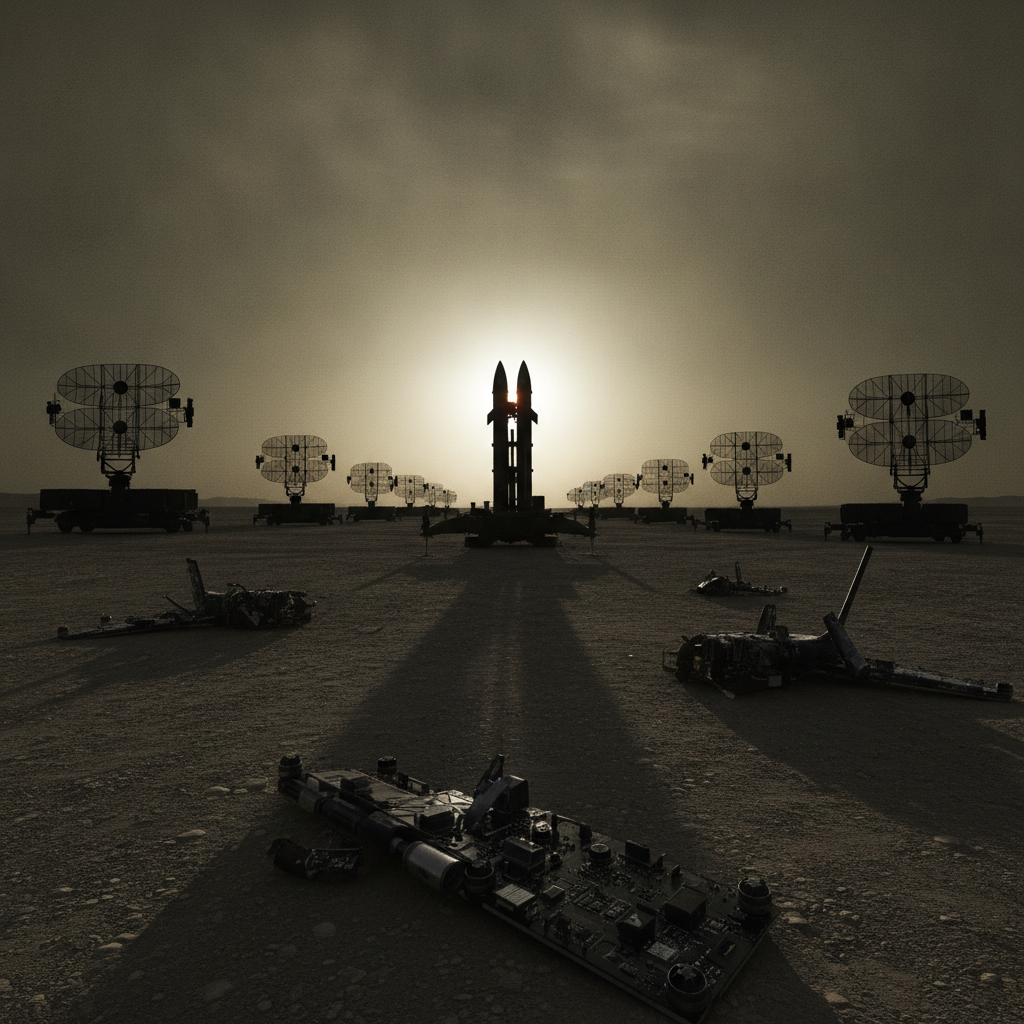
One contracting vehicle. A ceiling of $7 billion. The target: every drone that shouldn't be in the sky above an American military base or piece of critical infrastructure. [1]
The awards, announced by Army acquisition leaders and Joint Interagency Task Force 401 officials, are structured as an indefinite delivery, indefinite quantity vehicle—the Pentagon's preferred mechanism for buying capabilities it knows it needs but can't fully specify yet. [1] That architectural choice is not incidental. It is the strategy.
For years, the counter-drone problem was treated as a procurement puzzle. Pick the best system, field it widely, move on. What the past several years of conflict have made clear is that the puzzle has no fixed shape—and the pieces keep changing.
Brig. Gen. Matt Ross, the commanding general of JIATF-401, put it plainly to reporters: "There's no silver bullet. I think at times in the past, people thought that we could just down-select to a really good counter-UAS capability and give one to everybody. What we've seen is that there is no single solution." [1]
Instead of a monolithic system, the Army is assembling what Ross described as a "layered defense" capable of detecting, tracking, identifying, mitigating and capturing drones. [1] Rather than relying on a single "system of systems," the service is buying multiple interoperable systems to perform those functions across different environments, threat profiles, and operational contexts.
The architecture of this contract tells a story about institutional learning. When threat vectors multiply faster than procurement cycles, flexibility becomes as important as capability. Locking into a single vendor is not just a technical risk—it is a strategic one.
[They] really give us options as newer requirements emerge. The Army wants competition. The JIATF-401 team wants competition. We want to bring better technology forward every day, and we don't want to be locked into a single vendor as that threat evolves," Ingraham said. "We've laid the contracting foundation before the next requirement hits." [1]
The contracts will feed into two distinct channels. The first is the Pentagon's Domestic Shield program, which is focused on protecting US military installations and critical infrastructure from small-drone threats. [1] That program sits at the intersection of homeland defense and base security—a domain that has become markedly more urgent as consumer-grade drones have proliferated and their tactical uses have multiplied.
[1] Ingraham said he foresees the counter-drone marketplace being just as successful as the Army's existing drone marketplace, which has already recorded over $800 million in sales. [1]
The marketplace model is where this story gets genuinely interesting. Defense procurement has long operated on a hub-and-spoke logic: the Pentagon decides, industry delivers, allies wait. A marketplace inverts that relationship, letting demand signal itself and letting supply respond in something closer to real time.
Ross described the marketplace's function in terms of supply chain transparency rather than procurement efficiency alone. "What we're trying to do through the marketplace is to connect those producers with customers so they can see that true demand across the United States, then also with our partners and allies," he said. [1] "A large IDIQ contract will allow companies to raise additional capital to build up their inventory because they have a reasonable expectation that we're going to continue to partner with them."
That capital formation argument is not rhetorical. If a drone manufacturer can point to a federally backed IDIQ as evidence of sustained demand, it can access commercial financing at more favorable terms—which in turn accelerates production at a moment when, as Ross acknowledged, the demand for counter-drone systems "exceeds available supply right now." [1]
The announcement also came packaged with a separate institutional move: the National Nuclear Security Administration and JIATF-401 signed a memorandum of understanding to improve information sharing on drone threats. The NNSA framed the purpose plainly: "Together, we will reduce duplicative testing, accelerate the fielding of effective C-UAS capabilities, and strengthen protection of critical national security facilities." [1]
The MOU signals something worth noting about how the federal government is restructuring its approach to drone defense: it is no longer treating counter-UAS as a purely military domain. Nuclear security facilities, critical infrastructure operators, and civilian agencies are all now inside the same information loop—sharing test data, reducing redundant spending, and in theory fielding solutions faster because they are not each running their own isolated evaluation programs. [1]
What takes shape across all of these announcements is less a procurement event than a posture. The Army is not buying a solution. It is building a framework designed to absorb whatever comes next—new threats, new vendors, new operational requirements—without having to restart the contracting process from zero each time.
Ingraham and Ross declined to answer questions about delivery timelines or end recipients. The contracts, as structured, do not require them to. [1] The IDIQ vehicle is a standing offer, not a delivery order—which means the real spending decisions come later, shaped by whatever requirements the next conflict, the next threat actor, or the next technology cycle happens to generate.
Seven billion dollars is a large ceiling. Whether it proves sufficient depends entirely on how fast the threat moves—and on whether a layered, competitive, marketplace-oriented doctrine can keep pace with adversaries who face no procurement rules at all. [1]