The Army's Hidden Navy Is Going Autonomous
A small, underappreciated fleet of Army watercraft is being retooled for Pacific logistics—with drone boats, retrofit kits, and up to 100 new USVs on the horizon.
By The Defense Desk
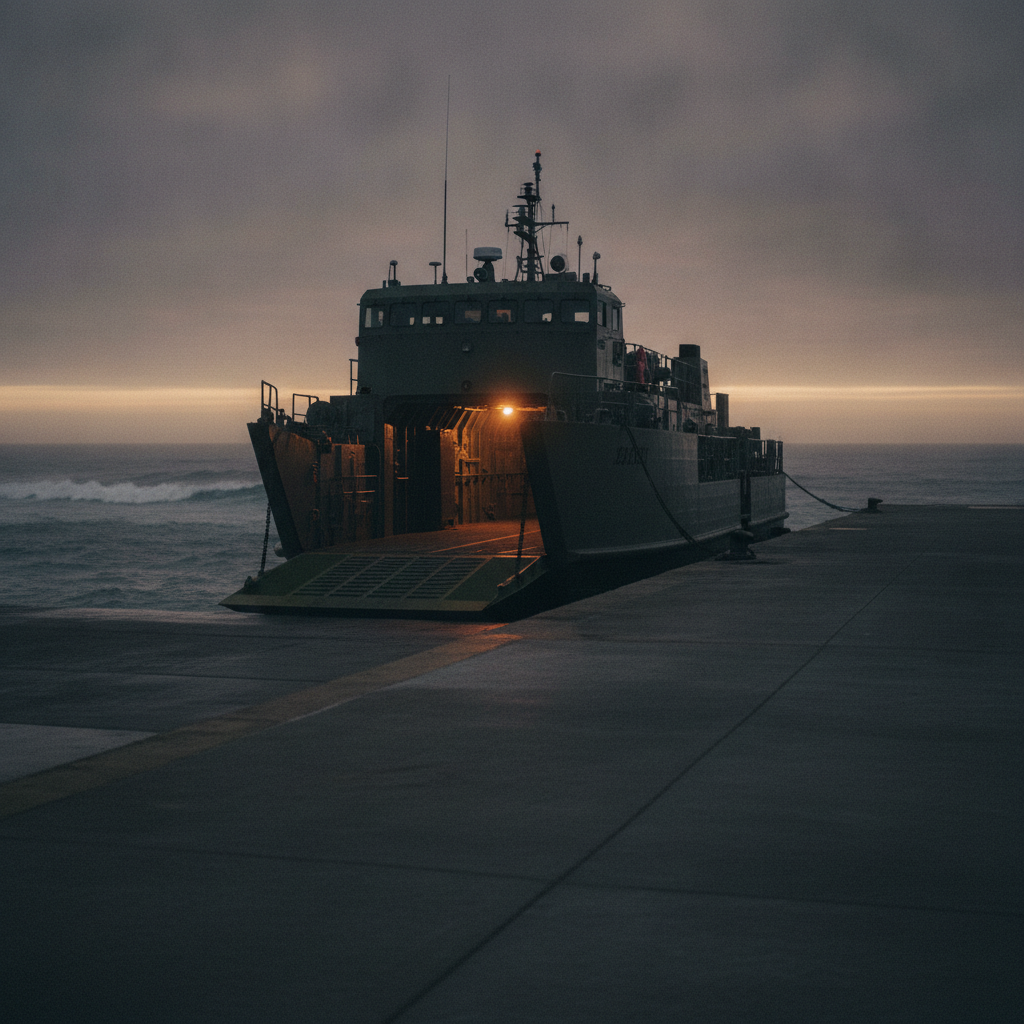
The U.S. Army operates a fleet of ships almost nobody talks about. Known informally as 'the Army's Navy,' the force of amphibious landing ships, logistics support vessels, and landing craft has long handled the kind of unglamorous port-to-beach supply work that keeps forward-deployed soldiers fed and equipped. Now, the service wants to make much of that fleet autonomous—and to supplement it with as many as 100 purpose-built drone boats. [1]
Army Maj. Gen. Frederick Crist, head of 8th Theater Sustainment Command, laid out the vision at the Association of the U.S. Army's main annual symposium. His command, headquartered at Fort Shafter in Hawaii, manages U.S. military logistics across the Pacific—a vast, island-studded theater where moving supplies by sea is not optional. [1]
The immediate proof of concept came in August, when U.S. Army Pacific retrofitted a commercial offshore support vessel, the HOS Resolution, with an autonomous navigation kit. Maritime autonomy firm Sea Machines integrated its SM300 software package onto the 257-foot ship in just nine days. The vessel—normally used to support oil and gas rigs—also has a stern ramp and four jack-up legs that make it well suited to loading and unloading cargo at remote beaches. [1]
S. Special Operations Forces. [2]
Crist framed the HOS Resolution trial as a stepping stone, not a finish line. 'You could increase the fleet of autonomous vessels by tapping into the existing manned fleet,' he said. 'Put on retrofitting kits to be able to conduct navigation, and then eventually propulsion and engine room activities, and eventually get to a fully autonomous system.' [1]
The logic is elegant in its pragmatism: the hardest part of building an autonomous fleet may not be the software but the hull count. If existing ships can be upgraded in stages, the path from crewed to uncrewed becomes a continuum rather than a cliff.
Beyond retrofits, the Army wants purpose-built uncrewed surface vessels. Earlier this year, Maj. Gen. Gavin Gardner—Crist's predecessor at 8th TSC—said he wanted to rapidly acquire as many as 100 drone boats, with larger variants capable of carrying eight to 10 standardized shipping containers. 'I could see those operating in the U.S. PACOM area of responsibility,' Gardner told reporters at a roundtable in June, according to Military Times. 'I think that gives you a ton of operations, inventory in motion, easy to respond. And then because they're autonomous, and we can work with our partner nations forward, you have those berthed up everywhere from Korea to Japan, the Philippines, Australia, Singapore, Thailand, etc.' [1]
The Army has also been testing smaller, combat-oriented USVs. During the Salaknib 2026 exercise in the Philippines, Army forces used unarmed Rampage USVs from U.S. firm Havoc to escort a General Frank S. Besson class Logistics Support Vessel, with the drone boats heading out in front to help spot potential hazards. Separately, the 7th Infantry Division experimented with a Ukrainian-developed Magura-series USV—configured to launch a quadcopter drone—during an exercise in Michigan. A Saronic Corsair USV also appeared at that exercise; the same type was used in what is reported as the first known U.S. kamikaze USV strike, against a coastal target in Iran in July. [1]
The broader fleet structure is also being reorganized. The Army recently reflagged the 10th Support Group in Okinawa as the 45th Sustainment Brigade and is standing up a second composite watercraft company at Yokohama North Dock on Honshu. At full build-out, two composite watercraft companies will sit west of the International Date Line under the 45th Sustainment Brigade's command. [1]
Crist is also eyeing a mixed portfolio that blends Army vessels, Army mariners, and commercially owned ships contracted through U.S. Transportation Command. 'It's going to be a broad portfolio of systems of systems,' he said. Last year, the Navy struck the four oldest Spearhead-class ships from its rolls entirely. [1]
The contrast is worth sitting with. One service spent tens of millions demonstrating a capability and then shelved it; another is now building the same capability into its foundational logistics doctrine. The difference may be less about technology than about institutional will to follow through.
The Pentagon is also laying groundwork for a new Autonomous Warfare Command, which it hopes to see come to fruition next year. Whether the Army's watercraft ambitions survive budget cycles and bureaucratic friction remains to be seen—but the service is at least placing its bets in the water, not on a slide deck. [1]