The Black Hawk Isn't Going Anywhere
A $356 million undefinitized contract keeps Sikorsky's production line running — and signals the Army isn't done with its workhorse helicopter.
By The Defense Desk
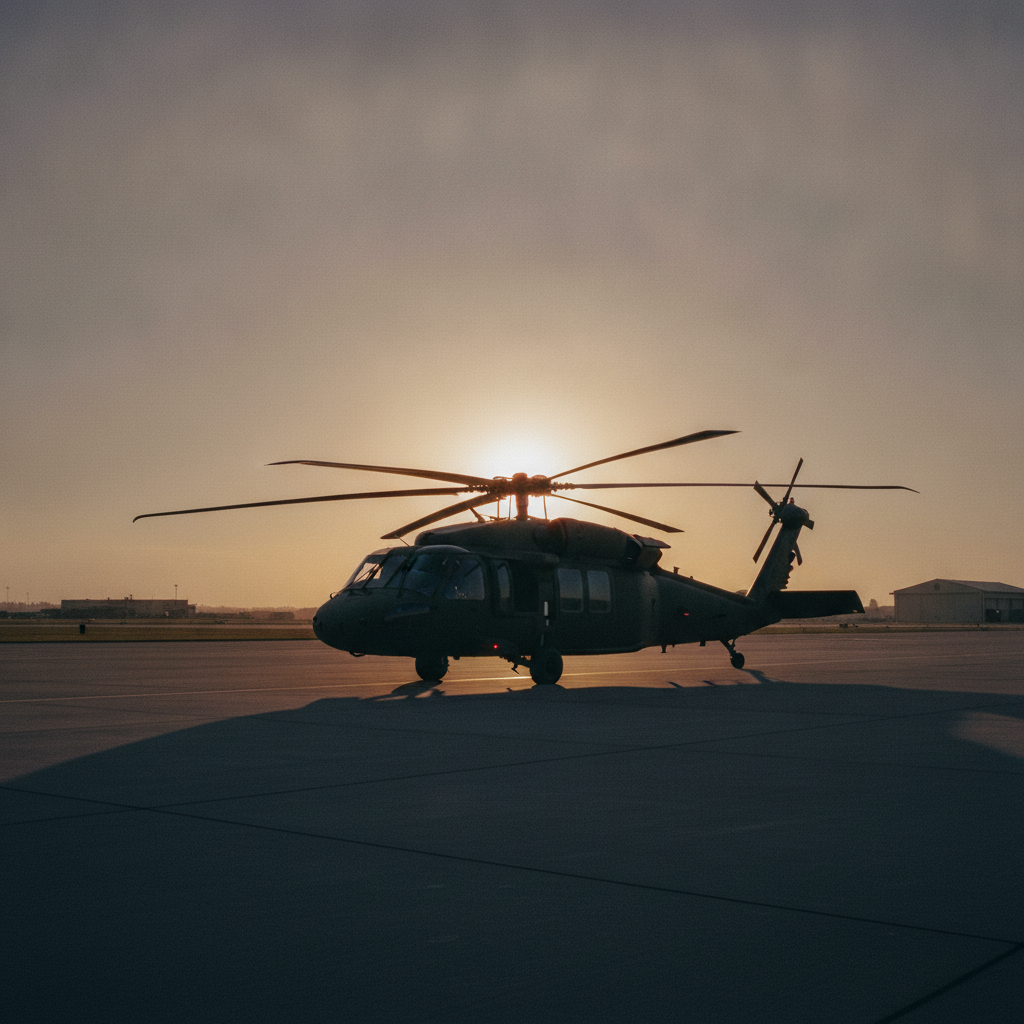
The Army has handed Sikorsky an additional $234 million in an undefinitized contract action for 16 Black Hawk UH-60 helicopters, pushing the total contract value to $356 million and keeping the manufacturer's production line moving without waiting for Congress to sort out its appropriations calendar. [1]
The move is deliberate. Sikorsky's 10th multiyear deal — awarded by the Army in 2022 — is set to conclude by the end of 2027, and the new undefinitized contract action is designed to bridge that gap without a break in production. [1] The 16 initial aircraft are scheduled for delivery in fiscal 2028 and are being funded by leftover fiscal 2025 and 2026 appropriations. [1]
[1] One of Sikorsky's goals with the new agreement, Benton said, is to be "flexible" and able to have a quick turnaround time in delivering the aircraft. [1]
There is something telling about how defence procurement works when it works well — not in grand announcements, but in the quiet mechanics of keeping a line moving. The undefinitized contract is a tool precisely for moments when certainty is a luxury the production schedule cannot afford.
An undefinitized contract action means dollar values and quantities remain subject to change as negotiations continue, but the format gives the Pentagon a way around legislative gridlock: the vendor starts production before a final deal is signed. [1] It is a workaround that trades fiscal precision for operational tempo.
"We met the Army where they needed to be, right," Benton said. "They needed us to be agile. They needed us to contract quickly, and they needed [us] to maintain continuous production, which to us was a priority." [1] That framing — supplier as responsive partner rather than passive vendor — reflects a shift in how large defence primes are positioning themselves amid a procurement environment that rewards flexibility.
Once definitized, Benton predicts the deal could encompass as many as 150 aircraft over the next three to four years, with deliveries split across the active Army, the National Guard, and foreign military sales. [1] Jason Wrigley, director of business development at Sikorsky, confirmed that the 16 initial aircraft are scheduled to be delivered to the Army in fiscal 2028 and are being funded by leftover fiscal 2025 and 2026 appropriations. [1]
The numbers in any defence contract are a form of storytelling — they describe not just what is being bought, but what is being valued, and what is being hedged. Reading them carefully reveals the gap between what an administration requests and what the legislature intends to spend.
That gap is striking here. The president's FY27 budget request included $39 million for a single UH-60M Black Hawk — a figure that sits in stark contrast to last year's request of $913 million. [1]
The Senate Armed Services Committee's draft NDAA adheres to the president's reduced request, and the Senate has yet to pass its version of the bill. [1] The result is a procurement picture that is fractured along institutional lines — a White House asking for restraint, a House pushing to spend more, and a Senate yet to render a verdict.
Despite the sharp drop in requested funds, Army senior leaders have been explicit: the service is not "getting rid" of its existing fleet of helicopters, including the Black Hawks. [1] The UCA, in that context, reads less like a hedge and more like a signal — that whatever the budget documents say, the helicopter the Army has flown for decades is not being quietly retired.
Every programme that survives a decade of budgetary pressure does so because people on both sides of the contract keep finding reasons to say yes. The interesting question is never whether the machine works — it is whether the institution still believes in it.
Benton framed the new agreement as more than a production bridge. "The next agreement will not only continue the active production line we have today, but it's also going to set the infrastructure and the foundation for the Black Hawk that's going to come," he said. [1] That language — infrastructure, foundation — points toward a longer arc: a platform being maintained not just for current missions but for a version of itself that has not yet been fully defined.
Sikorsky's stated goal of flexibility is built into the contract mechanics. By starting subassembly and ordering long-lead components before the deal is definitized, the company is absorbing near-term financial risk in exchange for the ability to deliver on schedule when the numbers are eventually locked in. [1] It is a bet on the Army's continued commitment — and on Congress eventually moving the money.
The Black Hawk has been a constant in American military aviation for nearly half a century. The new contract does not guarantee the platform's future — no contract does. But it keeps the factory floor running, the production workers employed, and the delivery schedule intact. In defence procurement, that is often what continuity looks like: not a declaration, but a purchase order with room to negotiate.