The Black Sea Is Now a Drone War
Ukraine's maritime strike campaign and the U.S. Navy's first combat USV deployment signal a structural shift in how wars are fought at sea.
By The Defense Desk
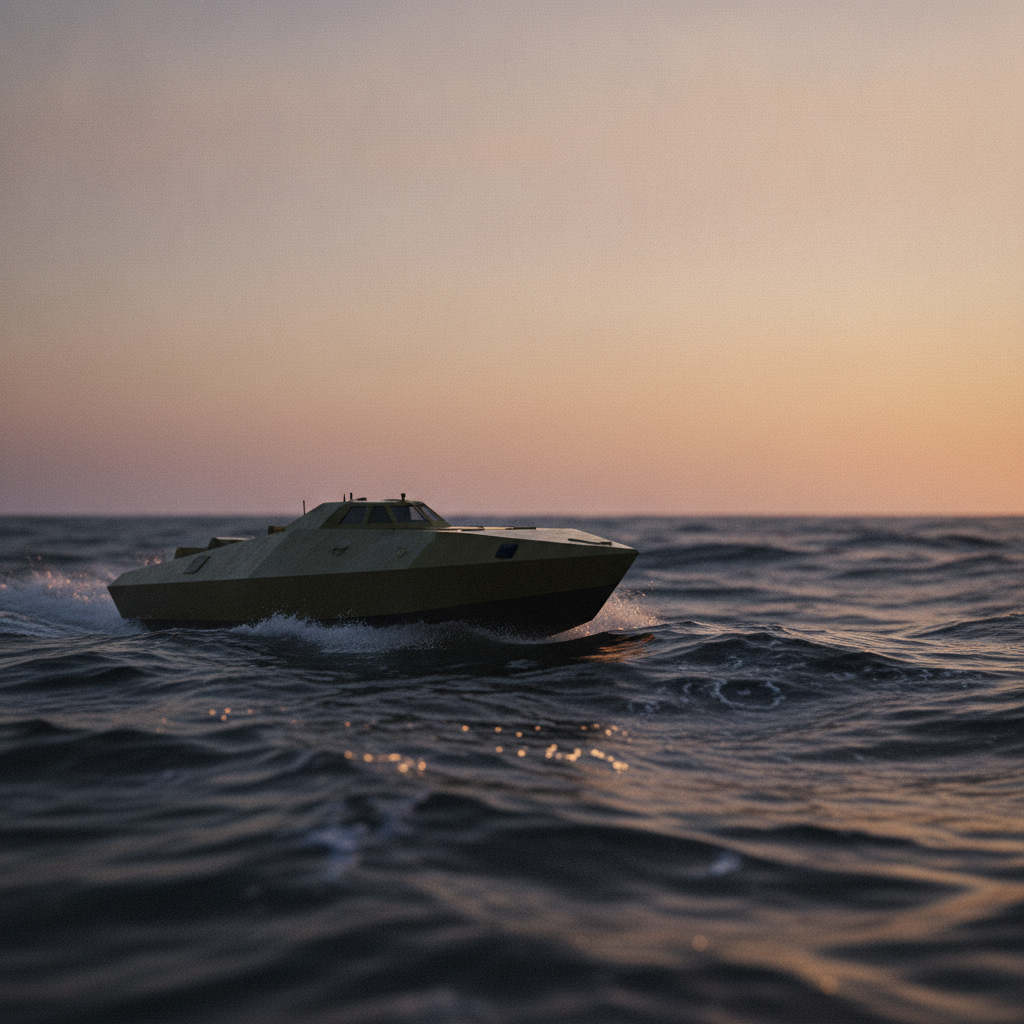
In a field in southern Ukraine, soldiers scrawled sardonic messages on a sleek grey attack drone before it hunted Russian ships on the Black Sea. [1] Thousands of miles away, U.S. Central Command utilized three Corsair unmanned surface vessels to strike a submarine and ship maintenance facility at the Bandar Abbas naval base in Iran. [2] Two theaters, two separate conflicts — and the same emerging truth: the crewed warship is no longer the primary instrument of naval power.
Ukraine's drone units, operating from the steppe far behind the front line, have hit more than 180 vessels and other sea-borne targets around Crimea over the past three weeks. [1] His emoji-riddled after-action reports function as both operational log and information weapon.
The logic is attrition by geography. Ukraine has already targeted road and rail links connecting Crimea to Russia, producing fuel shortages and a state of emergency on the peninsula. [1] Shifting pressure to the sea closes the remaining supply corridor. Brovdi's forces claim the Kerch ferry crossing between eastern Crimea and Russia's Krasnodar region has lost around 75% of its capacity — a figure Reuters could not independently verify. [1] What is verifiable: shipowners temporarily suspended vessel arrivals at Ukraine's Black Sea ports for agricultural exports following the surge in attacks, according to Kyiv's agriculture minister. [1]
The hardware making this possible is the Ukrainian-made FP-1 and FP-2 drone. [1] These fly automatically to the operational zone; pilots based far away take over for the terminal phase. [1] Launch teams use a small jet booster to catapult propeller-powered airframes, pack up within minutes, and relocate — no site is reused, and teams move at a few hours' notice. [1] Technological advances have pushed the safe launch distance to over 100 km behind the front line. [1]
Sidharth Kaushal, a senior fellow at the Royal United Services Institute, told Reuters the attacks are "a logical continuation" of Ukraine's Crimea campaign — and that Ukrainian strikes on overland logistics had pushed Russia toward increased sea transport, creating more maritime targets. [1] The sea war has costs on both sides: in the first two weeks of July, Russia struck Ukrainian ports 23 times and civilian vessels 17 times. [1] On a Sunday in late July, 10 sailors were killed after Russian forces struck a Guinea-Bissau-flagged vessel carrying corn from Odesa. [1] Agricultural exports — more than 90% of which move through the Odesa region's maritime corridor — are Ukraine's largest source of foreign currency earnings. [1]
The American deployment reads as a parallel data point from a different conflict. U.S. Central Command marked the "first time American forces have employed sea drones in combat operations" when it used three Corsair USVs to strike Bandar Abbas. [2] Its embedded AI stack and open architecture allow rapid integration of sensors and autonomy software. [2]
What connects these two theaters is not alliance or coordination but architecture — the logic of cheap, expendable, networked platforms doing work that once required crewed ships, trained crews, and decades of procurement. The drone is not supplementing naval power; in these engagements, it is naval power.
According to previous Navy Times reporting, a handful of unmanned vessels were launched from Aqaba, Jordan, into the Red Sea with a broad-edged surveillance mission — to observe the "pattern of life" in the region and increase maritime domain awareness. [2] With the Corsair strikes on Bandar Abbas, that mission has shifted to incorporate strikes. [2] The U.S. Navy has been testing and utilizing Corsair vessels for various missions over the past two years. [2]
Speed of iteration matters here as much as the hardware itself. The units running these campaigns — whether on Ukraine's steppe or in the Fifth Fleet's area of operations — are adapting doctrine in real time, not waiting for doctrine to catch up with capability.
Battalion commander Ray put the operational reality plainly: "This is a constant war — a continuous struggle of measures and countermeasures." [1] In the Black Sea and the Strait of Hormuz alike, the question is no longer whether unmanned systems can fight. It is whether the institutions built around crewed platforms can adapt fast enough to use them well.