The Border as a Battlefield Lab
The U.S. Army is using cartel drone incursions along the southern border to test counter-drone tech — and rehearse the pace of war it sees in Ukraine.
By The Defense Desk
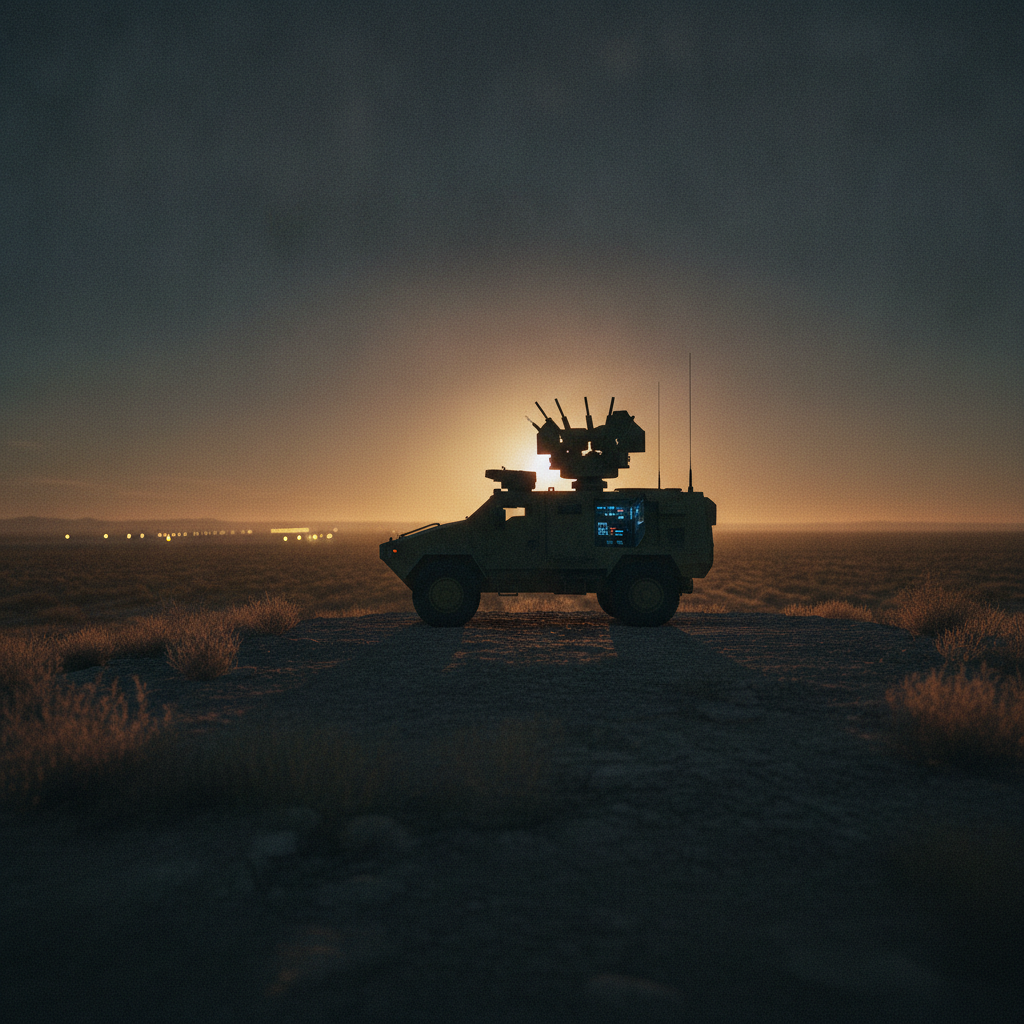
In September, soldiers stood in the Arizona desert and watched machines shoot down other machines. Radars swept the sky. Interceptor drones launched. An automated gun system — the kind that fires without a finger on a trigger — tracked small unmanned aircraft and took them out. This was Falcon Peak, a U.S. Northern Command exercise, and the targets it was rehearsing against were not state actors. They were cartel drones. [1]
The U.S. Army is testing counter-drone technology along the U.S.-Mexico border, and the operational logic is straightforward: cartels are flying commercially available drones over the boundary in increasing numbers, and the military wants to stop them — and use the experience to sharpen skills it may need elsewhere. Brigadier General Brian Filler, deputy commander for operations at Joint Task Force Southern Border, told reporters the military detected 378 drone incursions in the previous 30 days, and that the trend was increasing. [1]
The drones crossing the southern border are, by official description, modest threats. "We are seeing largely commercial off-the-shelf available drones," Filler said, adding that most carry surveillance cameras. [1]
There is a familiar tension running through this story — between the mundane and the consequential. A drone bought at a consumer electronics retailer is not a military weapon. But a border is not a laboratory, either. And what gets tested in the desert has a way of traveling.
Military officials are careful to caution that cartel-operated drones are not comparable to the sophisticated battlefield systems seen in Ukraine or the Middle East. [1] Yet that disclaimer has not slowed investment or ambition. The U.S. military said it had downed 11 cartel drones using lasers since deploying the technology along the southern border in August — a data point that, however modest in scale, represents live operational use of directed-energy weapons outside a combat theater. [1]
What makes the border exercise notable is less about cartel drones and more about what the Pentagon is practicing for. Military planners are racing to keep pace with lessons from Ukraine, where drones have transformed the battlefield and driven rapid innovation in both offensive and defensive systems. [1] The border, officials said, offers a valuable operational environment to test equipment, train soldiers, and evaluate how systems perform outside controlled laboratory conditions — the kind of real-world friction that no testing range can fully replicate.
That framing was explicit in what Brigadier General Matt Ross told reporters at the exercise: "We tend to look at Ukraine and we say, 'I am so impressed with how quickly they can adapt on a daily or weekly basis,'" Ross told reporters. "What we should really do is replicate that process." [1] The border is not Ukraine. But it is available, it is active, and it is outside the lab.
The logic is seductive and worth examining carefully. A live operational environment accelerates learning. It also accelerates commitment — to systems, to vendors, to doctrines — before the full implications are understood. The speed that impresses generals in Kyiv was forged in existential necessity. Replicating the pace without replicating the stakes is a different kind of experiment.
Falcon Peak also functioned as a trade show for the new generation of defense technology companies. [1]
The hardware on display at the Arizona exercise read like a catalog of that investment wave. Anduril's Ghost drone was featured in the demonstrations, alongside the radar-and-camera detection system produced by Teledyne FLIR, the "Bullfrog" counter-drone automated machine gun produced by Allen Control Systems, and an interceptor drone sold by Powerus, which went public on Thursday, merging with a company backed by sons of U.S. President Donald Trump. [1]
The overlap of capital, politics, and military procurement is not new. But the density of that overlap — a single field exercise featuring publicly traded companies with family connections to the sitting president — signals something about how the defense technology market has repositioned itself. The border is not just a test range. It is also a stage.
The commercial drone market created the cartel threat, and the venture-capital defense market is now building the answer to it. Both emerged from the same decade of cheap sensors, miniaturized computing, and accessible manufacturing. The border exercise puts these two industries — one criminal, one aspirationally patriotic — in direct conversation, with the U.S. military as the judge. [1]
For soldiers in the field, the exercise is also a training exercise in a more immediate sense. Watching systems perform against real targets — even surveillance-camera drones crossing at low altitude — is categorically different from watching them perform on a range. Officials said that is precisely the point: the border offers a proving ground where equipment meets environment, and where the humans operating it learn what the specifications never mention. [1]
Every technology program has a gap between the promise and the proof. That gap is usually closed by time, iteration, and exposure to conditions that designers did not anticipate. What the Army is doing at the southern border is, in essence, buying that exposure — at a cost that is not purely financial.
Ukraine's lesson — the one Ross and his colleagues keep citing — is that speed of adaptation matters more than perfection of design. Weekly iteration, not annual procurement cycles. In Ukraine, that speed was driven by the brutal arithmetic of attrition. The Army is hoping to absorb the method without waiting for the conditions that produced it. [1]
The Arizona desert is a long way from Kharkiv. But the logic connecting them — move fast, test in the field, iterate before the next wave arrives — is the same logic reshaping how militaries think about procurement, readiness, and what a border is actually for. [1]