The Carbon Beneath the Burn
Arctic wildfires are thawing permafrost faster than climate models predict. A new research coalition wants to fight them—before the freeze is gone for good.
By The energy-climate Desk
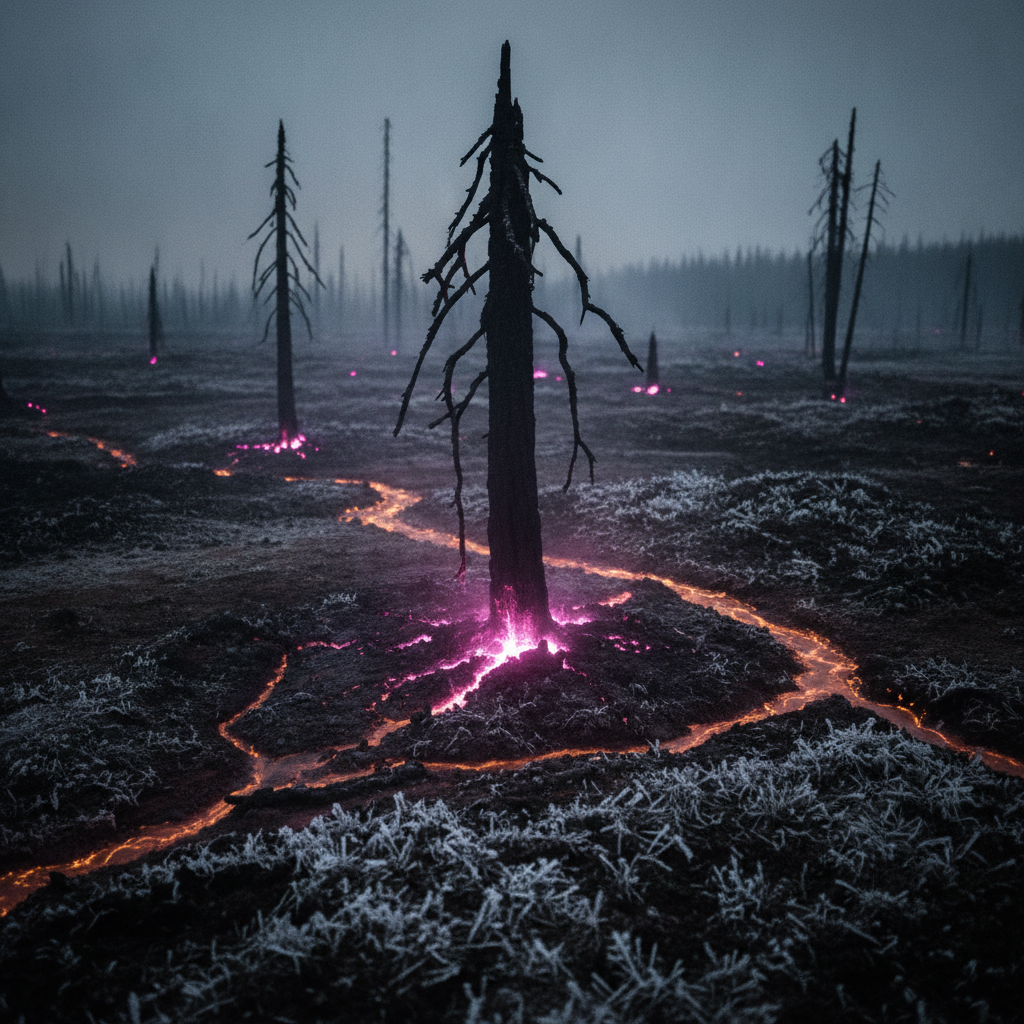
The blaze put up a 500-foot column of smoke and drew about 80 firefighters on the ground, four water-scooping planes, and three helicopters to contain it. [1][2] It was, by Arctic standards, a small fire—five acres, with crews returning Saturday morning to mop up. But what it left behind tells a much larger story.
Walk into the burn scar today and the evidence is underfoot, not overhead. Hilary Shook, coordinator of the Alaska Fire Science Consortium, carries a thaw probe—a T-shaped metal rod—to measure how deep the permafrost sits. Just outside the burn, the probe hits the concrete-like frozen layer about a foot below the surface. Inside the scar, where fire consumed the moss and organic topsoil that once insulated the ground, the probe plunges at least three times deeper. [1]
"That was an immediate effect of the fire," said Alison York, the outgoing coordinator of the consortium, standing at the edge of the scar. "When we monitored right after, it had already thawed quite a bit." [1] That thawing is not a local curiosity. The permafrost underlying northern latitudes stores around 1.5 trillion tons of carbon, much of which froze in place millennia ago. The steady rise in global temperature has already shrunk the footprint of Arctic permafrost by about 12% since 1850, with that loss rapidly accelerating during the last 50 years. [1]
What begins as a smoldering carpet of lichen ends, eventually, as a contribution to the very warming that sparked it. Fire does not merely consume a forest—it can dissolve the cold archive beneath it, releasing carbon that took geological time to accumulate.
Emissions from forest fires have risen 60% around the world since 2001, but they have nearly tripled across the boreal forests of the far north. [1] The Arctic is warming as much as four times faster than the rest of the planet, drying out the landscape and increasing the convective energy in the atmosphere that triggers lightning—the very mechanism that may have started the Yankovich Road Fire in the first place. [1][2] Intensifying wildfires in Canada released more carbon than the nation's combined fossil fuel emissions in 2023. [1] And many of these megafires burn across vast remote territories under a policy of managed neglect: let them burn unless they threaten people.
The feedback loop is not hypothetical. As fire thaws permafrost, the organic matter trapped inside breaks down and releases greenhouse gases that drive more warming, more fire, and more thaw. [1]
[1] Brian Buma, a senior climate scientist at the Environmental Defense Fund, calls warming-driven permafrost emissions a "massive blind spot." [1] The planet is almost certainly warming faster than the models suggest—and the gap between those projections and reality keeps widening.
The reckoning, when it arrives, tends to arrive at the level of soil. It is invisible, slow, and nearly impossible to reverse—which is precisely what makes it so difficult to defend against.
A 2022 paper in Science Advances, led by researchers at the Woodwell Climate Research Center and the Union of Concerned Scientists, found that making greater efforts to put out boreal fires could be a cost-effective climate solution—comparable to, or even cheaper than, addressing emissions by building wind turbines, solar farms, or carbon-sucking factories. [1] Those findings were instrumental in persuading more researchers to take the idea seriously, says Peter Frumhoff, a coauthor of the paper and now a senior science policy advisor at Woodwell. [1] Now, Woodwell, the University of Victoria's Polis Institute for Ecological Governance, and the nonprofit Alaska Venture Fund are partnering on a multimillion-dollar initiative called North Fire to study and scale such interventions. [1]
The initiative already has a proof of concept, fragile as it is. [1] In 2019, the region burned some 750,000 acres. After an Alaska Fire Science Consortium meeting at which Woodwell scientists highlighted the possible climate benefits of more aggressive fire suppression, the refuge's then manager, Jimmy Fox, persuaded managers at the US Bureau of Land Management's Alaska Fire Service to carry out a pilot project on a 1.6-million-acre section of the Yukon Flats. [1]
The early skepticism was blunt. "You're going to have people jumping out of airplanes with parachutes to save frozen woolly mammoths—and maybe dying from that?" Fox recalls being asked. [1]
Kate Hayes, an assistant professor at Western Washington University working with Woodwell on fire emissions research, frames the intervention debate in terms that short-circuit the hand-wringing. The permafrost's yedoma "took kind of the last ice age to accumulate," she says. "So there's no rapid way to re-accumulate it. We can't really put it back." [1] As for whether humans should intervene in natural systems: "We've already intervened, arguably. And so from here, it's a little bit of a Band-Aid on a bullet wound." [1]
The moral calculus is uncomfortable but not complicated. The question is no longer whether to act in ecosystems that humans have already altered—it is how to act, at what cost, and on whose terms.
Brendan Rogers, a senior scientist at Woodwell, puts the central challenge plainly: "We're not going after all fires all the time. We can't do that. We don't want to do that. We shouldn't do that. So how do we prioritize our resources?" [1] The answer, under development, is a map of burn risk and carbon vulnerability across interior Alaska—one that will eventually expand across much of Canada—highlighting yedoma reserves, forecasting where fires are most likely to ignite over the next 10 to 15 years, and predicting how they will spread. [1]
Detection speed is one of the program's sharpest constraints. Currently, it can take days to spot a fire from satellite. [1] The full constellation, which will eventually include more than 50 satellites, could detect fires down to five by five meters anywhere on Earth every 20 minutes or less once the full constellation is in place, likely in the early 2030s. German-based OroraTech has launched 18 fire-detecting satellites in the last year and a half, and Canada is planning its own constellation, WildFireSat, beginning in 2029. [1]
Faster detection generates a new problem: data volume. EDF is developing an AI-powered triage tool to help fire agencies sort through the flood of detections and decide which fires demand an immediate response. [1] Other technologies under discussion include cloud seeding to suppress lightning strikes and pre-positioning autonomous firefighting helicopters—Sikorsky, a Lockheed Martin company, is developing autonomous Black Hawk variants equipped with thermal sensors and water tanks, in collaboration with Rain Industries, a startup based in Alameda, California. [1]
None of that technology addresses the fuel already on the ground. Edward Alexander, cochair of the Gwich'in Council International and senior Arctic lead at Woodwell, argues that the answer lies in a practice far older than any satellite: cultural burning, carried out by Indigenous communities for thousands of years to reduce fire danger and manage land. [1] "There's not enough money in the world for this to be a chainsaw-and-ax problem," he says. "This country is too big up here." [1] The North Fire initiative includes a pilot project in which a wildland firefighting crew operated by the Council of Athabascan Tribal Governments will carry out cultural burns near Fort Yukon, Alaska, next spring. [1]
Randi Jandt, a fire ecologist at the Alaska Fire Science Consortium, captures the institutional tension at the heart of all of this. Federal and state agencies responsible for fire in Alaska are "tasked with protecting life and property now, and to a lesser extent natural resources," she says. "But they're not tasked to save the world." [1] North Fire is an attempt to fill that gap—not by replacing those agencies, but by building the scientific and political case that protecting frozen carbon deserves a place in the mission.
Rogers, speaking at a Stanford workshop in January, was honest about the limits of everything being assembled. "I do think that it can make a meaningful difference," he said of the research effort. [1] But meaningful difference is not the same as sufficient difference. The boreal north is warming four times faster than the global average, its fires are nearly tripling in emissions, and the frozen carbon beneath it has no modern analogue—it cannot be rebuilt, refrozen, or recovered once lost. [1] What researchers are building now is not a solution. It is, at best, the machinery for a better set of choices.