The Coast Guard's Eye in the Sky
Four MQ-9B SeaGuardian drones and $247.8 million signal a quiet but consequential shift in how America watches its maritime borders.
By The Defense Desk
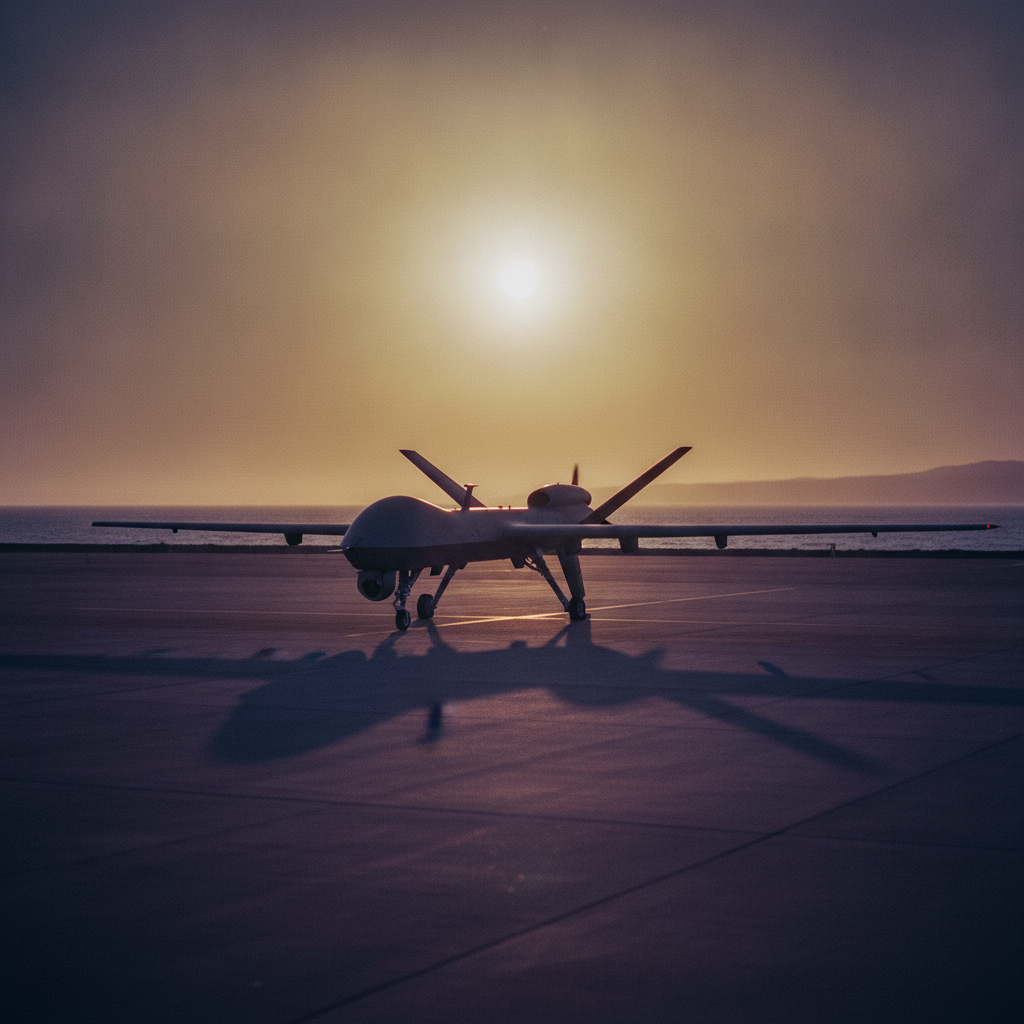
For decades, the Coast Guard has watched America's coastlines from the windows of C-130s and the cockpits of helicopters — aircraft that can stay airborne for 14 hours at best, demanding constant crew rotations, frequent handoffs, and the blunt calculus of fatigue. That calculus is about to change. The service is purchasing MQ-9B SeaGuardian drones for the first time, a $247.8 million contract covering four aircraft, ground control stations, and supporting equipment — the opening move in a deliberate, long-gestating plan to extend the service's gaze far beyond what any manned platform can manage. [1]
The purchase did not arrive in a vacuum. Funding for the acquisition stemmed from the FY25 reconciliation package that included nearly $25 billion for the Coast Guard, alongside FY26 appropriations — money that traces back to the "One Big Beautiful Bill Act" signed into law in July 2025. [1][2] That legislation injected a scale of investment into the service that officials have described as rare. Acting Vice Commandant Vice Adm. Thomas Allan, Jr. [2]
The MQ-9B SeaGuardian — built by General Atomics — is designed for maritime intelligence, surveillance, and reconnaissance, staying aloft for more than 30 hours at a time with a mission radius of roughly 1,200 nautical miles.
The service has not been flying blind while waiting for its own aircraft. Since the mid-2000s, the Coast Guard has partnered with U.S. Customs and Border Protection to fly CBP's MQ-9 Alpha drones on mostly customs missions out of San Angelo, Texas. [2] Those operations produced measurable results: in FY26, the aircraft supported CBP to seize 60,700 pounds of illegal drugs and the apprehension of roughly 20 smugglers. [1] The collaboration gave Coast Guard crews hands-on experience with the platform — institutional knowledge they will now deploy with their own equipment, at their own locations, on their own mission timelines.
"The MQ-9B long-range unmanned aircraft systems will expand our reach and strengthen our ability to protect the nation," said Anthony Antognoli, the assistant commandant and program executive officer for robotics and autonomous systems for the Coast Guard. "This investment will give Coast Guard crews a longer-range view of our maritime domain, helping them detect threats earlier, make better-informed decisions and act faster across our missions." [1] The language is measured, almost bureaucratic — but behind it sits a structural bet on autonomous systems that the service has been reluctant to make until now.
What makes this moment worth examining is not just the hardware. It is the philosophy underneath it — a shift from a service that borrowed capability to one that is building it, from a posture of reactive patrol to one of persistent, wide-angle awareness. The drone does not replace judgment; it extends the window in which good judgment can be applied.
One of the most cited advantages of the MQ-9 is crew rotation. Where a manned aircraft demands that the same small crew sustain focus across an entire patrol, the MQ-9 swaps operators approximately every two hours — fresh eyes on the same continuous mission. Lt. Commander Andrew Denning, the Coast Guard's long-range drone program manager, put it plainly: "You have a fresh set of eyes, so you can really mitigate risk by doing that. By keeping the crew fresh, you can keep it out there, so you don't have as many pass downs going from aircraft to aircraft." [2] Each drone can collect intelligence information for about 24 hours in a 60- to 80-mile radius of detection. [2]
That capability was already tested in a search-and-rescue scenario that officers now cite as a proof of concept. In November 2023, CBP and Coast Guard MQ-9 pilots at the Joint Program Office in San Angelo were able to use one of the CBP's drones to locate a lost vessel carrying four people after Coast Guard helicopters and surface vessels had failed to find it in the Corpus Christi area. [2]
The missions the aircraft will fly are deliberately non-lethal. Officials confirmed the drones will not be armed — a deliberate positioning that separates the Coast Guard's maritime surveillance role from the combat applications that have made the MQ-9 Reaper, the armed variant, one of the most recognized unmanned platforms in U.S. military history. [1][2] The SeaGuardian variant is purpose-built for maritime ISR, and the Coast Guard's initial deployment will focus on counter-drug operations, search and rescue, and overseeing offshore waters, including an expanded operational footprint along the Gulf of America as border-crossing activity on the southern land border has declined. [2]
[2] That framing — fiscal efficiency as strategic justification — matters in a defense environment where competition for ISR assets is intense. The Coast Guard, historically underfunded relative to the missions it is asked to perform, is positioning itself as a net contributor to national surveillance capacity rather than a consumer of shared military resources.
The service is also widening the pipeline of who can fly these systems. Until recently, the Coast Guard required designated naval aviators to operate its UAS assets. That policy has shifted: pilots who hold a commercial Federal Aviation Administration certificate and 1,000 hours of flight experience on any combination of manned aircraft are now eligible. [2]
Broadening access to who operates these aircraft is as important as the aircraft themselves. Doctrine and equipment tend to arrive together, but the human architecture — who trains, who qualifies, who decides — determines whether a platform becomes a capability or simply an expensive asset that collects dust between deployments.
For the Coast Guard, the MQ-9B purchase is the visible tip of a larger transformation. Force Design 2028 calls for the service to become more agile and to lean further into unmanned systems as a force multiplier. [2] Allan told attendees at a Washington ceremony that the Coast Guard was "significantly increasing" the use of unmanned aerial systems as part of that agenda. [2] With the four aircraft expected to eventually operate from West Coast and East Coast locations — extending ISR reach beyond the CBP partnership's Texas hub — the service is drafting the map of a different kind of maritime watch.
The MQ-9B is not a symbol of militarization. It is a practical answer to a straightforward problem: the ocean is vast, the missions are many, and C-130s get tired. Four aircraft will not cover every mile of American waters, but they mark the end of the Coast Guard's reluctance to own the tools it has long depended on borrowing. The watch is getting longer — and the eyes, for the first time, belong to the service itself. [1][2]
This investment will give Coast Guard crews a longer-range view of our maritime domain, helping them detect threats earlier, make better-informed decisions and act faster across our missions.Anthony Antognoli