The Data Center That Does Everything Right—and Nobody Wants
Verrus built a quieter, water-sipping, battery-backed data center. Its two proposed sites are still buried in local opposition.
By The Energy-Climate Desk
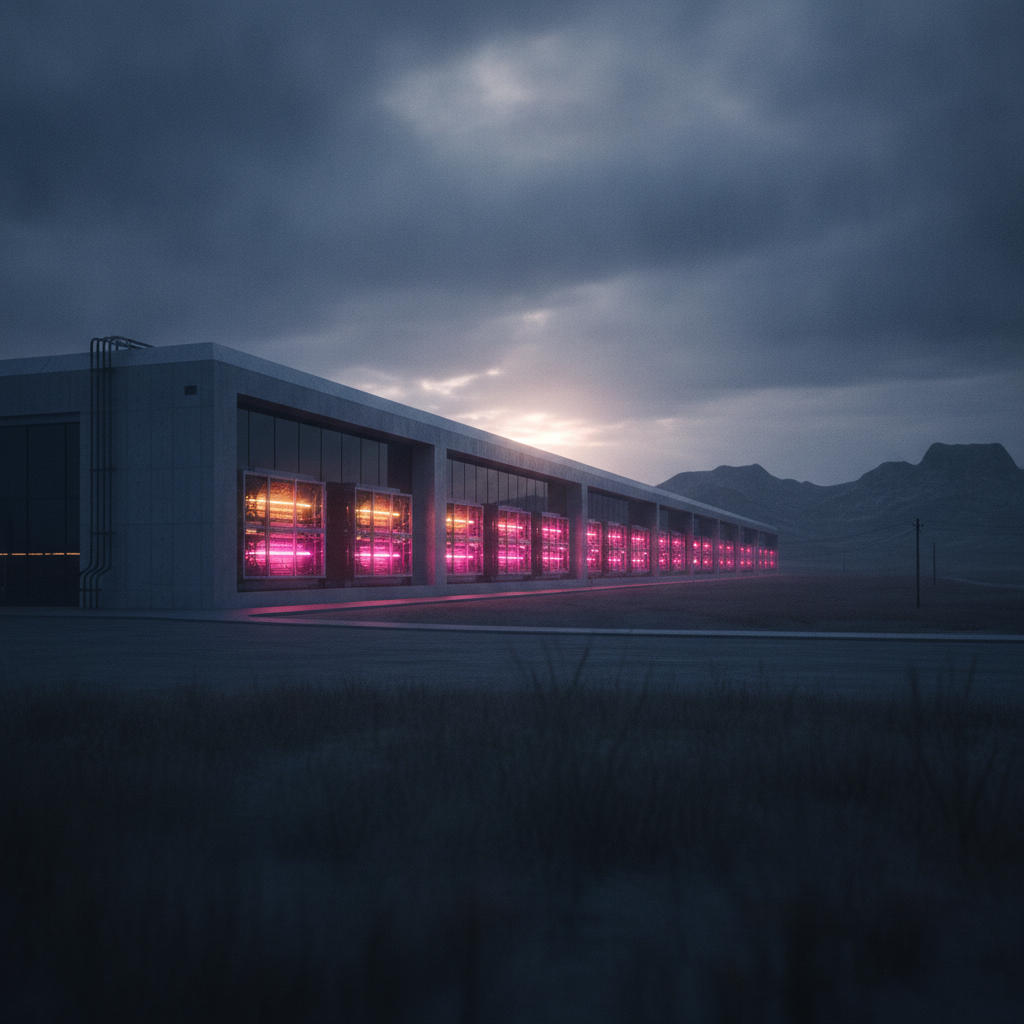
Verrus has an answer for every complaint neighbors lodge against data centers: no diesel generators, no evaporative cooling towers, quieter fans, and a design that squeezes more servers into the same grid connection. [1] Its two proposed sites—one outside Detroit, one in Oregon—are mired in fierce local opposition anyway. [1][2]
The company replaces the diesel generators that anchor most conventional data centers with large arrays of lithium iron phosphate batteries—the same chemistry utilities use for grid-scale storage. [1] In Detroit, those batteries serve as the primary backup source. [1]
On cooling, Verrus swaps the evaporative towers that drive large-scale water use for air-cooled chillers closer in kind to standard office air conditioning. Abramson claims the switch cuts water consumption by 95 to 99 percent compared with a conventional data center. [1] A chapter of the Volts podcast covering the project is titled "Water use and the 12 million gallon question"—a figure that points to how much water a typical facility consumes and how loaded that number is in community fights over siting. [1]
The third distinguishing feature is a medium voltage power plane—a distribution architecture that keeps power at medium voltage far longer before stepping it down near the rack. Conventional data centers convert to low voltage early, then slice capacity into small buckets that cannot be shared across the floor. [1] Verrus's system lets power flow to wherever servers need it, and Abramson says that pooling effect allows the facility to fit roughly a third more racks into the same underlying grid capacity. [1] For context on the scale of what is being managed: the next generation of NVIDIA racks will consume a megawatt or more each, compared to the sub-megawatt whole-facility footprint of the first data center Abramson worked in—a converted Hechinger's hardware store. [1]
The UPS batteries in a traditional data center—usually lead-acid, usually good for about five minutes—sit adjacent to server rooms and must take load in less than one-sixtieth of a second. [1] That constraint forces early conversion to low voltage, which is exactly what locks power into those small buckets. Verrus's battery energy storage system is not designed for sub-cycle response; instead, it provides sustained runtime during a prolonged outage, while per-server batteries handle the instantaneous smoothing job. [1] The result, Abramson argues, is fewer conversion steps, less copper, less heat loss.
The engineering case is coherent. Whether it translates into community trust is a different problem entirely—one that better specs sheets have not historically solved.
Verrus has not yet built a data center. [1] The two sites it has proposed are generating recall petitions, moratorium votes, and threatened lawsuits—documented in a string of local news items that Abramson and podcast host David Roberts walk through on air: "No Data Center Lyon Township," a Salem council moratorium, a stalled Oregon campus. [1] Roberts frames the underlying question baldly: "It's an open question these days whether any data center, no matter its purported improvements, can get around that kind of backlash." [1]
Part of the problem is sequencing. Verrus is asking communities to trust performance claims—quieter, dryer, more grid-friendly—on facilities that exist only in filings and renderings. [1] Emerald AI, which Volts covered separately, takes a software approach to the same flexibility problem: its system ramps down or relocates compute jobs on demand, making an existing data center a dispatchable grid asset without new hardware. [1][2] Two different bets on where the constraint actually lives—in the physics of the building or in the scheduling of the workload.
What both approaches share is a recognition that the grid cannot simply absorb another decade of inflexible, water-hungry, diesel-backed construction without something breaking—whether that is transmission capacity, aquifer levels, or the patience of the people who live next door.
[1] The harder task is convincing a Lyon Township resident that this time, the data center coming for the industrial parcel down the road is actually different. Engineering can redesign a power plane. It has not yet redesigned the public hearing.