The Diesel Deal That Feeds the War
Trump's Russian fuel agreement won't cut prices at the pump. Experts say it will cut Ukraine's best weapon against the Kremlin.
By The Defense Desk
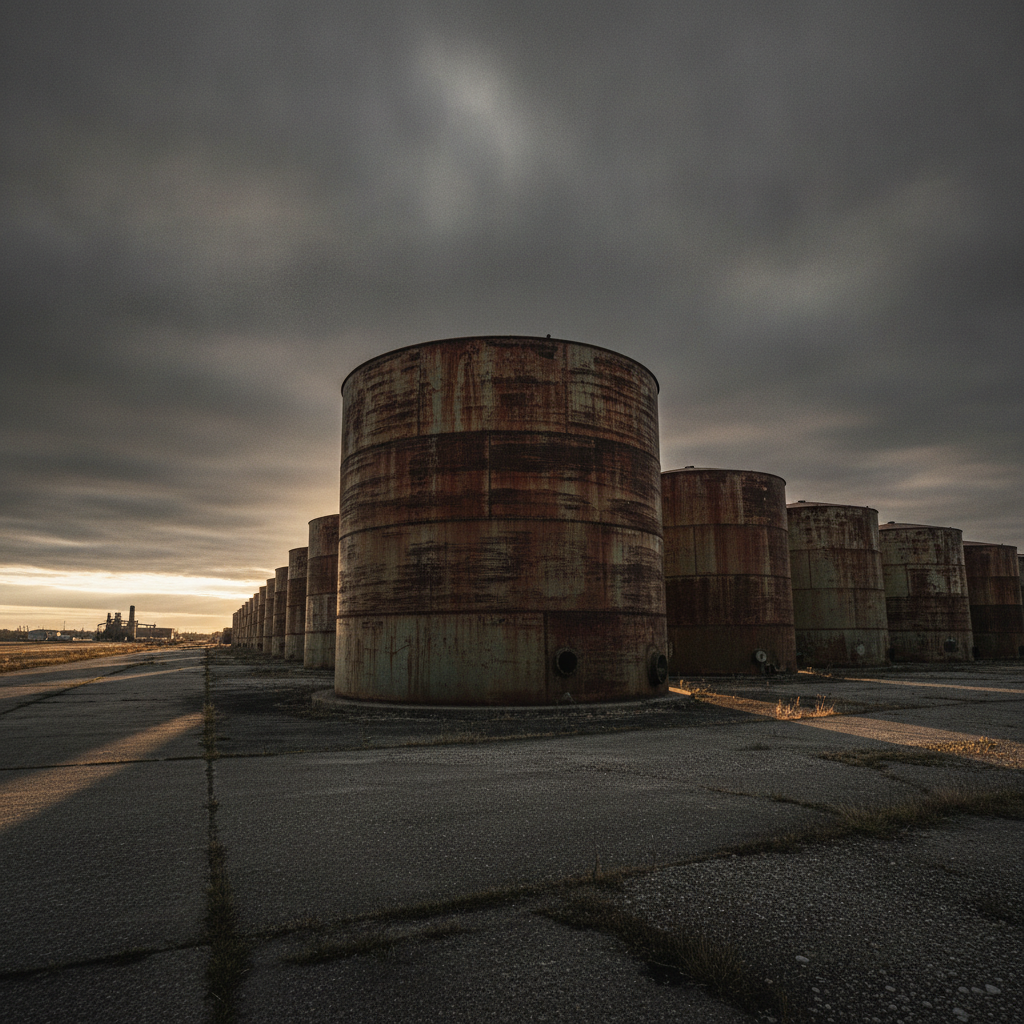
American diesel hit $6.35 a gallon this week — just below the record $6.The timing is not coincidental, but the causal chain the White House is selling voters is almost entirely wrong.
President Donald Trump eased sanctions on Russian diesel after an Oct. [1]. Goldman Sachs put a number on what "fast" actually means: the first two months of deliveries would cut wholesale prices on the U.S. Gulf Coast by just $1 to $2 a barrel, or roughly 2 to 5 cents a gallon [1].
The first shipment alone equals just about 2% of U.S. diesel demand over a month, CNBC reported [1]. The International Energy Agency confirmed in an Oct. 14 report that easing Russia's diesel export ban is unlikely to materially change global supplies because Russia lacks the working refinery capacity [1]. The deal's symbolic weight in a midterm campaign vastly exceeds its practical effect at the pump.
The architecture of a political narrative can be more durable than the facts it rests on. A leader facing economic discontent needs a villain, a fix, and a deadline — and a fuel deal with a foreign adversary, announced weeks before an election, offers all three. Whether the fix actually fixes anything is a separate question, one that tends to arrive after the votes are counted.
Ukrainian President Volodymyr Zelenskyy has been blunt about the origin of the price spike. "This crisis has its roots in the Middle East. Everyone understands that perfectly well. Everyone knows how to do the math," Zelenskyy said on Oct. 12, quoting his remarks to the Warsaw Security Forum. "If Russia accounts for 2.2% of global diesel supplies, what impact can it have on the price? That's how negligible it is." [1]
Federal data supports Zelenskyy's arithmetic. U.S. diesel stayed below $3.90 a gallon from August 2025 until the U.S. and Israeli strikes on Iran began Feb. 28, then jumped nearly 25% in a week to $4.86, according to the Energy Information Administration [1]. Trends in federal data show that the steep initial rise in diesel prices followed the start of the Iran war — not Ukrainian strikes on Russian production infrastructure [1]. Diesel exports from the region dropped to 390,000 barrels a day in August — just over a quarter of prewar levels — according to International Energy Agency figures [1]. Russia's promised deliveries will not close that gap.
Even Russian officials have effectively conceded the point. "The key guarantee of full stabilization of this market is the speediest normalization of the situation around the Persian Gulf, overcoming the conflict around Iran," Russian Deputy Foreign Minister Georgy Borisenko told reporters Oct. 12 [1]. Moscow, in other words, agrees with Kyiv about what is actually driving prices. The Kremlin simply benefits from Washington believing otherwise.
What looks like an energy policy can double as a diplomatic instrument. The transaction itself matters less than the relationships it restructures, the leverage it redistributes, and the precedent it sets for the next round of negotiations. Fuel is just the medium; the real exchange is something harder to measure.
Carnegie senior fellow Tatiana Stanovaya wrote on Oct. 14 that "the diesel agreement gives Putin an opportunity to advance economic cooperation with Washington before any settlement in Ukraine" and that "Economic agreements can coexist with unchanged demands on Ukraine and continued military pressure" [1].
The asymmetry in refinery infrastructure makes the strategic stakes concrete. Zelenskyy told the Warsaw Security Forum that Ukraine has "just one oil refinery," while Russia has 32 major refineries, according to the International Energy Agency [1]. Ukrainian strikes had already taken a meaningful toll: Russian diesel production fell by nearly 30% as attacks on refineries intensified, the IEA said in a Sept. 17 analysis [1]. The deal gives Moscow relief from one of the few military tools Kyiv has that consistently bites.
The estimated gross value of Russia's seaborne crude shipments hit a wartime high of $2.76 billion this week, up roughly $430 million from the week before, Bloomberg reported [1]. No strikes on Russian refineries were reported last week, and the lull allowed Moscow to boost processing rates, likely diverting crude that would otherwise have been exported [1]. The war chest grows in direct proportion to the pause in Ukrainian attacks.
Opposition inside Washington has been unusually bipartisan. Four Republican and three Democratic senators urged the Trump administration on Oct. 11 to "immediately reverse course," saying in a joint statement that "the United States should not provide Putin with a financial lifeline while Russia continues to kill Ukrainian civilians" [1].
Rep. Don Bacon, a Nebraska Republican, wrote the day the deal was announced: "Putin is looking for a way to get the United States to pressure Ukraine to stop striking those refineries" [1]. ISW assessed the pattern as part of a recurring Kremlin strategy to offer Washington economic incentives claimed to be unrelated to the war "in order to extract concessions from the U.S. regarding the war" [1]. The diplomatic choreography around the announcement reinforces that reading: U.S. envoys Steve Witkoff and Jared Kushner told Ukrainian negotiators in Miami that the White House hoped the diesel deal would soften Moscow's stance on peace talks [1].
The human cost of that diplomatic context has not remained abstract. Ukraine paused refinery strikes at Trump's request, but Russia kept hitting Ukraine's energy infrastructure, prompting Kyiv to resume its own counterattacks, Zelenskyy told the Financial Times on Oct. 15 [1]. Within days of the sanctions announcement, Ukrainian officials accused Washington of pressuring Kyiv to capitulate by withholding missile warnings and throttling the military's essential Starlink connectivity — intelligence that Zelenskyy said "helps save people's lives" [1]. Both services have since been restored, Zelenskyy said, but Russia's attacks have not let up [1].
Russia fired 16 ballistic missiles and more than 280 drones at Ukraine overnight Monday into Tuesday, targeting "energy, logistics and ordinary urban infrastructure" almost everywhere, Zelenskyy said [1]. The barrage came as the U.N. Independent International Commission of Inquiry on Ukraine concluded that Russian authorities had committed war crimes and crimes against humanity through attacks on Ukraine's energy infrastructure [1]. The 84% of registered voters who told the Pew Research Center that the economy was "very important" to their midterm vote will likely hear about the diesel deal; they are less likely to hear about the drones [1].
Policy built to win a news cycle often outlasts the cycle it was built for. The concessions made to announce a deal, the leverage surrendered to stage a press moment, the alliances quietly strained in the background — these accumulate in ways that balance sheets and approval ratings rarely capture until it is too late to reverse them.
Zelenskyy said it plainly at an EU summit in Brussels on Oct. 16: "This diesel deal will never be enough to offset the impact of the Strait of Hormuz on global markets. But it will put more money straight into Putin's pocket to fund this war." [1] The deal's architects have not offered a convincing rebuttal. They have offered a midterm election instead.
Economic agreements can coexist with unchanged demands on Ukraine and continued military pressure.Tatiana Stanovaya