The Dog That Never Sleeps
Avnet and Weston Robot are strapping edge AI to a quadruped and sending it to patrol the factory floor—no cloud required.
By The Robotics Desk
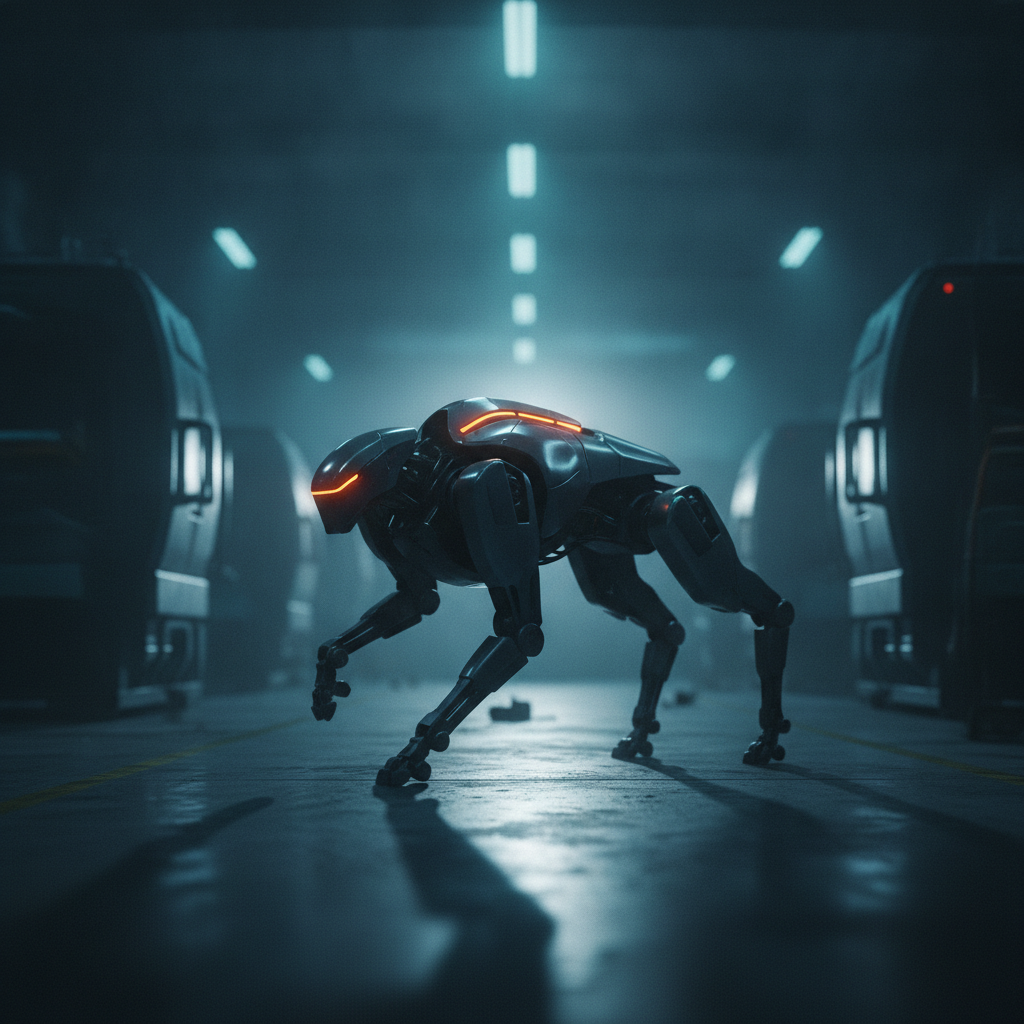
Somewhere inside a facility that could be a refinery, a port terminal, or a semiconductor fab, a four-legged machine is walking a beat. It pauses at a pressure valve, its cameras and thermal sensors reading the scene, then moves on. No human accompanies it. No cloud server is consulted. Every decision—flag or continue—happens in the robot's own backpack. This is the pitch from tech distributor Avnet and Singapore-based robotics integrator Weston Robot, whose new edge-AI inspection platform is designed to do exactly that: bring real-time autonomous inspection to industrial environments without ever needing to phone home. [1]
The platform pairs a quadruped robot—supplied through Weston Robot, which primarily resells Unitree robotic solutions—with a custom computing module that Avnet describes, with disarming literalism, as a backpack. That backpack carries Avnet's industrial compute architecture, powered by AMD Ryzen AI Embedded processors, and delivers up to 50 TOPS of AI performance. [1]
Fifty TOPS is a meaningful number in this context. It is enough to run AI-driven inspection, thermal and visual analytics, and 3D lidar mapping simultaneously—all while operating in GPS-denied environments where a conventional networked system would simply go blind. [1]
The logic here is one the industrial world has been circling for years: putting intelligence at the edge rather than centralizing it. The question has never been whether that is desirable—it obviously is—but whether the compute density, the sensor stack, and the software pipeline could actually be compressed into something a four-legged machine could carry without compromising its gait.
Weston Robot's approach to the market is worth understanding. The Singapore-based company integrates quadruped, humanoid, and mobile robot-based applications for customers whose needs range from inspection to security and facility management. It primarily resells Unitree robotic solutions, but it also manufactures custom autonomous mobile robot platforms and unmanned maritime systems. Critically, most of its business runs on a robots-as-a-service model—meaning clients pay for outcomes rather than hardware. [1]
That commercial structure matters because it shifts the risk calculus. A facility manager considering a RaaS contract is not committing capital to a depreciating asset; they are buying inspection coverage the way they might buy a maintenance contract. When the robot gets a software upgrade—when Avnet pushes a new inspection or recognition task down to the device—the customer gets the benefit without touching a procurement cycle. [1]
The operational workflow runs as follows. When combined with Weston's fleet management software, the robot can be set on a mission to patrol a defined path through a facility. Using onboard cameras and other sensors, the robot can stop and investigate any number of inspection sites along its patrol route. When something anomalous appears—a heat signature outside expected parameters, a structural reading that deviates from baseline—the system flags it in real time rather than logging it for a human to review later. [1]
This is where the phrase 'edge AI' stops being marketing language and starts meaning something concrete. The distinction between inference at the device and inference in the cloud is not merely technical—it changes what the robot can do in a tunnel, a basement, or a sprawling port facility where wireless coverage is a patchwork at best. A machine that cannot rely on connectivity must carry its own judgment.
Arthur Chung, Vice President, Sales & Supplier Management, Avnet Asia, frames the product within a broader argument about where AI is headed. "Physical AI represents the next evolution of artificial intelligence—one where intelligent systems can perceive, reason and act autonomously in the real world," he said. "Through our collaboration with Weston Robot, we are bringing together advanced computing, edge AI and robotics to help organizations scale industrial intelligence, strengthen safety and improve operational resilience. As organizations move beyond AI experimentation, intelligent autonomous systems will become an essential part of smarter, safer and more efficient industrial operations." [1]
Dr. Zhang Yanliang, Chief Scientist at Weston Robot, puts a sharper diagnostic edge on the same claim. "Industrial environments generate enormous volumes of operational data, yet many inspection processes remain manual, reactive and resource-intensive," he said. "By combining robotics, AI and edge computing, we are enabling a new generation of intelligent systems that continuously monitor critical infrastructure, detect anomalies earlier and deliver actionable insights in real time. We believe Physical AI will become a foundational technology powering the next generation of industrial operations." [1]
Low-latency AI inference is the mechanism that closes that gap. Because the platform executes AI workloads directly on the device, the lag between observation and decision collapses. [1]
There is also a subtler argument embedded in this product: that the quadruped form factor, long a curiosity at trade shows and a punchline in popular culture, is finally earning its keep in industrial settings. Four legs navigate stairs, grating, and uneven terrain that a wheeled AMR cannot. When you need a machine to actually go where a human inspector would go, morphology starts to matter.
Avnet is explicit about what the backpack adds to the base hardware. The company says the onboard computing architecture enables new capabilities not possible with the basic Unitree quadruped robot—specifically, the ability to train and deploy new inspection and recognition tasks directly to the robot. That modularity is the platform's most durable selling point: a robot that can learn a new job on site. [1]
The platform supports thermal and visual analytics alongside 3D lidar mapping, which means it can simultaneously build a spatial model of an environment and flag deviations within it. [1]
That is precisely the environment the Avnet-Weston platform is engineered for. Reliable operation in GPS-denied environments is listed as a design requirement, not a stretch goal. The edge-compute architecture is there specifically because cloud connectivity cannot be guaranteed. The thermal sensors are there because human inspectors miss things at the end of a twelve-hour shift. The quadruped frame is there because the facility was not designed for wheeled robots. Each choice is a response to a concrete failure mode. [1]
Industrial inspection has been described as dull, dirty, and dangerous—three categories that automation advocates have long promised to address and often failed to deliver on in full. The Avnet and Weston Robot platform does not solve all three problems at once, but it makes a credible case for the first two. Whether it earns a place in genuinely hazardous environments—the offshore platforms, the chemical processing units, the live electrical substations—will depend on a body of operational evidence that does not yet exist. That evidence is now being gathered, one patrol route at a time. [1]