The Drone That Killed the Tank
Ukrainian operators are rewriting the rules of armored warfare—and two NATO war games have made the lesson impossible to ignore.
By The Energy-Climate Desk
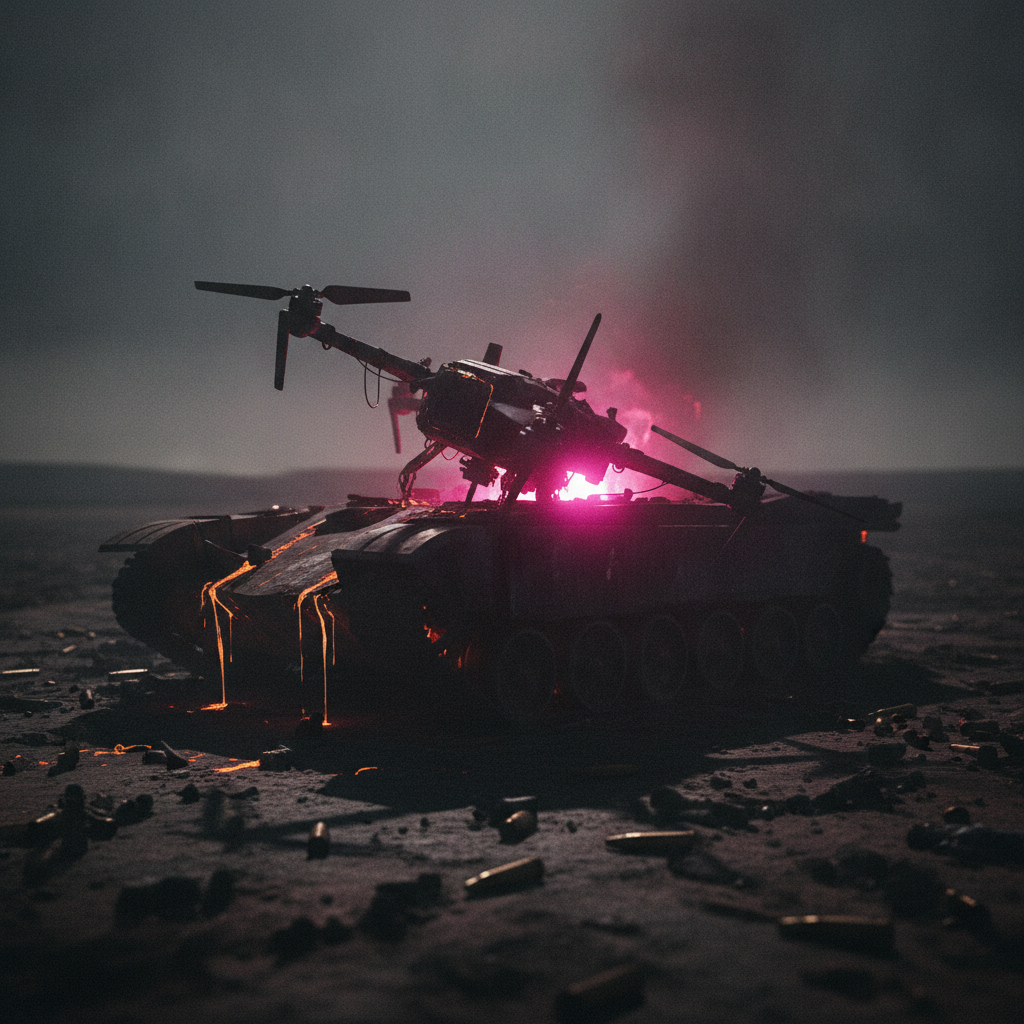
In a war game held in Germany between April 9 and May 10, Ukrainian drone operators didn't just outperform a US armored brigade—they erased it. [2] The exercise, called Combined Resolve, pitted battle-tested Ukrainian drone teams against troops from the 3rd Armored Brigade Combat Team of the 1st Cavalry Division, a unit built around M1A2 tanks and Bradley infantry fighting vehicles. [2] The result was so lopsided that US armored vehicles had to be 'respawned' and sent back into the simulated fray simply to keep the training moving. [2]
The Ukrainian operators mimicked real battlefield techniques: dropping bombs from above or moving close enough to simulate a kamikaze strike. [2] They could spot and destroy US armored vehicles with a consistency that rattled American commanders. One unnamed US Army soldier, captured in a promotional video for Combined Resolve, put it plainly: 'Using the drones with the Army, it keeps everyone on edge. There is never a safe spot or safe moment in the game anymore.' [2]
Combined Resolve was not a one-off humiliation. Ukrainian drone teams also participated in a Swedish-led military exercise for NATO, called Aurora 26, that was also held in May. [2]
Two exercises, two resets, one verdict. The armored vehicle—for more than a century the dominant instrument of land power—is being stress-tested by something far cheaper, far more numerous, and far harder to kill.
The story of the drone kill zone is already written in metal and open-source data. Since Russia launched its full-scale invasion of Ukraine in 2022, Russia has lost more than 14,000 tanks and armored vehicles, according to the Dutch open-source intelligence tracking project Oryx, which counts only visually verified losses. [2] Ukraine has lost over 6,000 armored combat vehicles. [2] Both totals dwarf anything seen in a major conflict since the Second World War.
The kill zone those numbers describe has fundamentally reshaped how both sides move. [2] Both Russia and Ukraine have been forced to rely primarily on infiltration tactics using small groups or even individual soldiers, sometimes riding motorcycles, all-terrain vehicles, or horses. [2]
Russia's offensives illustrate the cost of ignoring that reality. In July, Russian forces launched a mechanized assault with tanks and infantry fighting vehicles in the hotly contested Donetsk Oblast in eastern Ukraine. [2] Ukrainian forces reportedly destroyed 80 percent of the Russian vehicles before they even reached the frontlines. [2] The attack was repelled. The math of the drone kill zone does not negotiate.
And yet armor has not vanished. It has adapted, haltingly, at great cost, through trial and catastrophic error. The question facing NATO planners is whether Western militaries can compress that learning curve before the next conflict demands it in earnest.
Ukraine itself offered a partial answer in May. Limited armored counterattacks managed to penetrate Russian defenses—a feat enabled by Ukrainian military experiments combining electronic warfare with targeted strikes on Russian drone pilots to suppress the kill zone locally. [2] What was impossible one year became feasible the next, at least in narrow corridors and under specific conditions.
The Combined Resolve exercise was designed to accelerate exactly that kind of adaptation for American forces. [2] The lesson was not that armor is finished. It was that armor, operated as it was designed to be operated, is finished. Survival requires new doctrine, not new hardware alone.
The Pentagon has heard the message, at least in budgetary terms. Its fiscal year 2027 budget proposal requests more than $54 billion for acquiring drone and counterdrone systems—a figure that exceeds Ukraine's entire military budget. [2] That spending signals genuine institutional recognition of the threat. Whether it translates into reformed training and operational doctrine is a slower, harder problem than writing a check.
Armored tanks first played a useful role in helping break through entrenched battlefield lines during the final years of World War I more than a century ago. [2] For more than a century, they represented concentrated, mobile firepower that infantry simply could not stop without specialist weapons. The drone has changed that calculus.
The Combined Resolve exercise will not be remembered as the moment armor died. It will be remembered as the moment a major Western military had to watch, in real time, what everyone paying attention already knew—and was forced to take that knowledge seriously.
The broader picture from this summer's exercises is that the industrialization of drone warfare has created a new baseline for any future peer conflict. Ukrainian operators who have spent years flying missions over actual battlefields arrived at NATO exercises with institutional knowledge that no manual or simulation had yet codified for Western armies. [2] The drill exposed US vulnerabilities to drone attacks, according to Ars Technica as cited in MIT Technology Review. [1] That exposure, painful as it was, may be the most valuable training output of 2026.
The NATO alliance is not uniform in its response. European nations have moved with varying speed toward drone-centric force structures, and the question of interoperability—of whether allied units can share drone intelligence and countermeasure systems in real time—remains unresolved. [2] Meanwhile, the Trump administration has declared 100% tariffs on many drones, a policy that cuts against the urgency the Combined Resolve results would seem to demand. [1]
The war game in Germany ended. The drones landed. The tanks were counted. [2] What the exercise demonstrated is that the dominant weapon of twentieth-century land warfare is now contingent—survivable only with the right electronic cover, the right dispersion, the right doctrine, executed in the right moment. That is a narrow margin. The Ukrainian operators who forced NATO planners to reset two war games in a single spring did not invent the drone kill zone. They just made sure the people who need to understand it could no longer look away. [2]
There is never a safe spot or safe moment in the game anymore.Unidentified US Army soldier