The God Coin That Cost 500 People Everything
How a pastor's 'divine' crypto pitch swallowed $3 million from evangelical communities—and what it reveals about faith, finance, and fraud.
By The energy-climate Desk
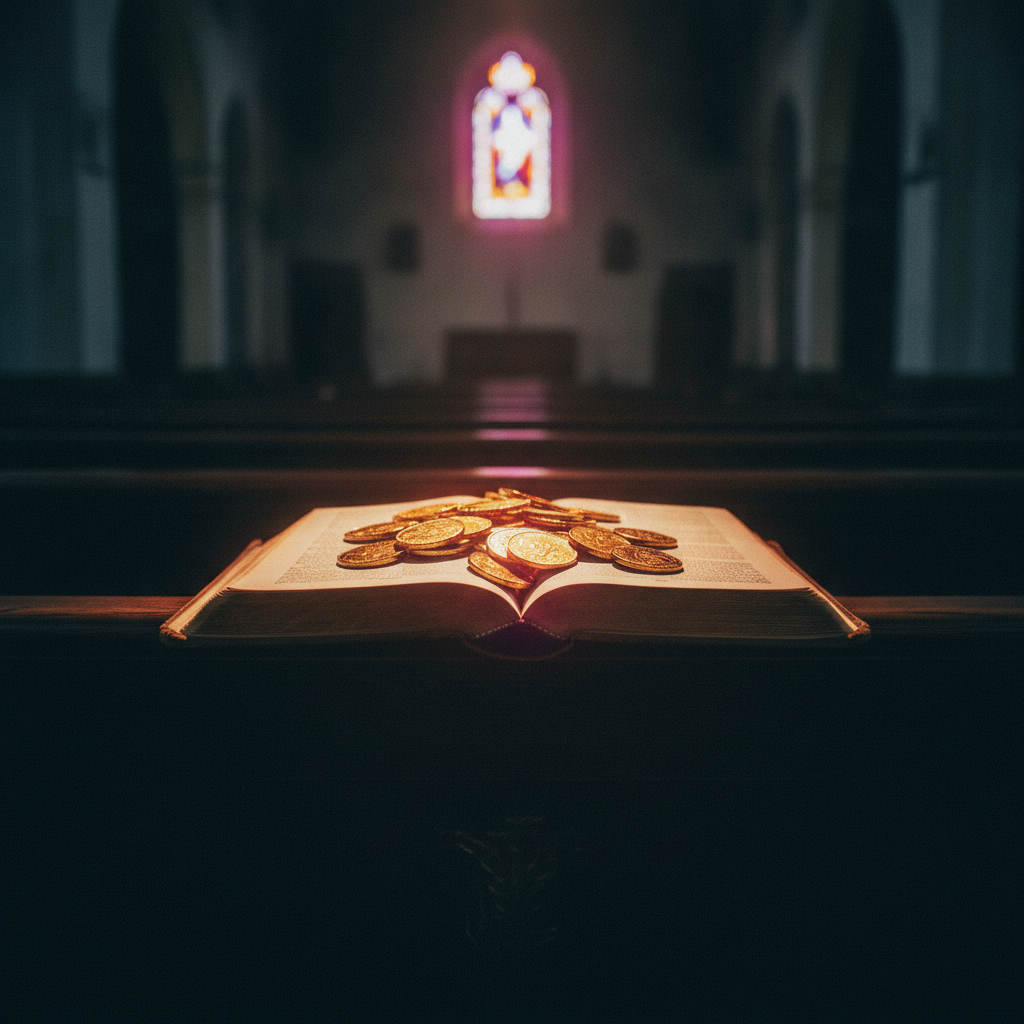
That October, the Regalados later testified in court, they received holdings in a little-known digital coin. Eli heard God say: "Take this to my people for a wealth transfer."
The collapse of INDXcoin is documented in detail by a story produced in partnership with Type Investigations and with support from the Fund for Investigative Journalism. [1][2] What the reporting surfaces is not simply a crypto scam—it is a case study in how trust networks, stripped of institutional friction, become vectors for financial catastrophe. [2]
Faith communities have always moved on trust. That trust is the architecture of belonging—it lowers the cost of believing someone, which is precisely what makes it so easy to exploit.
According to Eli and his wife, divine instruction had previously told them to get married, buy a house, and start having kids. [1] Then in 2021, that same guidance steered them toward crypto. [1] The Regalados received holdings in a little-known digital coin and came to believe that God wanted them to launch their own. [1]
The resulting coin, INDXcoin, was promoted through family, friends, and contacts in evangelical Christian circles. [1] When it collapsed, investors lost it all, leaving many to wonder where the funds went and whether they had fallen victim to an elaborate fraud. [1] A pastor and his wife created a cryptocurrency and hawked it in Christian communities; when it came crashing down, investors lost millions—and they were accused of fraud. [2]
The mechanics here are not new. What shifts with each technological wave is the costume the scheme wears—the vocabulary it borrows from whatever feels most modern, most vital, most inevitable.
Crypto, since its earliest mass-market moment, has attracted promoters who frame speculation as destiny. What distinguished the Regalado case was the addition of theological authority. [1] The community they targeted did not primarily identify as investors. They were congregation members, family contacts, people bound by shared belief. [1] That relational infrastructure—built over years and entirely independent of financial markets—became the distribution network for INDXcoin. [1]
Separately, Type Investigations has documented other pressures on institutional trust in America. [2] America's 911 dispatchers are straining under pressure, leaving thousands of callers waiting during emergencies—and across the country, callers in deadly situations are routinely left on hold. [2] The INDXcoin story sits in that same landscape: institutions and systems people depend on, buckling.
When the state is absent or slow, communities fill the gap with whatever is available—sometimes mutual aid, sometimes inspiration, sometimes someone who says God told them to sell a coin.
The reporting was produced as part of MIT Technology Review's Big Story series, described as the home of MIT Technology Review's most important and ambitious reporting. [1] That framing matters. Placing a crypto-fraud story inside a technology publication is a deliberate editorial choice—it signals that what happened to those 500 investors is not a religion story or even a crime story in isolation. [1] It is a technology story: about what digital financial instruments do when they meet communities that have high trust and low regulatory familiarity.
Eli Regalado testified in court that he first heard God speak to him and wondered whether he was hallucinating. [1] That detail is worth holding. Whatever one makes of the theology, the testimony describes a person whose internal experience was initially indistinguishable—to himself—from delusion. The system around him, the community, the contacts, the evangelical networks, did not pause at that ambiguity. [1] It moved.
This is where the architecture of trust becomes dangerous: not because the people inside it are gullible, but because the architecture is designed to make doubt feel like disloyalty.
The broader landscape of energy technology offers a useful contrast. The US energy storage market is growing at a record pace, and that growth is happening with the help of cheap Chinese batteries that the Trump administration is trying to phase out. [1] The tension raises a broader question: how much should countries take advantage of cheap, available tech, and how much should they cut themselves off from foreign sources to develop their own, even if it costs more. [1]
Hannah Earley, 31, cofounder and CTO of Vaire Computing, offers a different inflection on the same era. [1] Her company builds chips that recycle energy usually thrown away as heat—a strategy known as reversible computing. [1] Last year, Vaire announced a key breakthrough: a chip with a resonator that recovered more energy than it lost, even after the energy needed to power the component was taken into account. [1]
Meanwhile, scientists have spent half a century exploring whether releasing reflective particles into the stratosphere could counteract climate change, mimicking the cooling effects of volcanic eruptions—and even after hundreds of studies, there is still no systematic plan for clearing up the uncertainty. [1] Reflective, a San Francisco nonprofit, has now published a detailed road map of the experiments, studies, and infrastructure needed to make informed decisions about the use of solar geoengineering. [1]
Rigor is not glamorous. A road map that admits uncertainty does not feel like a wealth transfer. But it is what separates a testable claim from a testimony, and an investment from a donation made under duress of belief.
The 500 people who handed over more than $3 million to INDXcoin are not a statistic. [1] They are the endpoint of a network—family members, friends, evangelical contacts—whose social architecture was repurposed for financial extraction. [1] Whether that extraction was criminal is a matter for courts. What it illustrates, for anyone watching the next coin launch in the next faith community, is the specific danger of authority that cannot be questioned.
The Regalados heard God say "take this to my people." [1] More than 500 people did. [1] The project collapsed within a year, and investors lost it all. [1] The next version of this story is already being drafted somewhere—different coin, same architecture, same silence where the accountability should be.