The Implant That Gives Back What AMD Takes
A 378-pixel chip, a pair of smart glasses, and a fiber-optic handshake are returning lost central vision to patients with advanced macular degeneration.
By The energy-climate Desk
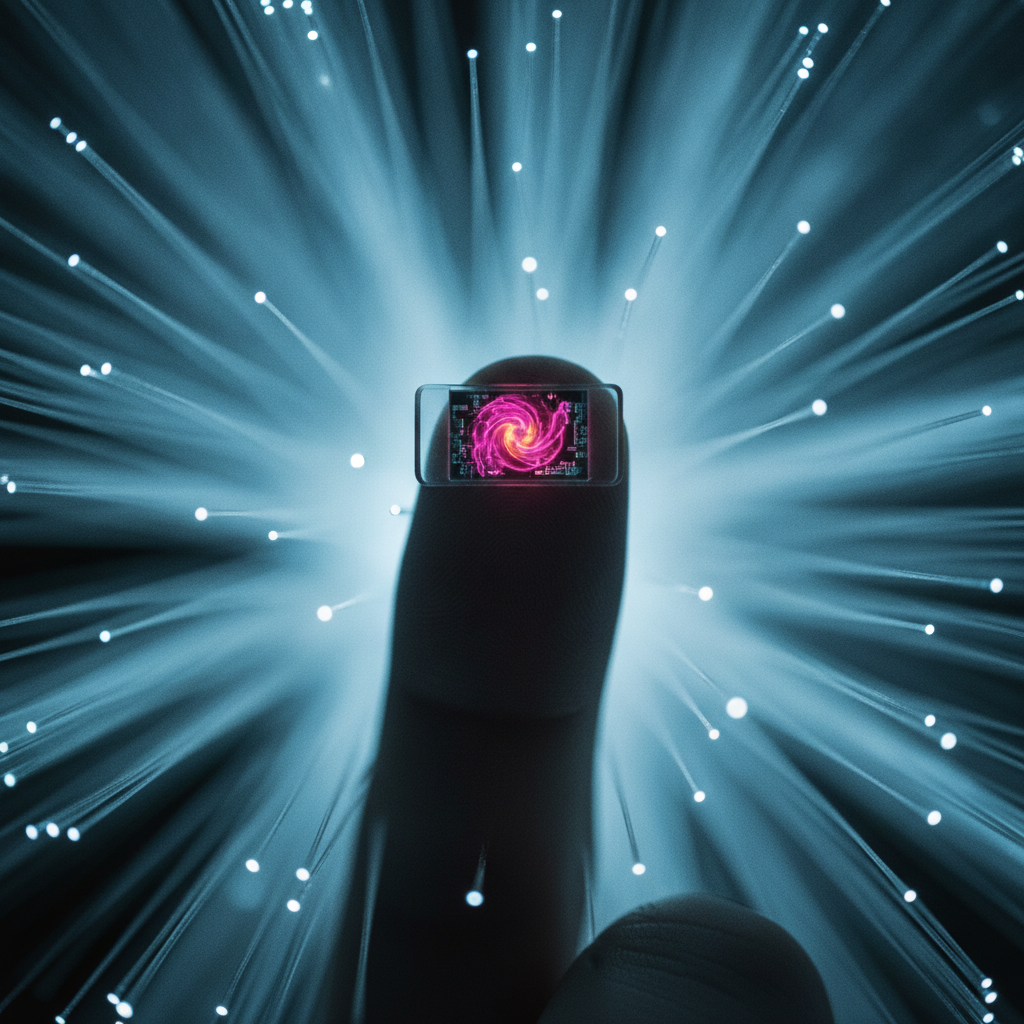
For most of her adult life, a patient could read a menu, recognize a face across the room, thread a needle. Advanced age-related macular degeneration took all of that. The condition, which affects more than 5 million people worldwide, destroys the central field of vision and, until recently, left clinicians with nothing to offer patients once it reached its final stage [1]. A retinal implant system called Prima is changing the math — and the evidence is hard to dismiss: after a course of training sessions, more than 80% of recipients were able to read, do crosswords, and use their phones [1].
The Prima system, developed by California-based Science Corporation, received European approval in July and is currently awaiting FDA clearance in the United States [1]. It works by exploiting a biological detail that AMD's progression conveniently leaves intact. The disease kills photoreceptors — the retinal cells that convert incoming light into electrical signals — but it does not destroy the downstream circuitry that carries those signals to the brain [1]. Prima steps into the gap where the photoreceptors used to be.
What makes the system worth examining closely is not just the clinical outcome, but the architecture behind it — a chain of off-the-shelf optical physics, surgical precision, and photovoltaic ingenuity that together substitute for cells the body can no longer grow back.
The patient wears a pair of glasses fitted with a miniature front-facing camera that captures the visual field in real time at roughly five megapixels and 30 frames per second — a resolution similar to TV [1].
The projector then fires pulses of near-infrared light at 880 nanometers — a wavelength invisible to the unaided human eye — directly through the pupil and onto the retinal implant at the back of the eye [1]. The wearer can adjust contrast, brightness, and zoom using physical buttons on the handheld unit, giving the system a degree of tactile control that does not require a companion app or touchscreen [1].
The elegance of the approach lies in what it refuses to do. Rather than attempting to reconstruct vision from scratch or route signals around the eye entirely, it inserts itself at exactly the point where biology has failed and trusts the rest of the visual pathway to do its job.
Those cells perform a dual function: they convert the incoming infrared light pulses into electrical current, which the eye's surviving bipolar and ganglion cells then carry on to the brain, and they simultaneously act as solar cells to power the chip itself [1]. There is no battery. The implant draws all the energy it needs from the same light signal that carries the visual data [1].
Frank Brodie, an ophthalmologist at the University of California, San Francisco, and medical director for Prima, describes the logic in direct terms: "We're leveraging all of the body's own natural functions to process and transmit the information" [1]. That philosophy has practical consequences. Because Prima does not attempt to take over the entire visual processing chain, the brain receives signals through pathways it already knows how to interpret — which may help explain why outcomes improve with training rather than emerging all at once [1].
The training dimension is significant. Vision is not a passive recording; it is something the brain actively constructs. A system that respects that fact — that gives the brain structured repetition rather than demanding instant comprehension — is working with neuroscience rather than against it.
The 80% figure — the share of recipients who recovered enough central vision to read, complete crosswords, and navigate a smartphone — represents a threshold the field has circled for years without crossing [1]. Advanced AMD, the stage Prima targets, had no approved restorative therapy before this. Once the photoreceptors are gone, the clinical consensus had long been that they were gone for good [1]. Prima's approval in Europe is the first crack in that consensus.
The FDA clearance pathway in the United States will require its own evidentiary burden [1]. The European approval, granted in July, applies the CE mark framework [1]. For patients in the United States who have exhausted other options, that gap carries real weight.
Regulatory pace is, in its own way, a design problem — one that shapes who gets access, when, and under what circumstances. The clinical story and the policy story are not separable, and the distance between European approval and American clearance is a distance measured in patient-years of lost vision.
The 378-pixel resolution of the current implant is modest by consumer display standards — a single frame from a modern smartphone camera contains tens of millions of pixels. But the visual cortex is not a display. The implant needs only to stimulate enough of the surviving retinal network to allow the brain to reconstruct useful central vision, not to replicate the full fidelity of a healthy eye [1]. The five-megapixel camera feed and 30-frames-per-second cadence ensure the upstream data is rich enough; the bottleneck, by design, is the implant — and 378 pixels, each with an electrode, has proven sufficient for functional reading in more than 80% of recipients [1].
Science Corporation's decision to eliminate the battery entirely is worth underscoring. Implantable devices that require power typically carry it in one of two ways: an internal battery that eventually depletes and may require additional surgery to replace, or a wireless charging system that demands discipline from the patient. Prima sidesteps both by harvesting energy from the same infrared light pulse used to deliver visual data [1]. The photovoltaic cells are not a secondary feature — they are load-bearing to the system's long-term viability.
There is something almost counterintuitive about it: a device implanted in the human eye that powers itself from the very light it was put there to process. The simplicity is not accidental. It is the result of asking what the body already does well, and building only what is strictly necessary around that.
Prima will not restore the vision of someone who has never lost it, and it will not work for the forms of macular degeneration that leave different circuitry damaged. But for the millions of people whose photoreceptors have failed while the rest of their visual pathway remains intact, a 378-pixel implant, a pair of glasses, and a pocket-sized processor now constitute a medically approved path back to reading the newspaper [1]. That is not nothing. For most of those patients, until very recently, it was everything.