The Jammer on the Hull
The Marine Corps is bolting AI-driven drone jammers onto its amphibious fleet. Ukraine wrote the requirement.
By The Defense Desk
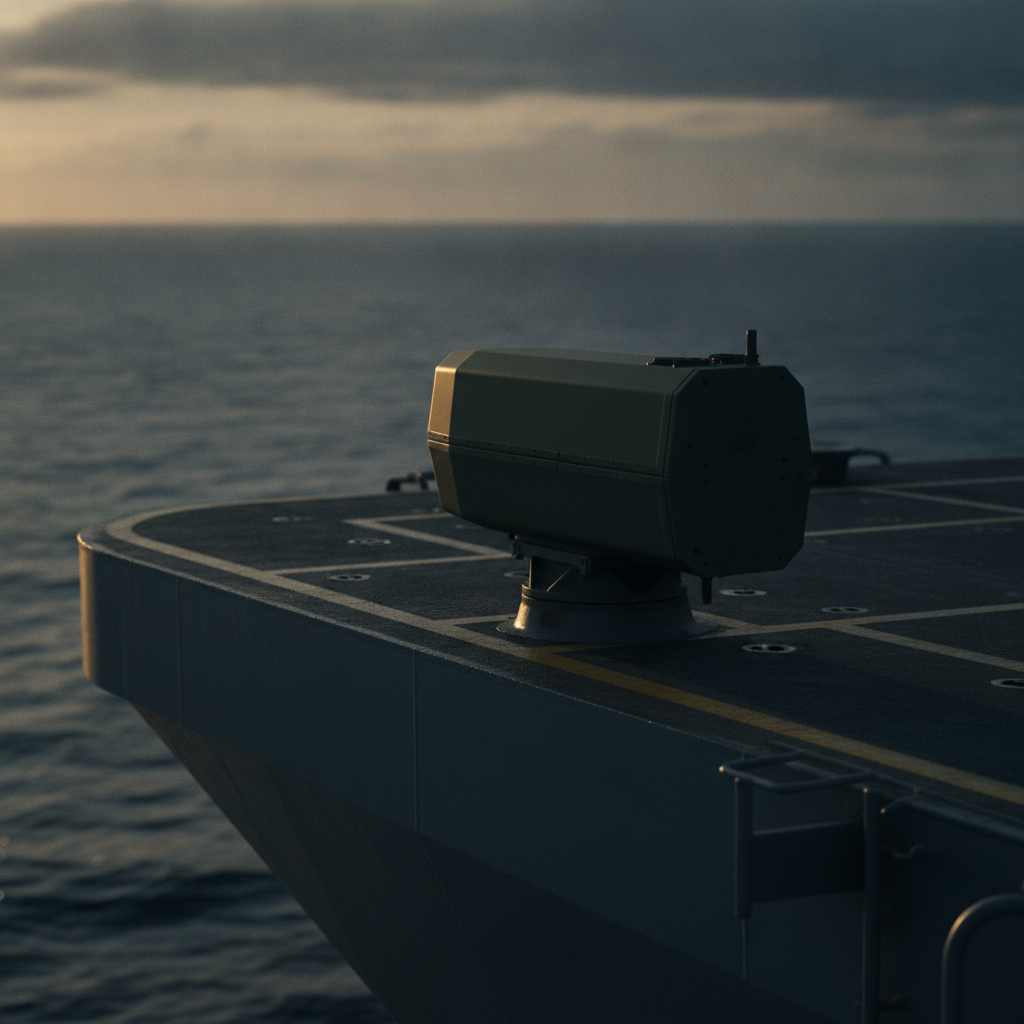
The contract notice was terse, the dollar figure precise: $15,711,445.50, awarded on a sole-source basis to Anduril Industries for an unspecified number of Pulsar-L electronic warfare jammers destined for the Marine Corps' 8×8 Amphibious Combat Vehicles. [1] No competitive tender, no multi-year study. Just an urgent operational need and a rapidly closing window.
Marine Corps Systems Command justified the sole-source deal in language that left little room for ambiguity: 'There is an unusual and compelling need for the rapid deployment of SK C-UASs to forward-deployed ground units as Marines currently lack the ability to conduct self-defense against emerging UAS threats. Failure to deliver this capability places Marines at unnecessary risk, potentially leading to mission failure and loss of life, and hampers the Government's ability to keep them safe during forward deployments.' [1] That is the vocabulary of a service that has been watching drone footage from Ukraine and doing the math.
The order is small in cost but large in implication. It marks the moment a lesson forged on European battlefields becomes a physical object bolted to American armor — a sensor package, a jammer array, a machine-learning core trying to stay one step ahead of an adversary that iterates faster than any procurement cycle was designed to accommodate.
The Pulsar-L itself is recent hardware. Anduril unveiled it in April 2025 as a lightweight addition to its larger Pulsar family of electronic warfare systems. [1] The system is described by MARCORSYSCOM as 'a platform-integrated omni-directional SK C-UAS with a combined sensor/jammer package that detects, tracks, identifies, and defeats radio frequency-dependent Group 1 and Group 2 Unmanned Aerial Systems.' [1] Group 1 covers drones weighing up to 20 pounds, flying at altitudes up to 1,200 feet, and reaching speeds of up to 100 knots. Group 2 encompasses types with gross weights between 21 and 55 pounds, altitudes up to 3,500 feet, and top speeds up to 250 knots. [1] Both categories are deployed daily in Ukraine against armored vehicles, unarmored vehicles, and personnel.
What makes Pulsar-L the sole-source choice is not just its weight budget. MARCORSYSCOM argues it is 'the only known commercially available system that meets the minimum requirement to rapidly identify and respond to emerging UAS technologies and tactics without frequent updates to predefined threat data libraries.' [1] The system, the justification document states, 'uses machine based learning to continually adapt to these ever-changing threats without requiring vendor updates, allowing the warfighters to continually be effective in the fight.' [1] The system is already in use by the Special Operations Command. [1]
That self-updating capability matters because the electromagnetic contest in Ukraine moves at a pace that conventional acquisition cannot match. The conflict in Ukraine has shown that the cycle of new developments in the electromagnetic spectrum and then the need for new countermeasures can be regularly measured in weeks. [1] Both sides iterate on airframes, payloads, and electronic countermeasures on cycles measured in weeks, forcing a shift from procurement built around decade-long programs to something closer to continuous, decentralized innovation. [2] A jammer that requires a vendor update every time an adversary changes its signal is already obsolete before the ink dries.
The Pulsar-L order is a dispatch from a new procurement logic — one where the threat library rewrites itself in the field and the weapon that cannot learn is the weapon that loses. It is a small, sealed box that contains a very large argument about how militaries must now think about time.
The ACV fleet that will carry these jammers is still maturing. As of April 2026, the Marine Corps had 150 baseline ACV-Ps and 21 ACV-C command-and-control variants in inventory. [1] The default armament on the ACV-P remains a single .50 caliber M2 machine gun in a remote weapon station. [1] The service's eventual acquisition goal includes 389 ACV-Ps, 33 ACV-Cs, 152 ACV-30s with 30mm cannon-armed turrets, and 34 ACV-R recovery variants. [1] Against a drone costing a few hundred dollars and capable of a terminal dive into the vehicle's thinner top armor, a .50 caliber machine gun is, at best, a partial answer.
Ukraine has made that arithmetic viscerally clear. First-person-view quadcopters costing a few hundred dollars, mass-produced and flown into vehicles, trenches, and individual soldiers, have become a feature of daily combat. [1] The Center for a New American Security has described this as a preview of the affordable-mass problem that established militaries must now confront. [2] When a drone costing hundreds of dollars can destroy armor worth millions, the traditional economics of exchange are inverted. [2]
The visible hardware response has been the 'cope cage' — anti-drone armor screens bolted over vehicles to defeat top-down attacks. That practice first emerged in Russia in the lead-up to its full invasion of Ukraine in 2022 and has since become a global trend, including inside the U.S. military. [1] Steel mesh is cheap and immediate. It is also a confession that the threat is real and that no single layer of defense is enough.
Melkonian framed electronic awareness as the gateway to everything else. 'Situational awareness, that's kind of a gateway to counter-UAS, in terms of the ability to sense your environment. Take all that video on board and then be able to feed that into [a] counter-UAS system,' he said. [1] Pulsar-L sits at that gateway: it detects and tracks before it defeats, giving the vehicle a picture of its threat environment that the current configuration simply does not have.
The electronic warfare dimension extends well beyond jamming a quadcopter's control link. In Ukraine, the electromagnetic contest has become a precondition for the effective use of nearly every modern weapon. [2] Both sides have invested heavily in electronic warfare to jam navigation signals, sever drone control links, and blind sensors. The effectiveness of an FPV drone often depends less on its airframe than on whether its operator can maintain a signal against enemy jamming. [1]
That FY27 program will be procured through full and open competition, MARCORSYSCOM notes, with the expectation that 'advanced non-kinetic and SK defeat technologies should be mature by this time.' [1] The Pulsar-L order is explicitly a stopgap — fast, effective against the most common threats, and honest about its limits. The U.S. [1] Whether Pulsar-L fully reaches that standard remains unclear; how exactly it uses machine learning to adapt, and the speed at which it does so, is still not entirely public. [1]
The urgency behind this contract is inseparable from a broader strategic moment. The dossier of lessons from Ukraine does not sit quietly in think-tank reports; it arrives in acquisition offices as a forcing function, compressing timelines that once stretched across congressional cycles into weeks between threat observation and contract award.
The timing of the requirement's formalization — April 7, roughly a week after the United States and Israel first launched major combat operations against Iran — is suggestive without being conclusive. [1] Iran is a prolific developer and user of weaponized drones, and Iranian drones have been a real threat to U.S. forces in the region. [2] The Marine Corps draws amphibious assault contingencies across multiple theaters; counter-drone capability would be especially critical in any future amphibious landing operation, wherever it might occur. [1]
What Ukraine has demonstrated at strategic scale is that the transparent battlefield — persistent surveillance from satellites, uncrewed aerial systems, acoustic sensors, and open-source reporting — has made concealment extraordinarily difficult. [2] The result has been a battlefield that in places resembles the attritional stalemate of 1916 more than the maneuver warfare of 1991. [2] An amphibious vehicle crossing a contested littoral zone is, in that environment, an extremely visible object. The Pulsar-L does not solve that problem. It gives the vehicle a fighting chance against the most affordable and most common tool an adversary would use to exploit it.
The Marine Corps is explicit that the Pulsar-L is one layer in a stack still being built — integrated eventually with active protection systems, overhead armor, and a future competitive program. [1] But the rush order itself is the real signal. When a service bypasses competition, cites operational urgency, and moves in weeks rather than years, it is telling you something about where the threat sits on the timeline. Drones are already here. The armor is already at risk. The jammer is being bolted on now because waiting for the perfect solution means waiting in the kill zone.