The Pentagon Wants to Build a City
A new joint military installation—self-sufficient, nuclear-powered, and drone-ready—is coming. The only question is where.
By The Defense Desk
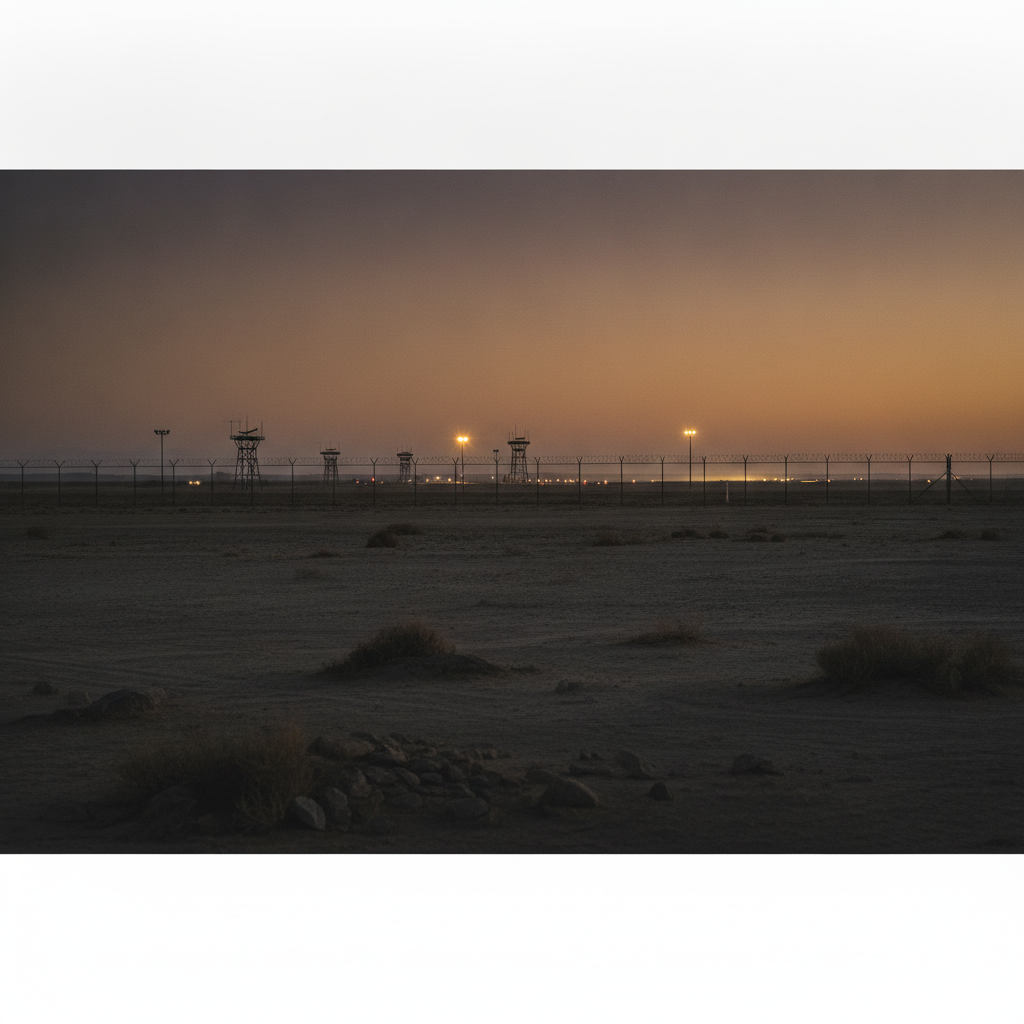
Dale Marks has a straightforward way of describing what the Pentagon is trying to build. 'We talk about this as a base, but this is building a city,' the assistant secretary of defense for Energy, Installations, and Environment told Breaking Defense last week on the sidelines of the Installation Innovation conference in Tampa. [1] The city in question would house between 80,000 and 100,000 people, sit atop small modular nuclear reactors, and train formations equipped with autonomous drone wings and directed-energy weapons. [1] A site selection decision is expected by June 2027.
The search began after Defense Secretary Pete Hegseth's late September announcement of a handful of new initiatives that involved tapping Marks to identify, evaluate, select, and prepare an 'optimal site' for the installation. [1] Hegseth's language was direct: 'Rapid advancements in disruptive technologies, growing strategic alignment among peer adversaries, and persistent, sophisticated cyber intrusions against critical defense and homeland infrastructure necessitate a modernized, resilient posture.' [1]
On Oct. 22, Marks sent a letter to the nation's governors and adjutants general spelling out the four criteria that will shape any bid. [1] States have until Dec. 1 to submit site nominations. [1] After that, Marks and his team will begin direct conversations with nominees, working through the details of each location—down to, as Marks put it, questions about where the perimeter fence lives, whether the installation builds its own housing, and whether local hospitals and schools might be folded into the support infrastructure. [1]
What Marks is describing is not an upgrade to an existing facility. It is a clean-sheet design problem—one where the constraints of inherited infrastructure, legacy contracting, and civilian grid dependency are treated as bugs rather than features to be accommodated.
The first criterion is land: the Pentagon is eyeing parcels in the 100,000 to 250,000 acre range, though the Oct. 22 letter clarified that 'otherwise compelling offers' that fall outside those bounds will still be considered. [1] The second criterion is population capacity: the installation must support 15,000 to 25,000 active service members and their families, totaling an estimated 80,000 to 100,000 people. [1] It must also be designed to accommodate future formations built around what Marks called 'autonomous mass' capabilities like those aforementioned drones and directed energy weapons. [1]
The third criterion is the one that separates this project from any American military installation currently in existence. The base must be entirely self-sufficient: on-site small modular nuclear reactors, hardened microgrids, and closed-loop water capture treatment and recycling systems capable of operating 'indefinitely.' [1] Speaking from the conference stage, Marks set a concrete benchmark: 'In our phased implementation roadmap, this base must demonstrate within its first 24 months that it can sustain 30 continuous days of full combat sorted generation, completely disconnected from the civilian grid and power supplies.' [1] His framing for why this matters was unambiguous: 'If the continental United States experiences a catastrophic grid collapse, this installation will remain 100 percent operational, locked and loaded, ready to respond.' [1]
The energy independence requirement is where the installation's ambitions become most legible. A base that can run for a month without external power, water, or fuel is not planning for a regional conflict. It is planning for a scenario in which the domestic infrastructure that usually surrounds and sustains military operations has failed entirely.
The fourth criterion concerns money—and, more specifically, who spends it. Marks wants states to structure their bids around public-private partnerships. Under the model he sketched, the Defense Department would fund the core military functions: the combat mission, power projection capabilities, subterranean command shelters, munitions bunkers, and tactical proving grounds. [1] Commercial capital would then build and operate the supporting digital infrastructure. [1] No cost estimate for the total program has been offered, because no site has been selected. Marks did confirm to Breaking Defense that the forthcoming 2028 budget request is expected to include a 'wedge' to initiate the project. [1]
[1] This is not language that maps neatly onto existing force structure. It describes capabilities that are, in several cases, still in development—which is precisely the point. The installation is being designed to absorb technology that does not yet exist at scale, avoiding what Pentagon acquisition officials have long called 'vendor lock.' [1]
The attempt to embed flexibility into concrete and acreage is one of the more unusual architectural ambitions in recent defense planning. Building for formations that do not yet exist, with technologies that have not yet matured, using funding models that have not yet been negotiated, requires a tolerance for open-ended questions that procurement bureaucracies typically resist.
Marks acknowledged the political sensitivity of the selection process. With governors from across the political spectrum submitting bids, there is an obvious risk that the final decision will be read as a reward for states aligned with the current administration. His response is to make the bids and decision-making process as public as possible. [1] 'There's going to be a panel,' he told Breaking Defense. 'We've been told the president might be involved, but at this point, we're just driving in a direction to get it to that selection criteria [in place].' [1] Whether a transparent rubric can insulate a decision of this magnitude from political pressure is a question Marks did not resolve—and probably cannot.
The Dec. 1 submission deadline gives states roughly a month to pull together site nominations. [1] After that, Marks and his team move into a consultation phase, working with nominated communities to stress-test concepts and fill in specifics. The fence question—whether it is a fence at all, or something else entirely—stands in for a broader set of design choices that remain genuinely open. [1] Some of those choices will be shaped by what communities are willing to offer. Others will be shaped by what the Pentagon discovers it actually needs once it starts examining real land at the resolution of individual parcels.
The June 2027 deadline for a site decision is ambitious by the standards of any federal infrastructure project, let alone one that involves nuclear reactors, autonomous weapons formations, and a projected population the size of a mid-sized American city. [1] What Marks is selling to governors, to the defense industry, and to whatever community eventually wins the bid is not just an economic opportunity. It is a theory of deterrence—the idea that the most credible signal the United States can send is a base that functions even when everything around it has stopped. [1]
If the continental United States experiences a catastrophic grid collapse, this installation will remain 100 percent operational, locked and loaded, ready to respond.Dale Marks