The Quality Engineer Holding Moon Missions Together
At NASA's Stennis Space Center, Kristie Foster moved from contractor to civil servant—and became the institutional memory Artemis can't afford to lose.
By The space-quantum Desk
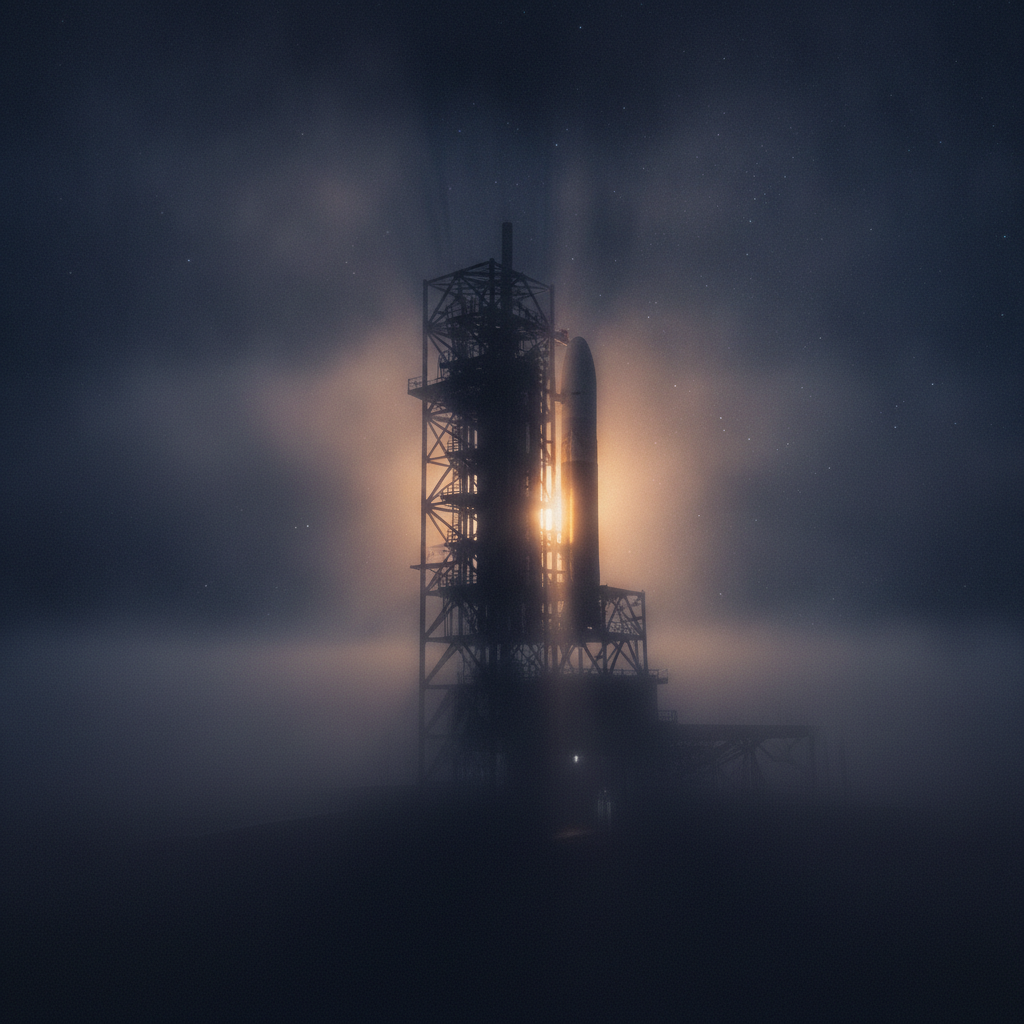
On a Tuesday morning at America's largest rocket propulsion test site, Kristie Foster is reviewing test preparation sheets for a facility that pushes gases through a 7-mile pipeline at pressures most engineers never encounter outside simulation. [1] This is not glamorous work in the way that launch countdowns are glamorous. It is the work that makes launch countdowns possible.
Foster is a quality engineer at NASA's Stennis Space Center near Bay St. Louis, Mississippi—a site that few outside the aerospace industry could place on a map but that sits, quietly, at the center of the Artemis program's propulsion ambitions. [1]
The facilities Foster oversees day-to-day are unglamorous by design. [1] Adjacent to it, the High Pressure Industrial Water Facility draws on a 66-million-gallon reservoir to pump massive volumes of water to the test stands for cooling and sound suppression. [1] These are not experimental installations. They are the plumbing of American spaceflight.
There is a tendency in coverage of space programs to focus on the dramatic: the launches, the astronauts, the distant surfaces waiting to be stepped upon. What that framing consistently elides is the layered, unglamorous infrastructure of verification and process—the people whose job is to ensure that nothing goes wrong before anyone has a chance to watch something go right.
Foster's role at Stennis spans that entire verification chain. Her technical work involves reviewing test preparation sheets, verifying operational plans in the field, and ensuring processes are executed from the initial design phase through final closeout. [1] She has also taken on a safety role supporting the build-up at the Thad Cochran Test Stand (B-2), where Blue Origin will conduct second stage hot fire testing of the company's New Glenn rocket. [1] That single test stand connects two of the most consequential propulsion programs currently active in American aerospace.
Her philosophy on that work is precise. "If you put safety and quality up front and incorporate it throughout the entire process, you are going to end up with a better product at the end," Foster said. [1] "Because NASA pushes safety and actively performs it, we are able to work at a fast pace with safety at the forefront." [1] That framing—safety as an accelerant rather than a brake—runs counter to how the aerospace industry has historically narrated quality assurance. Foster treats it as an engineering variable, not a compliance exercise.
The relationship between institutional knowledge and mission continuity is one the aerospace sector has negotiated imperfectly for decades. Programs are cancelled, contractors cycle in, workforce pipelines fragment. What remains, when the documentation is incomplete and the systems are bespoke, is the memory of the people who built and tested them—which is precisely why the question of who holds that knowledge, and under what employment arrangement, matters more than org charts typically suggest.
Foster's path to that knowledge was neither linear nor conventionally prestigious. She completed two years at Pearl River Community College, along with summer night classes at Mississippi Gulf Coast Community College, before finishing a bachelor's degree in construction management and land development at Mississippi State University. [1] Her first contact with Stennis came through an internship with the Naval Oceanographic Office—the largest tenant of the NASA Stennis Federal City is the United States Navy, a fact that surprises most people who assume the site belongs entirely to NASA. [1]
The pivot toward NASA came during her senior year, when a four-week holiday internship on a Stennis construction project evolved into a schedule of working three days a week at the center, then driving hours back to campus to attend classes the other four days. [1] That is the knowledge NASA moved to retain.
The family dimension of that retention is not incidental. Foster's father retired from NASA last year after working approximately 20 years at Stennis. [1] "It means a lot, especially carrying the family legacy forward," she said. [1] Her 12-year-old son, a self-described space enthusiast, now has the kind of aerospace conversations with his mother that she once had with her father—a generational relay of technical literacy running through a single Mississippi family. [1]
The missions Foster's work supports are advancing toward their most complex phases. [1] Each of those missions requires propulsion testing at Stennis—which means each depends, in some traceable way, on the quality assurance processes Foster manages.
What the Artemis program represents, at the infrastructure level, is a bet that the knowledge accumulated across decades of testing can be preserved, transferred, and applied to systems that did not exist when most of that knowledge was first earned. That is not a technical problem. It is a human one—and it is solved, or not solved, one hire at a time.
Foster is characteristically direct about the appeal of that work. "One neat thing about working with NASA at Stennis, especially in the test complex, is that I have never done the same thing twice," she said. [1] "It is always an evolving situation." [1] At Stennis, she is doing both simultaneously.
Outside the test complex, Foster is a resident of Poplarville, Mississippi, and runs a farm alongside her career. [1] The image resists the archetype of the aerospace engineer as a coastal, credentialed professional—and that resistance is part of the point. The workforce NASA is trying to build for the next phase of lunar operations will not come entirely from the places it has traditionally recruited. Some of it is already in Poplarville, commuting to a 66-million-gallon reservoir at the edge of the Gulf Coast. [1]
The Moon is, by any measure, a long way from a Mississippi farm. The pipeline between them runs 7 miles through Stennis Space Center, carries pressurized gas to test stands that will verify the engines of Artemis, and is maintained by a quality engineer who has spent the better part of two decades learning exactly where it can fail. [1] That is what mission readiness actually looks like—less countdown clock, more institutional memory with a civil service badge.
One neat thing about working with NASA at Stennis, especially in the test complex, is that I have never done the same thing twice. It is always an evolving situation.Kristie Foster