The Robot That Never Calls in Sick
Robotic arms are no longer just moving parts around CNC shops. They're running full production cells — overnight, unsupervised, and with micron-level consistency.
By The Robotics Desk
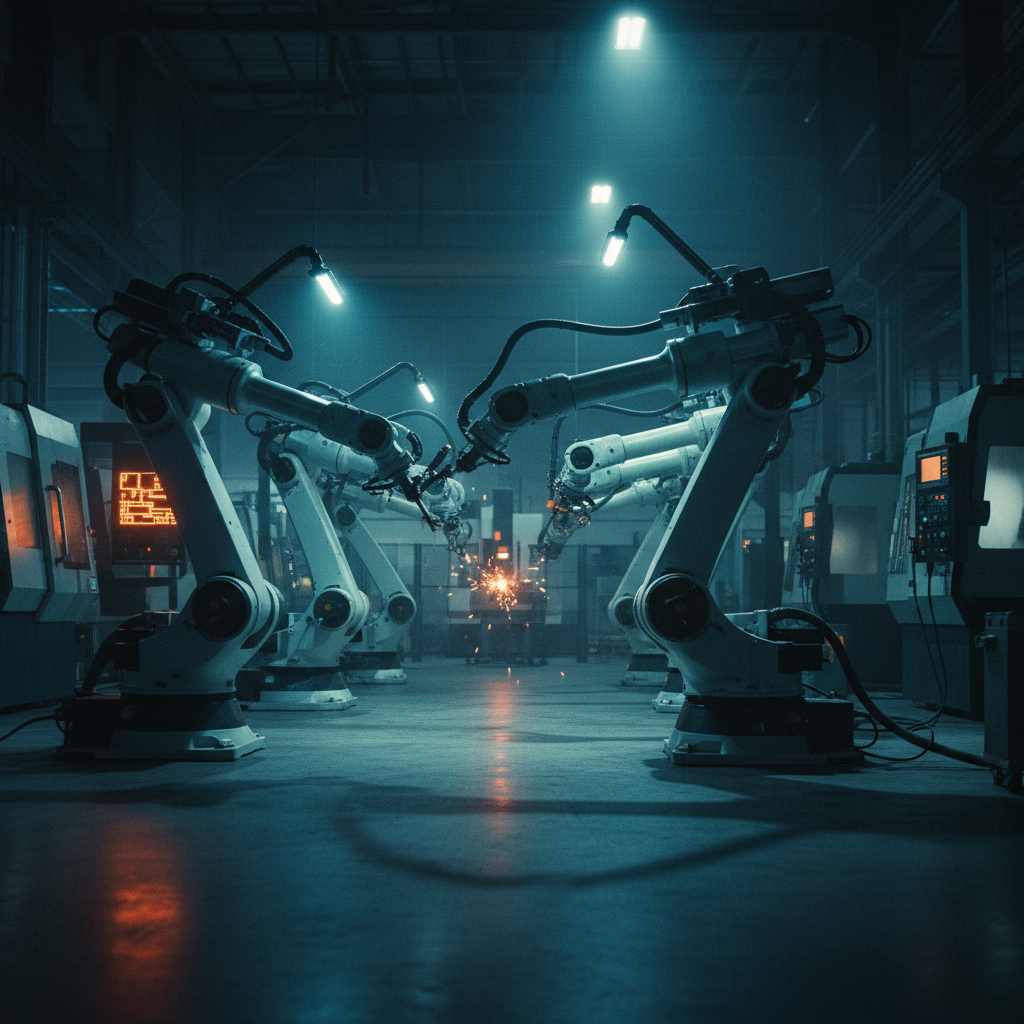
A Deloitte study puts the number starkly: up to 1.9 million of the 3.8 million manufacturing positions that need filling by 2033 could go unfilled due to skills gaps. [1] Manufacturers aren't waiting for that gap to close. They're automating around it — and the tool they're reaching for is the robotic arm, now wired directly into the CNC machine beside it.
What changed isn't the hardware in isolation. CNC machines and robotic arms have shared factory floors for decades. [1] What's new is the depth of integration. A single arm now loads a raw blank, transfers it between machines, inspects the finished part, and routes it downstream — all without human involvement. [1] That's not an efficiency tweak; it's a different production model entirely.
The implications ripple beyond headcount. When a machine no longer waits for a human to return in the morning, the economics of capital equipment shift fundamentally. The floor doesn't sleep; it just keeps running.
Lights-out manufacturing is the clearest expression of this shift. CNC machines are major capital investments that routinely sit idle outside of staffed shifts when tended manually. [1] Robotic arms change that calculus by running material changes autonomously overnight and through weekends. [1] ABB's FlexLoader M, a pre-engineered modular tending cell available in six configurations, reports machine utilization exceeding 97% — compared to 40% to 60% in manually operated environments. [1] Installation averages one to two days.
Consistency is the other gain that rarely makes the headline. Operator fatigue, inconsistent grip, and minor misalignments accumulate over a shift and surface as scrap or rework. [1] Robotic arms place every part into a chuck or fixture with the same orientation and force, every time, allowing CNC machines to operate consistently at their designed capability. [1] At Toolcraft, a Seattle machine shop, the UR5e's 30-micron repeatability enabled multi-threaded parts to be accurately placed across three sequential fixtures for a medical device component — delivering a 23% reduction in production costs and a 43% increase in throughput. [1]
FANUC's integration goes further still. In 2024, the company unveiled the ROBODRILL α-D28LiB5ADV Plus Y500 with the R-50iA controller, featuring an embedded vision system for part recognition and placement verification. [1] A case study from APT Manufacturing Solutions documented a 33% efficiency gain on a FANUC-tended ROBODRILL line — output climbing from 100 to more than 150 parts per eight-hour shift, with ROI achieved in 33 weeks. [1]
KUKA is solving a different problem: programming friction. Its KUKA.CNC software allows robots to be programmed in G-code — the same language CNC operators already know. [1] At IMTS 2024, Robotics Solutions Inc. displayed a robotic milling application using a KR Quantec Nano robot and DKP 3 positioner processing a cast part made of hard material, with full CNC-type operations including automated toolchangers, tool presetters, hotwire harps, probes, 3D scanners, and unlimited file size capabilities. [2] In aerospace and defense, where any deviation in placement propagates directly into dimensional error in the finished part, that precision isn't optional. [1]
The software layer underneath all of this is quietly becoming as important as the arms themselves. RoboDK offers a manufacturer-agnostic platform supporting over 1,200 robots from more than 50 manufacturers, generating native programs for ABB RAPID, FANUC LS, KUKA KRC, and Universal Robots from a single interface. [1] It also converts five-axis G-code directly into robot programs, enabling robotic arms to perform machining tasks that previously required dedicated CNC equipment. [1] For shops running mixed fleets, that's a significant reduction in programming overhead.
Each of these solutions addresses a different constraint — labor scarcity, floor space, programming complexity, changeover speed — but they converge on the same outcome: a production cell that operates closer to its theoretical maximum.
A robot that loads a part today follows fixed logic. [1] The next design question — already visible in how FANUC and KUKA are wiring in vision systems and real-time measurement — is what happens when that logic becomes adaptive. A system that monitors spindle load, detects tool wear in real time, and decides autonomously whether a part passes inspection is a different kind of participant in the manufacturing process altogether. [1] The floor is already running overnight. The question now is how much of the decision-making goes with it.
Operator fatigue, inconsistent grip, and minor misalignments accumulate over a shift and surface as scrap or rework.therobotreport.com