The Robot That Never Stops to Charge
WiBotic's Ben Waters explains why opportunity charging—not faster batteries—is the real fix for scaling robot fleets.
By The Robotics Desk
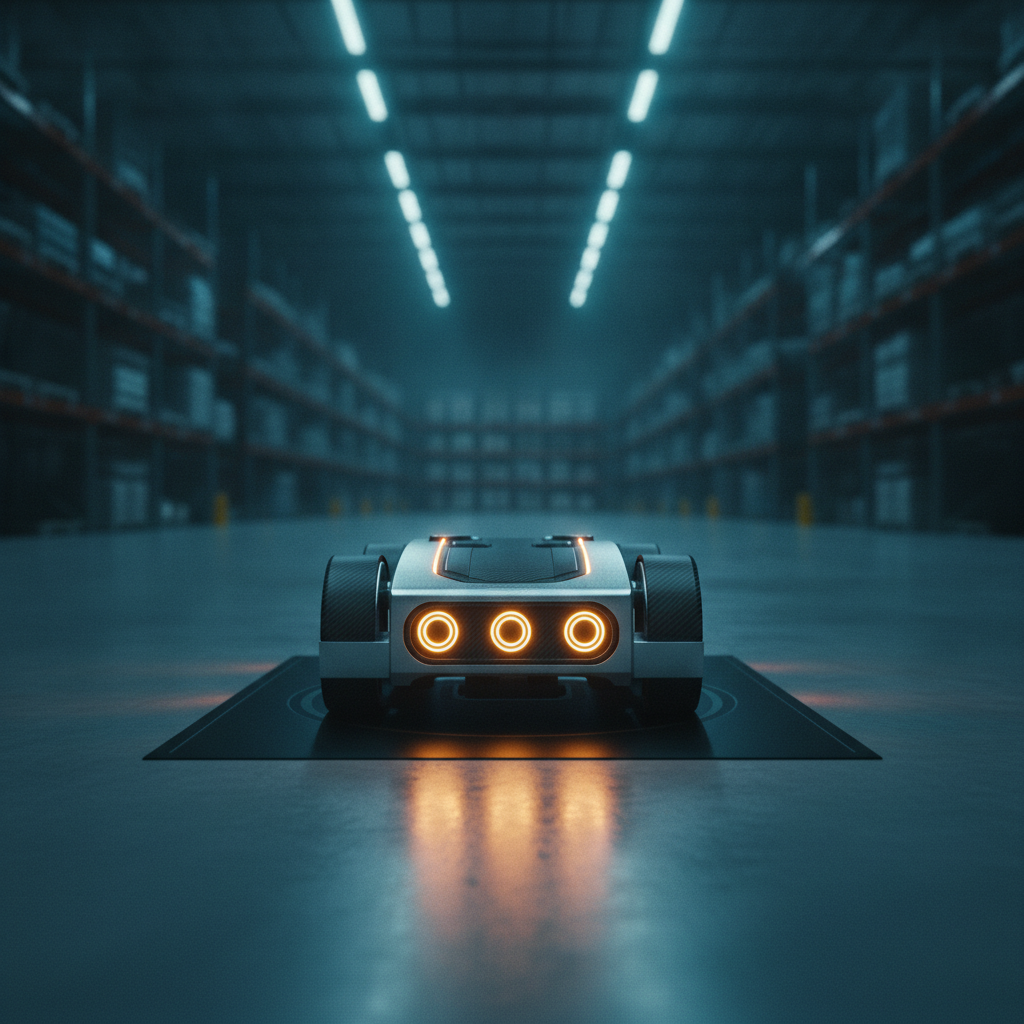
Picture a warehouse robot running low on power at the far end of a facility. [1] Multiply that across a fleet of 20 to 40 machines and the math turns ugly fast.
Ben Waters, CEO of WiBotic, calls this the central operational problem facing mobile robot deployments today. [1] Charging strategy, he argues, now shapes fleet uptime, facility infrastructure, maintenance load, and even the size of the batteries robot manufacturers choose to spec in the first place. [1] The question is no longer how quickly a battery can recharge—it's whether the robot ever needs to stop at all.
The answer Waters proposes is opportunity charging: embedding wireless charging pads directly into the locations where robots already pause—right where the robot naturally is going to sit. [1] "If the robot does a task and it's got 10 seconds to sit there, well, a charging station should be positioned right where that robot naturally is going to sit," Waters told The Robot Report Podcast. [1] Ten seconds of charging sounds trivial, but repeated hundreds of times across a shift, it restores enough capacity to let machines run continuously around the clock. [1]
The logic inverts the standard relationship between infrastructure and operations. Instead of designing the robot's route around charging, you design charging around the route.
Waters is explicit that opportunity charging only works wirelessly. [1] "Even if you had the world's most strongest contact, it still would require maintenance at some point, times all of the chargers in your fleet," he said. [1] Wireless pads have no moving parts and no mechanical wear.
The strategic argument extends back to the design table. Waters says operators who treat charging as an afterthought get burned on three fronts: power infrastructure capacity (whether existing electrical outlets can support the number of chargers required), battery sizing (whether they're carrying more capacity than a good charging strategy actually demands), and long-term maintenance. [1] "If you wait till you've already finished your design, and you're starting to deploy and haven't thought about those things, then almost surely, you will get bit by every one of those things within at least a couple of months, if not sooner," he warned. [1]
On fast charging specifically, Waters urges restraint. Have you seen a data sheet from the battery manufacturer that says what that's gonna do to lifetime?"—degrades cell longevity in ways battery manufacturers document on their own data sheets. [1] If opportunity charging keeps state-of-charge high throughout the day, the case for aggressive fast charging weakens considerably.
WiBotic itself is extending its hardware envelope in parallel. The company recently launched an IP65-rated version of its 1 kW charger family, clearing it for outdoor deployments and environments where water and dust are routine hazards—floor-care robots and outdoor robotics applications. [1] A 3 kW product line is in active development. [1]
Humanoids are, by Waters's framing, an open variable. [1] Waters notes that the more mass you add to a humanoid, the more energy it has to spend because it's balancing that mass, and there's not a lot of space—making small form-factor, high-power wireless charging particularly well suited to the platform. [1]
What emerges from Waters's account is a discipline that's quietly rewriting the economics of autonomous fleets—not by making individual robots smarter, but by making the spaces they inhabit work harder.
As fleets scale into the dozens, then hundreds, the competitive edge will likely belong to operators who treat charging topology as a first-class design decision rather than a spec-sheet footnote. [1] The robots that win won't be the ones that charge fastest. They'll be the ones that barely seem to charge at all.