The Robots That Need to Feel
Humanoid machines are leaving the lab. The sensors that tell them how hard to grip — and when to let go — are the quiet infrastructure holding it all together.
By The Robotics Desk
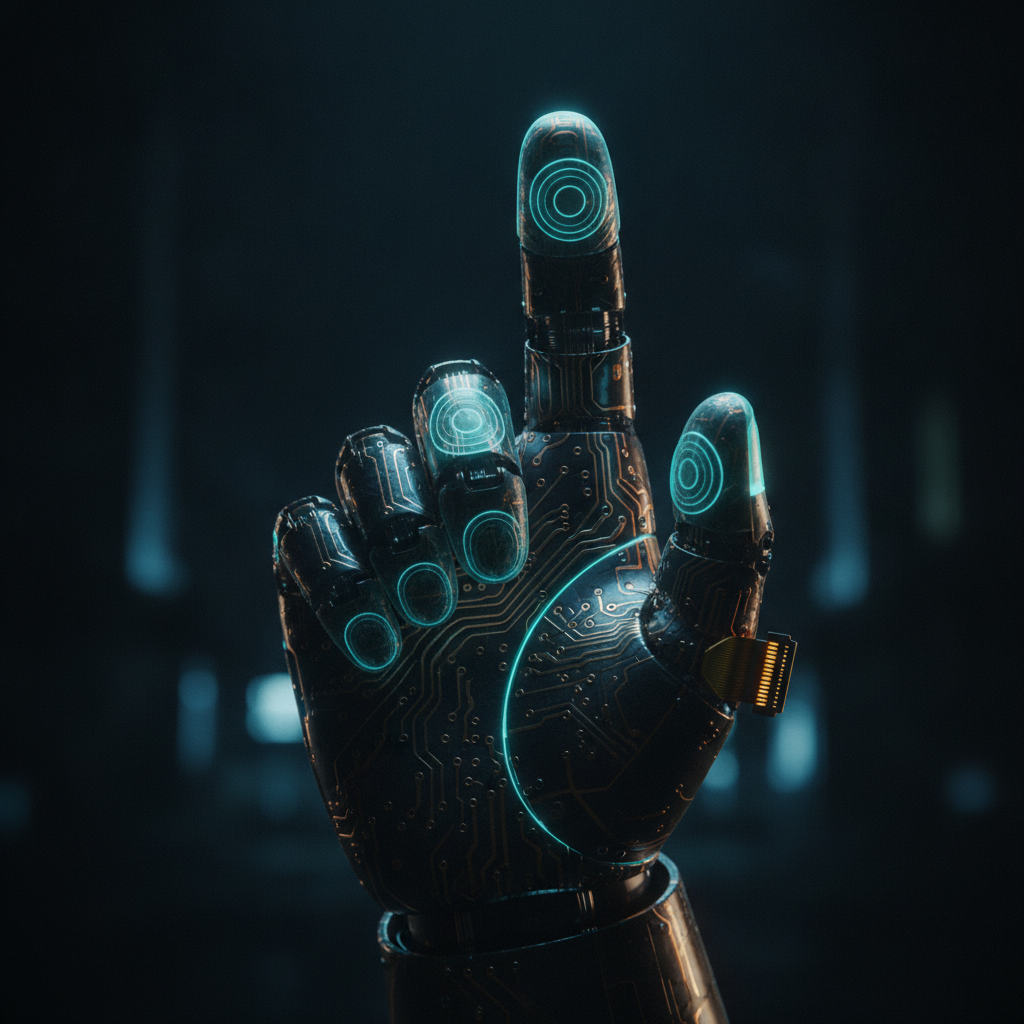
A humanoid robot reaching for a glass of water faces a problem no camera or language model can fully solve. Vision tells it where the glass is. AI plans the trajectory. But only touch — the measured resistance of fingertip against surface, the micro-torque in the wrist as the hand closes — tells it whether the glass is about to slip or shatter. [1] Force and torque sensing, not perception or path planning, determine how safely and smoothly a humanoid robot interacts with its environment.
This is the infrastructure problem of the humanoid moment. Billions of dollars have flooded into bipedal robots over the past three years, funding the AI stacks, the actuators, and the vision pipelines. But [1] as humanoid robots move from research labs into factories, warehouses, homes, and other shared spaces, accurate physical feedback becomes crucial. The sensing layer — the part that tells the machine what its body is actually doing — has quietly become the bottleneck.
The gap between a robot that looks capable and one that genuinely is has always lived in the details. What the machine feels, how fast it feels it, and how precisely that sensation is reported back to the control system — these are the margins where the whole enterprise either works or fails.
[1] Stationary industrial robots work on fixed tracks in controlled spaces, but humanoid robots must move through changing environments, handle unpredictable loads, and deal with many points of contact. That distinction is architectural. A fixed arm on an assembly line operates in a world of known variables. A humanoid working alongside people in a hospital or warehouse operates in a world that is fundamentally unpredictable — and must negotiate that world through its body.
[1] Humanoid robots need constant, high-quality data to control joint torque, balance, foot pressure, grip strength, and contact pressure, especially when working closely with people. Each of those data streams demands its own sensor, its own calibration, its own signal path. Stack them across a full humanoid body — fingertips, knuckles, wrists, elbows, shoulders, knees, feet — and the sensing system becomes, in complexity, a machine within the machine.
The engineering teams building these robots know this. The harder question is whether the sensor industry has caught up — whether the components available today were actually designed for this application, or whether they are being borrowed from adjacent fields and made to fit.
The honest answer, for much of the field, is the latter. [1] Many engineering teams start with standard off-the-shelf components for quick prototyping but run into major integration problems as their designs develop. Stock sensors are often too large for small robot limbs, and their shapes or mounting needs can force engineers to redesign parts just to fit the sensor. That is the tail wagging the dog: mechanical architecture distorted by a component that should have been invisible.
The specification mismatches compound the physical ones. [1] Catalog sensors have measurement ranges that are too broad, which reduces signal accuracy. They often lack multi-axis measurement and need bulky external electronics that add to the system's size, wiring, and electrical noise. Standard parts also don't have the thermal and environmental adjustments needed for the temperature changes and vibrations found in compact robotic joints. In a device that may be carrying a tray of food or steadying an elderly patient, that noise is not an abstraction — it is the difference between a confident grip and a dropped object.
Vishay Precision Group — VPG — is making the case that the answer is custom sensing built into the robot's structure from the start. [1] VPG designs custom force and torque sensors that are built right into the robot's structure. These sensors use precise strain gage technology attached directly to mechanical parts, so even tiny deformations under load create measurable changes in electrical resistance. Using a Wheatstone bridge circuit, these changes are turned into accurate analog or digital signals. The approach transforms passive structural components into active measurement surfaces — the robot's skeleton becomes its nervous system.
At RoboBusiness 2026, held October 20–21 at the Santa Clara Convention Center, VPG will present its expertise in custom force and torque sensing solutions. [2] Micro-Measurements, part of VPG, develops custom strain gage-based sensing to fit a robot's geometry and measurement needs, with integrated signal conditioning and the output the system requires. The product range spans tactile sensing for fingertips and grippers including sub-gram designs, multi-axis force and torque sensing for wrists, shoulders, and other joints, and embedded torque and force feedback for actuators and closed-loop control.
[1] Miniature Tactile Force Sensors are made for very small, low-capacity uses like humanoid fingertips, knuckles, and joint mechanisms. They use flexible designs and are extremely lightweight, so they don't affect the robot's movement. They can measure both tension and compression, and respond quickly, with natural frequencies at kHz levels. That kHz-range response time matters: the tactile window for catching a slipping object is measured in milliseconds, not seconds.
At the joint level, [1] Multi-Axis Force Sensors use sensitive strain gage patterns, crosstalk compensation, and strong thermal stability to measure multiple directions at once in a compact design. The data feeds directly into balance and gait control — the real-time calculations that keep a walking robot from falling over when someone bumps it in a crowded corridor. Meanwhile, Joint Torque Sensors, custom-fit to each joint, measure torque directly and in real time, without adding extra weight or complexity. By getting accurate torque data from inside the actuator, the sensors help robots move smoothly, respond quickly, and keep actuators lightweight.
The fourth category — Force Feedback Loop Sensors — is perhaps the most consequential for human-robot collaboration. [1] They provide fast, stable data even when loads change quickly, allowing humanoid robots to grip objects gently, adjust their resistance, recognize gestures, and work safely with people in factories or healthcare settings. That last phrase — healthcare settings — marks a significant threshold. A robot that can recognize a gesture and calibrate its grip in response is no longer just a tool; it is a participant.
Ron Zukerman, Innovation Director at Vishay Precision Group, frames the company's position in terms of institutional depth. [1] "At VPG, we focus on providing precision sensing solutions exactly where they are needed most: at the key points of performance, safety, and control in today's advanced intelligent systems," he said. "With sixty years of experience in aerospace-grade force sensing, we connect experimental mechanics with smart system integration, helping engineers test, validate, and add sensing with outstanding accuracy and reliability." Aerospace-grade provenance matters here: the tolerance standards that keep sensors reliable under the vibration and thermal cycling of a jet engine translate cleanly to the compact, hot, constantly-moving environment of a humanoid joint.
The pathway from a single prototype sensor to a robot rolling off a production line in volume is where most sensing companies quietly lose the plot. Getting the physics right in a lab is one problem. Getting the same result at manufacturing scale, consistently, is another discipline entirely.
[1] VPG manages the whole process in-house, from defining requirements and optimizing strain with FEA, to prototype testing, thermal adjustments, design changes, production tooling, and final quality checks. Depending on the project stage, VPG works with engineering teams through flexible partnerships, including full development, co-development, or manufacturing to customer specs. For robotics OEMs, this matters because the sensor cannot be treated as a late-stage procurement decision — it has to be designed into the body of the robot before the body is finalized.
[2] Limited space, complex wiring, multi-axis loads, and the move to production can make catalog sensors difficult to use. That sentence, from VPG's own event literature, is a precise diagnosis of an industry-wide condition. The humanoid robotics field has largely solved the question of whether these machines can move and reason. The open question now is whether they can feel — with enough speed, resolution, and reliability to operate in the same world as people who trust them.
The machines that will matter most in the next decade are not the ones with the best cameras or the largest models. They are the ones whose fingertips know, in milliseconds, that the hand is holding on too tight — and ease off before anything breaks. [1] These sensors should be built into the robot's structure from the start, turning basic mechanical parts into smart, responsive systems. The body, finally, learns to listen.