The Satellite Bus That Bends to the Payload
Danish manufacturer Space Inventor is betting that modular, in-house-built mini-constellations can outmaneuver both megaconstellations and legacy procurement.
By The space-quantum Desk
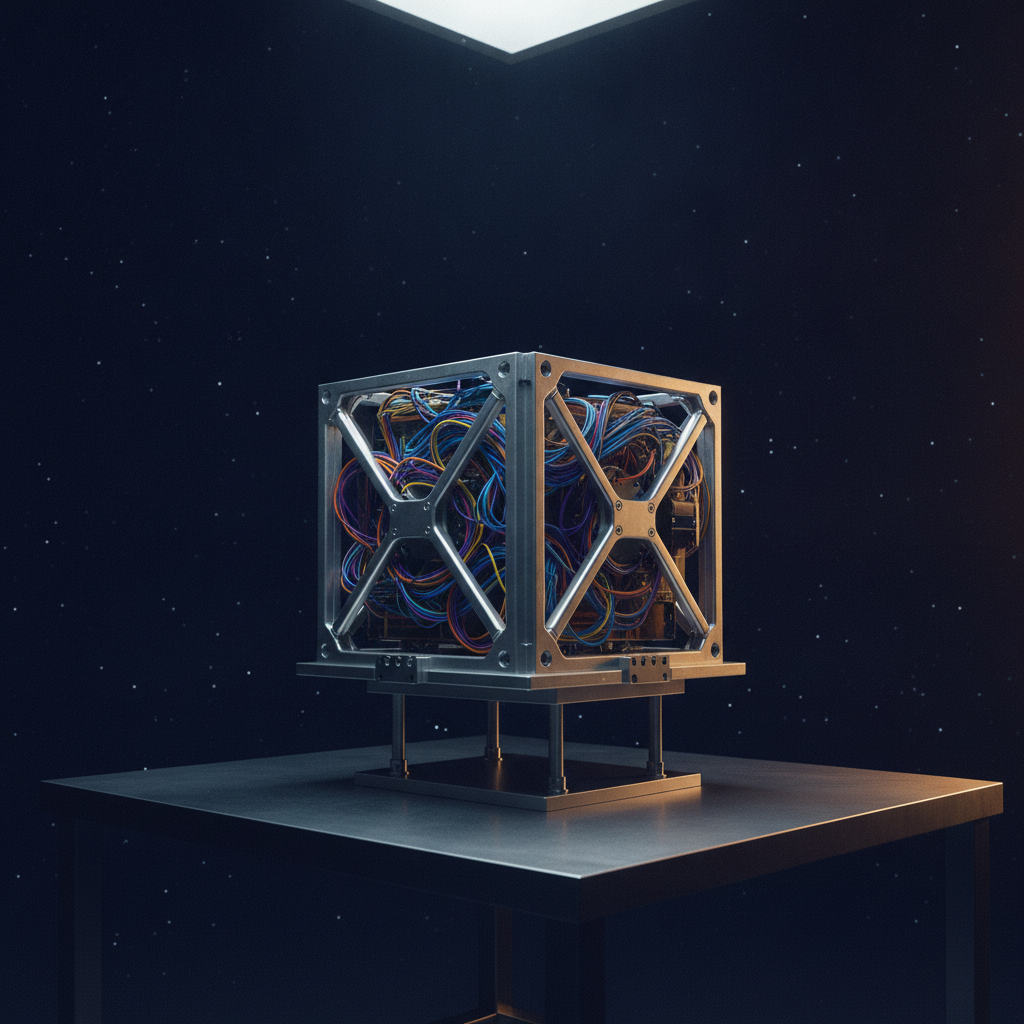
When the European thermal-imagery company constellr began working with Space Inventor on its next generation of satellites, some of the most important details of the spacecraft had yet to be finalized. [1] That is not unusual in the small satellite industry — but what happened next was. Instead of forcing constellr's evolving payload requirements to conform to a fixed bus, the Danish manufacturer adapted its BIG CAT 600 platform as those requirements changed. [1]
The Munich-based firm wanted its HiVE — High-precision Versatile Ecosphere — constellation to measure temperatures from space with the precision required for agricultural applications and urban planning. [1] But payload size, weight, and power specifications were still in flux. In traditional satellite development, that kind of uncertainty is expensive: lock in the bus design too early and the payload must conform to it; let the payload evolve and the bus may require a costly redesign from scratch. [1]
Space Inventor's answer is a philosophy of iteration built around configurable platforms. The BIG CAT 100, 300, and 600 platforms are each configurable rather than fixed — if a mission suddenly needs more power, improved pointing performance, or a new communications capability, engineers swap out bus modules rather than rebuild the spacecraft. [1] "The standardization is in the satellite modules, not in the bus," said Jan Smolders, the chief commercial officer at Space Inventor. [1]
That iterative logic is particularly valuable for mini-constellations, which typically range from a few satellites to a few dozen and target specific geographies or niche capabilities — a middle ground between bespoke one-offs and megaconstellations numbering in the hundreds or thousands. [1] As one batch of satellites is being built, Space Inventor is already applying lessons from that production run to the design of the next. [1] Operators get the kind of feedback loop that fixed-bus architectures structurally prevent.
The broader shift here is about who holds the design authority. For decades, the bus set the terms and payloads were shaped to fit. Flipping that relationship demands a manufacturer willing to absorb complexity — and one with enough vertical integration to move faster than the market.
Vertical integration is, in fact, Space Inventor's second strategic pillar. The company manufactures nearly all of its components — with the exception of propulsion — in house at its factory in Aalborg, Denmark. [1] The company also maintains a standing stock of components and offers next-day shipping on parts, reducing the risk that a single supplier delay stalls spacecraft production. [1]
The same configurable architecture that serves commercial operators underpins Space Inventor's defense offerings. [1] Lynx detects radio-frequency emissions, geolocates their source, and identifies activity that may warrant further investigation; Leopard can then be tasked to capture high-resolution optical or thermal imagery of the same area. [1] The pairing follows a tip-and-cue model: one sensor finds, the other looks. [1]
[1] There, Lynx satellites can identify anomalous RF emissions that may reveal dark vessels or help locate sources of GPS spoofing, then cue a Leopard satellite to collect additional intelligence. [1]
The pitch to defense customers is fundamentally the same as the pitch to commercial operators: persistent, reconfigurable coverage at a cost that large legacy platforms cannot match. Whether procurement culture on either side of that divide moves fast enough to meet the offer is a different question entirely.
Space Inventor's model will be tested not by what it can build but by how quickly operators — commercial and military alike — are willing to treat satellite architecture as a living document rather than a contract deliverable. If the mini-constellation market matures the way its proponents expect, the pressure to iterate will only increase. The bus that bends may be the one that survives.