The Sun's Hidden Whirlpools, Finally Seen
A 4-meter telescope in Hawaii caught plasma vortexes on the solar surface that physicists had predicted for decades but never confirmed.
By The space-quantum Desk
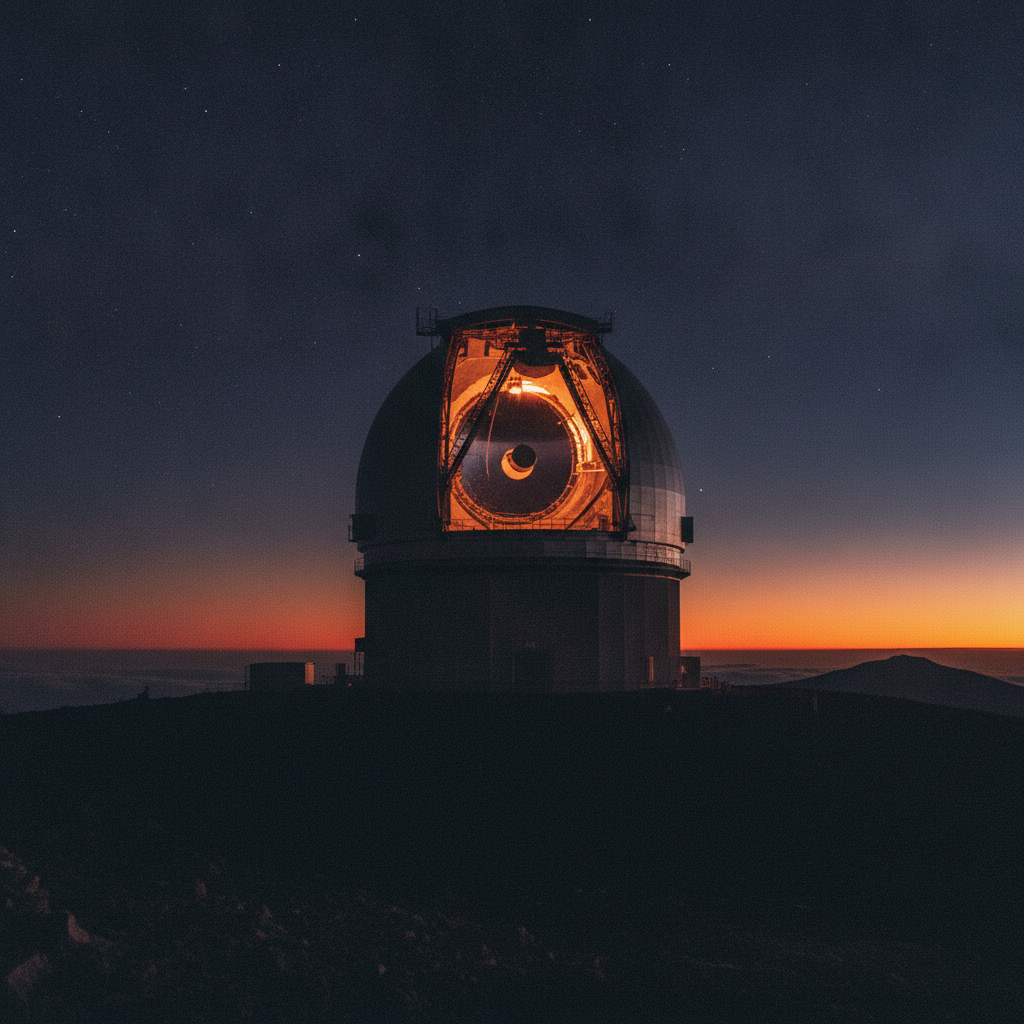
For decades, solar physicists suspected the same fluid instability that ripples water and shears clouds must also be churning plasma on the Sun's surface. Nobody could prove it—until the Daniel K. [1]
The phenomenon is the Kelvin-Helmholtz instability, physics worked out in the late 1860s: when two fluids slide past each other at different speeds, their shared boundary buckles, curls, and rolls into vortexes. [1] The structures stayed invisible because they are very small—their scale sits below what any telescope with a mirror smaller than 2 meters can resolve. [1]
At a wavelength of 416 nanometers, the Inouye telescope's camera read out 740 frames per second with exposures of 100 microseconds. Two thousand frames were combined via multi-frame blind deconvolution, yielding a spatial resolution of about 19 kilometers—right at the theoretical limit of a 4-meter mirror at that wavelength. [1] The vortexes measured between 25 and 170 kilometers in diameter, spaced 60 to 100 kilometers apart, and could double in size in under a minute. [1]
A team led by David Kuridze and Friedrich Wöger of the National Solar Observatory ran simulations of a patch of photosphere seeded with the actual observed magnetic field map. The synthetic images accurately reproduced the vortexes' appearance and dynamics, including growth rate, distribution, and propagation speeds—between 0.67 and 3 kilometers per second—which led the team to conclude their observations are most likely real. [1]
What makes this more than a resolution milestone is what the vortexes imply: a stirring mechanism at the edge of every magnetic element, where none was expected, potentially rewriting models of how energy and matter move through the solar atmosphere.
The next challenge is turning a byproduct into a baseline.