The Trainer Jet That Cannot Fly in the Rain
The T-7 Red Hawk was meant to reshape how the US Air Force trains its pilots. A new investigation reveals a program in serious trouble.
By The Defense Desk
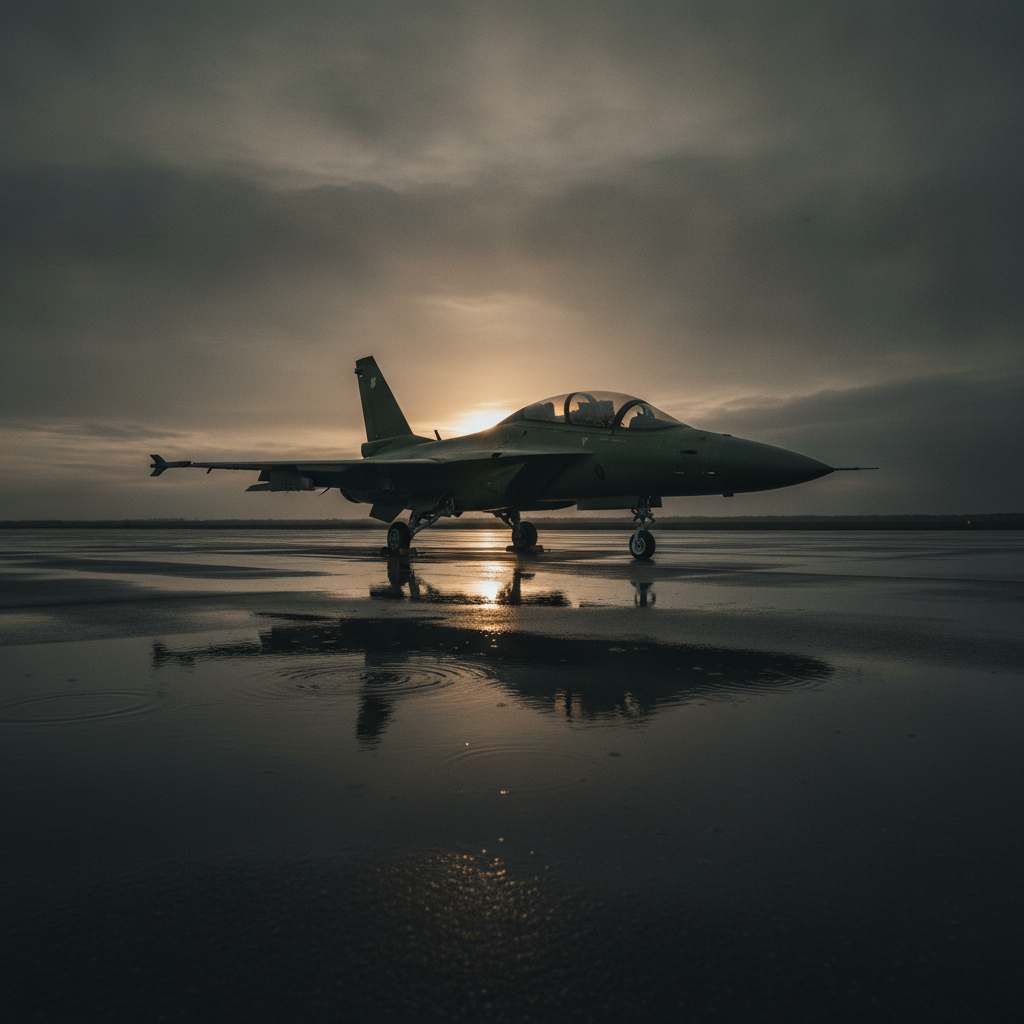
The Boeing T-7 Red Hawk was supposed to be a clean-sheet answer to one of the US Air Force's most pressing problems: how to train the next generation of fighter pilots on a jet modern enough to prepare them for what combat actually demands. Instead, a three-part investigation published by Breaking Defense this week reveals a program buckling under airworthiness concerns, data-rights disputes, and a sustainment outlook the Air Force itself has rated as "high risk." [1]
The headline finding is stark. The first 82 T-7 aircraft are projected to fly with a "serious" airworthiness risk — a designation that carries weight in a community where the margin between training and catastrophe is measured in seconds. [1]
Its scope is both granular and systemic — tracking how a key Pentagon acquisition program comes together, and where it threatens to fall apart. [1]
Part one maps the program's origins and the concerns sources hold about its current trajectory. Part two dissects the ongoing dispute between the Air Force and Boeing over data rights — specifically, Boeing's failure to provide certain data on the aircraft, which internal Air Force documents characterize as "non-compliance" on the part of the company. That designation matters: without adequate data, sustainment becomes guesswork, and guesswork in aviation maintenance has historically fatal consequences. [1]
Part three surfaces what may be the most operationally peculiar element of the saga: a previously unreported agreement in which Air Force and Boeing officials are mulling a plan to change how the government buys the T-7's engines — at an "additional" taxpayer cost of up to $1.5 billion — which could come in exchange for technical data Boeing would provide on the company's 747-8i jumbo jet. [1]
The logic of trading data on a commercial widebody for leverage on a military trainer is the kind of arrangement that makes procurement watchers reach for their highlighters. It speaks to a broader tension embedded in how the Pentagon and its major contractors negotiate: the technical knowledge that should flow as a matter of contract compliance instead becomes a bargaining chip, wielded across programs that have nothing else in common.
Beyond the financial mechanics, the operational picture raises questions that go directly to pilot welfare. Sources familiar with the program told Breaking Defense they are concerned that attempts to rush the T-7 to the fleet faster could increase risk for junior pilots — the very population the aircraft is designed to protect by giving them a training environment that mirrors the demands of front-line jets. [1]
The program has also struggled with its ground-based simulator, a tool that sits at the center of modern military aviation training precisely because it lets pilots rehearse dangerous scenarios without consequences. And in a detail that would seem almost satirical if it appeared in a novel, the T-7 currently cannot fly in the rain. [1]
A trainer that cannot reliably operate in adverse weather conditions is, by definition, a trainer that cannot fully prepare pilots for the conditions they will face. Weather does not pause for readiness timelines.
The Air Force's response to the investigation was carefully measured. Boeing's statement was similarly calibrated: the company said it is working with the Air Force on "accelerating the path to delivering this critical capability," and both the service and the contractor emphasized that pilot safety was, as Boeing put it, "paramount." [1]
Statements of this kind — competent, measured, carefully non-committal — are the standard language of programs under pressure. They signal awareness without conceding urgency. They acknowledge the diagnosis while deferring on the prognosis. What they rarely do is answer the question the documents have already raised.
What the documents do raise, taken together, is a picture of a program caught between competing institutional pressures: a service that needs a new trainer and needs it soon, a contractor navigating its own data-rights calculus, and a procurement structure that has historically rewarded speed over scrutiny. The T-7 is not an outlier in this regard — it is an illustration of how large defense acquisitions tend to accumulate risk at the intersection of schedule pressure, contractual ambiguity, and the administrative distance between program office and flight line. [1]
The Breaking Defense series is notable not only for what it reveals about the T-7 specifically, but for the methodology it demonstrates: using unreported internal documents alongside on-record and background interviews to reconstruct the decision-making architecture of a live acquisition program. That kind of accountability journalism is rare in defense coverage, where classification, contractor sensitivities, and the complexity of the subject matter tend to limit public visibility into programs that will cost taxpayers billions and shape military readiness for decades. [1]
The gap between what a program promises and what it delivers is often only visible in retrospect, years after the contracts are signed and the press releases are forgotten. Investigations like this one are one of the few mechanisms that bring that gap into view while there is still time to act on what it shows.
The Air Force intends to use the T-7 Red Hawk to school the next generation of pilots. Whether that generation will fly aircraft rated fit for purpose — in all weather, with adequate data, on a sustainment footing the service can actually afford — remains, for now, an open question that a "horse trade" and a management regime are being asked to answer. [1]