The Truck Maker That Wants to Build Drones
Oshkosh Defense is partnering with Grid Aero to mass-produce military drones—by treating them like trucks.
By The Defense Desk
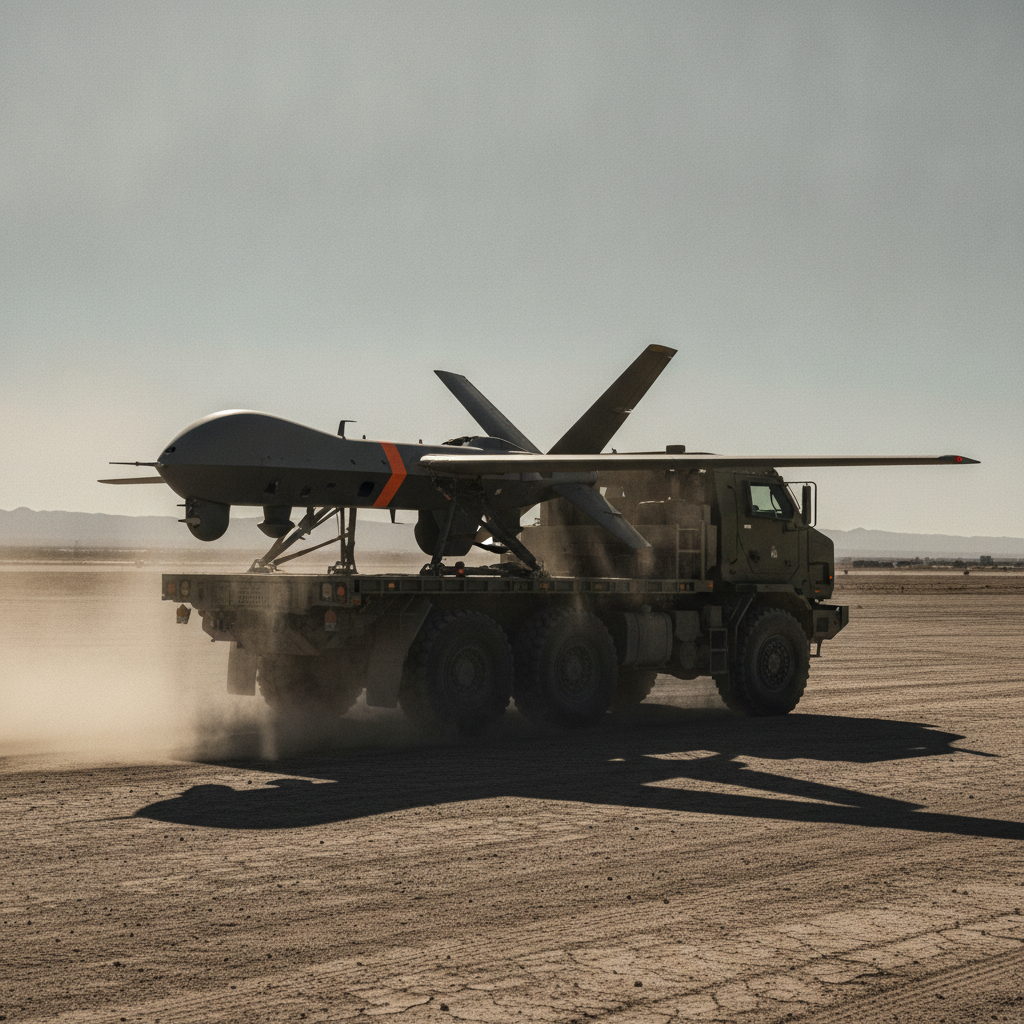
Oshkosh Defense has spent decades building some of the U.S. military's most recognizable heavy vehicles—the hulking transport trucks, fuel tankers, and logistics platforms that keep armies moving. Now the Wisconsin company is pointing its production lines skyward. In a partnership announced Monday, Oshkosh and Silicon Valley startup Grid Aero said they plan to manufacture thousands of large military drones for the Defense Department and commercial customers. [1]
It falls into the Group 4 or Group 5 category of unmanned aerial systems—classifications that cover aircraft weighing more than 1,320 pounds. [1] That puts the Lifter in the same weight class as light manned aircraft, well above the hobbyist quadcopters and tactical surveillance drones that have dominated news coverage of unmanned systems.
The partnership grew out of the Defense Department's Arsenal of Freedom campaign, which aims to expand the domestic industrial base. [1] Grid Aero needed a partner to help scale production, while Oshkosh was looking to manufacture something with long-term potential. The match, according to Oshkosh chief growth officer Logan Jones, was straightforward: "We looked where both the market was growing, and where the technology class would benefit from scale," he said. [1]
The logic is elegant, and slightly counterintuitive. Defense aviation has long been the province of aerospace specialists who treat manufacturing complexity as a feature—proof of technical sophistication. Oshkosh is betting the opposite: that the next generation of military aircraft needs to be built like vehicles, not like jets.
That bet rests on a deliberate material choice. The Lifter uses metal construction rather than composite materials—a decision that aligns directly with Oshkosh's existing fabrication capabilities. S. states and seven countries generating $10.4 billion annually, Oshkosh already operates at the kind of industrial scale that startup drone companies can only dream of. [2]
Grid Aero co-founder and CEO Arthur Dubois said the fit goes deeper than materials. "They build vehicles by the thousands, and that is the rate we need. Their lines are also built for variety. A single Oshkosh line can build many variants of a vehicle, each set up for a different mission, without slowing down. Lifter works the same way," Dubois said in an email to Defense News. [1] For Dubois, the Lifter's design philosophy makes this possible: the aircraft "borrows as much from military trucks as from traditional aircraft." [1]
That framing matters more than it might first appear. Aviation manufacturing has historically demanded bespoke tooling, specialized supply chains, and production cadences measured in months or years. Vehicle manufacturing operates on a different clock entirely—one calibrated to throughput, variant management, and surge capacity. If the Lifter can genuinely be produced like a truck, the implications for military logistics and battlefield attrition calculus are significant.
Oshkosh's corporate data suggests the surge capacity claim is not just marketing. [2] Its commercial operations—90% of the enterprise is driven by commercial volume, sustaining R&D, supplier relationships and technologies that directly benefit defense programs. [2] With 1,900+ engineers, including 400+ focused on advanced technologies such as autonomy, software, and electrification, the company maintains R&D investment independent of contract cycles. [2]
Jones was candid about the cultural leap involved. "We do things that like gravity and stay on the ground," he said, describing Oshkosh's typical product portfolio. [1] The partnership required Oshkosh to engage not just as a contract manufacturer but as a co-designer: the company is helping Grid Aero reconfigure the Lifter "to ensure that manufacturability is at the heart of their design and strategy from day one, not an afterthought." [1] Although Oshkosh is technically a subcontractor, both companies prefer the term partnership to reflect that depth of involvement.
Grid Aero was founded in 2024, which means it is navigating the leap from early-stage startup to defense supplier at considerable speed. [1] The initial plan calls for Grid Aero to conduct low-rate production while Oshkosh establishes a pilot production line. Volume will scale in stages. "As customer demand grows, we will move production to Oshkosh in stages and keep pace with what the customer needs," Jones said. [1]
Staged ramp-ups are a familiar hedge in defense procurement—a way to manage technical risk before committing to full industrial mobilization. But the ambition behind the partnership is clearly larger. Both companies are positioning the Lifter not as a niche capability but as a platform meant to operate at the same scale as the vehicles Oshkosh already sends to armies around the world.
The strategic rationale Jones articulates goes beyond any single contract. "As [the Defense Department] plans for future conflicts, the ability to field and replace aircraft at scale is one of the most important advantages it can build," he said. [1] That statement reflects a shift in how military planners are thinking about drone attrition—not as a problem to minimize through expensive platform protection, but as a variable to manage through production velocity. A drone fleet is only as durable as its replenishment pipeline.
Oshkosh's existing infrastructure gives it a credible claim to that pipeline role. The company's Pratt Miller motorsports-grade integration capability moves from identified need to first article in weeks, not years. [2] Its workforce includes 11,750 production team members, including 2,000+ welders and fabricators, strengthened by teammates with firsthand military experience, which shapes how the company interprets operational requirements rather than just engineering specifications. [2] Those attributes are harder to replicate than any single piece of manufacturing equipment.
What the Oshkosh–Grid Aero deal ultimately represents is a thesis about what industrial advantage looks like in modern conflict. Not the most sophisticated aircraft, but the most producible one. Not the aerospace supply chain, but the automotive one. The drone wars of the near future may be won not in the design lab, but on the factory floor.
For Oshkosh, adding drones to a portfolio of trucks, tankers, and tactical platforms is a logical extension of its core proposition: manufacturable defense hardware, delivered at scale, ready to surge when demand arrives. [2] For Grid Aero, landing a partner with 18,500 team members and $10.4 billion in annual revenue is a different kind of validation than any venture round could provide. [2] Whether the Lifter becomes as ubiquitous on the battlefield as Oshkosh's trucks remain to be seen—but the production infrastructure to attempt it is now in place.