The UAE's Shadow Airline
How Abu Dhabi quietly chartered sanctioned Russian cargo jets for over 100 missions across Africa — while telling the West a different story.
By The Defense Desk
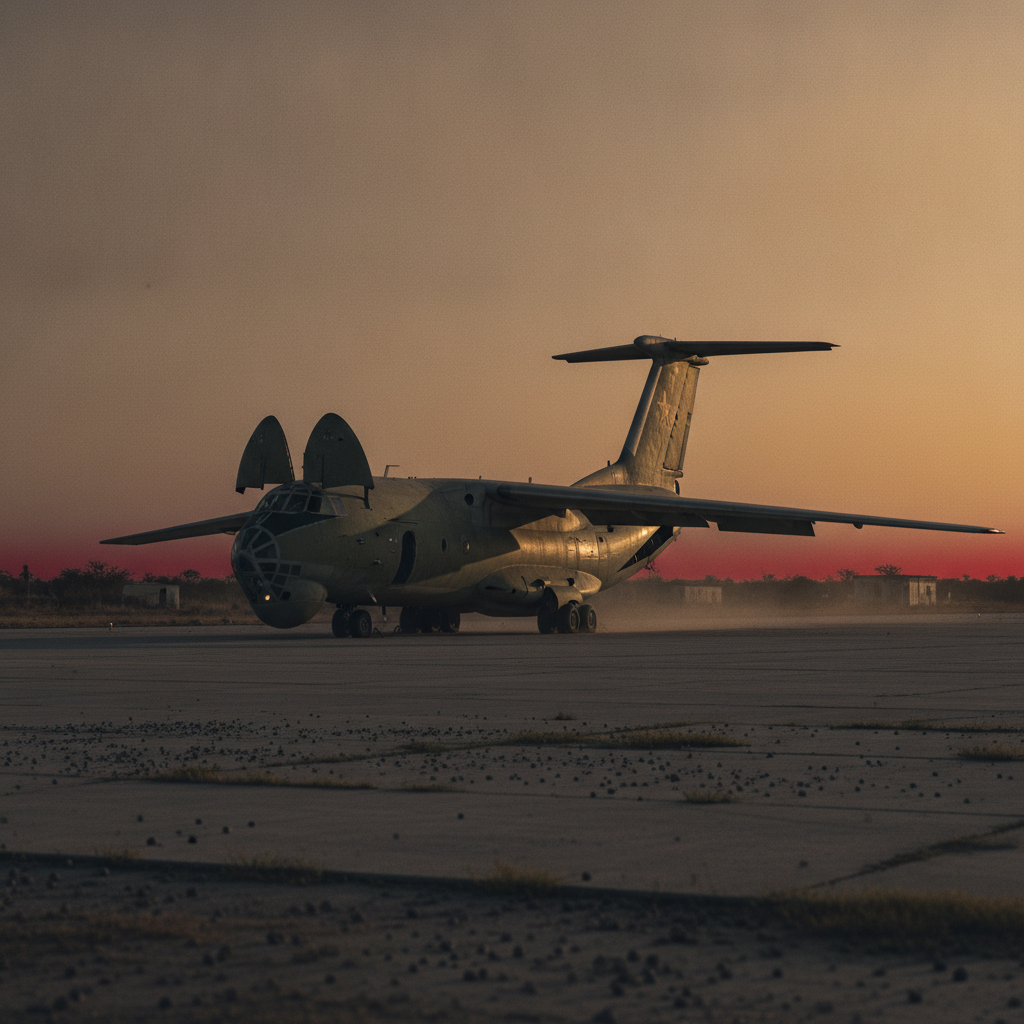
Somewhere over the Gulf of Aden, a Soviet-era freighter goes dark. Its ADS-B transponder cuts out. The plane vanishes from tracking screens. Minutes or hours later, the same aircraft reappears at the same coordinates, now heading back north toward the UAE. This is not a glitch. [1]
All three are explicitly listed by the U.S. Office of Foreign Assets Control as directly blocked property. [1]
Each flight was manually reviewed. [1]
What emerges is less a smoking gun than a slowly developing photograph — one that the principals clearly preferred to keep in the darkroom. The picture it reveals sits at the intersection of Gulf statecraft, African proxy conflict, and a sanctions architecture that is straining under its own contradictions.
The UAE's relationship with Russia is not a secret. While most Western countries have cut trade with Russia and its state-affiliated entities to a minimum, and the European Union has banned all Russian aircraft from its airspace, the UAE government maintains friendly commercial and diplomatic relations. Leaked Aviacon Zitotrans air waybills examined by Defense News routinely showed the procurement of Western goods, including sanctioned electronics, through the Gulf monarchy. Previous reporting by Reuters has also identified Dubai's gold markets as a crucial lifeline for Russia, given its exclusion from global payment systems such as SWIFT. [1]
What is less expected — and more damaging to Abu Dhabi's carefully managed Western partnerships — is that the UAE appears to have taken the next step: not merely tolerating sanctioned Russian operators in its territory, but actively chartering them. Several flights in the Defense News dataset operated out of UAE military bases rather than civilian airports, which the investigation notes implies a government connection. [1]
A recurring destination on the missions where full track data was available was Ethiopia — particularly Harar Meda Air Base, the Ethiopian military's main air force facility, and Addis Ababa International Airport. The Ethiopian embassies in Washington and Berlin did not return a request for comment. [1]
Margaux Garcia, senior analyst with C4ADS, a U.S.-based nonprofit organization specializing in analyzing illicit networks, reviewed the Defense News findings. "If you notice that all of these planes that are run by the same airline all drop off of coverage, then that's a notable pattern — especially if it happens that most other airplanes are able to travel through that area without dropping coverage," she said. "So it's not a signal issue. It's not a coverage issue. That suggests perhaps they are intentionally turning off their transponders; they're hiding their activity." [1]
The UAE and Russia share one peculiar feature of the Sudanese civil war: both are deeply involved, but on opposite sides. Abu Dhabi backs the Rapid Support Forces; Moscow has thrown its support behind the Sudanese Armed Forces and the government in Khartoum. The consequence is arguably the most perverse detail in the entire investigation — the same Aviacon Zitotrans aircraft may have been supplying opposing sides of the brutal civil war, sometimes flying from Russia and Turkey into Port Sudan, the SAF's main supply point, and sometimes operating on UAE missions likely supporting the RSF through the African hinterland. [1]
There is a particular kind of institutional dissonance in watching the same cargo hold service two warring factions in the same conflict. It speaks to an era in which allegiances are transactional, sanctions are a speed bump rather than a wall, and the geography of proxy war has become baroque in its complexity.
Aviacon Zitotrans is not a company that operates in obscurity by accident. It lists "government and military airlifts" as one of its areas of operations and advertises the Il-76's capacity to operate from short and unpaved runways. Its own website notes that the cabin and rear ramp "provides smooth loading/unloading for many kinds of rolling stock, such as armored personnel carriers (APCs), utility trucks, trailers etc." Leaked internal documents show the airline has delivered combat helicopters to Southeast Asia, armored personnel vehicles to Turkey, and received a special exemption from the Russian government to fly missiles and their warheads. [1]
"Aviacon Zitotrans specializes in using Il-76 aircraft, which are very helpful, very sturdy aircraft for transporting cargo and transporting people," Garcia told Defense News. "They were originally built to be military transport aircraft, so it makes sense that they're being used for that purpose." [1]
The African operations connect to a longer history. Sub-Saharan Africa was the main theatre of operations for the Wagner Group, which has been rebranded as Africa Corps following the death of its leader, Yevgeny Prigozhin. Aviacon Zitotrans previously attracted U.S. government attention and sanctions for its role in sustaining Moscow's mercenaries in Africa — the very network now operating in parallel with UAE logistics on the same continent. [1]
Then there is Pakistan. Defense News identified a separate set of flights by Aviacon Zitotrans aircraft from the UAE to a private airstrip in eastern Pakistan known as Chandana Airstrip or Al Habieb Airport — a facility that does not appear in online ICAO/IATA code databases or Pakistan's Civil Aviation Authority lists. International reporting has identified it as a gateway to the Gulf royal family's falconry hunting grounds in Pakistan. [1]
The airstrip's purpose is not a subject of much official controversy. According to sources who spoke to The Current, UAE President Sheikh Mohamed bin Zayed Al Nahyan and Vice President Sheikh Mansour bin Zayed arrived at the Chandna Airstrip in Bahawalpur, then departed for their palace in southern Punjab's Cholistan via two special helicopters for a one-week stay of falconry and hunting. Sources added that the royals often privately visited the country from November to February to hunt Asian Houbara bustards — an endangered migratory bird that once was common in the Arabian Peninsula and whose hunting is illegal in Pakistan due to its declining numbers. The Pakistani government issues yearly hunting permits for Middle Eastern dignitaries on the basis that foreign hunters bring investment to underdeveloped areas. [2]
The Chandana flights represent the more quotidian end of the Aviacon Zitotrans operation — logistics for royal hunting excursions rather than weapons runs into African conflict zones. But they sit within the same architecture: a sanctioned Russian airline, planes designated as blocked property by OFAC, flying missions for a government that told Western partners nothing was amiss. Defense News reached out to the UAE embassies in Vienna and Washington, the Abu Dhabi Media Office, and the UAE's foreign ministry. None responded. [1]
Garcia's conclusion, as reported by Defense News, is pointed: "If this is the case that Aviacon is also running missions for the UAE alongside illicit missions for Russia, then it is significant because it shows that the UAE does not see the sanctions against Aviacon as a sufficient deterrent to stop working with them." [1]
Sanctions work best when they impose a cost that outweighs the benefit of noncompliance. When a government with significant Western security relationships decides that cost is acceptable, it reveals something structural — not about one airline, or one set of flights, but about the architecture of financial pressure itself.
Defense News notes that the Aviacon Zitotrans investigation is the second in a multi-part series. Beyond these aircraft, the UAE operates a fleet of cargo planes through front companies and ostensibly civilian charter operators on similar missions. The next installment will examine that broader network. [1]
For now, the Il-76s keep flying — heavy, loud, built for Soviet airfields that no longer exist, dropping off radar somewhere above the Gulf of Aden, reappearing as if nothing happened. [1]