TITAN Goes to Production
The Army hands Palantir and Anduril $192 million to field a mobile battlefield intelligence node. The sensor-to-shooter timeline will never look the same.
By The Defense Desk
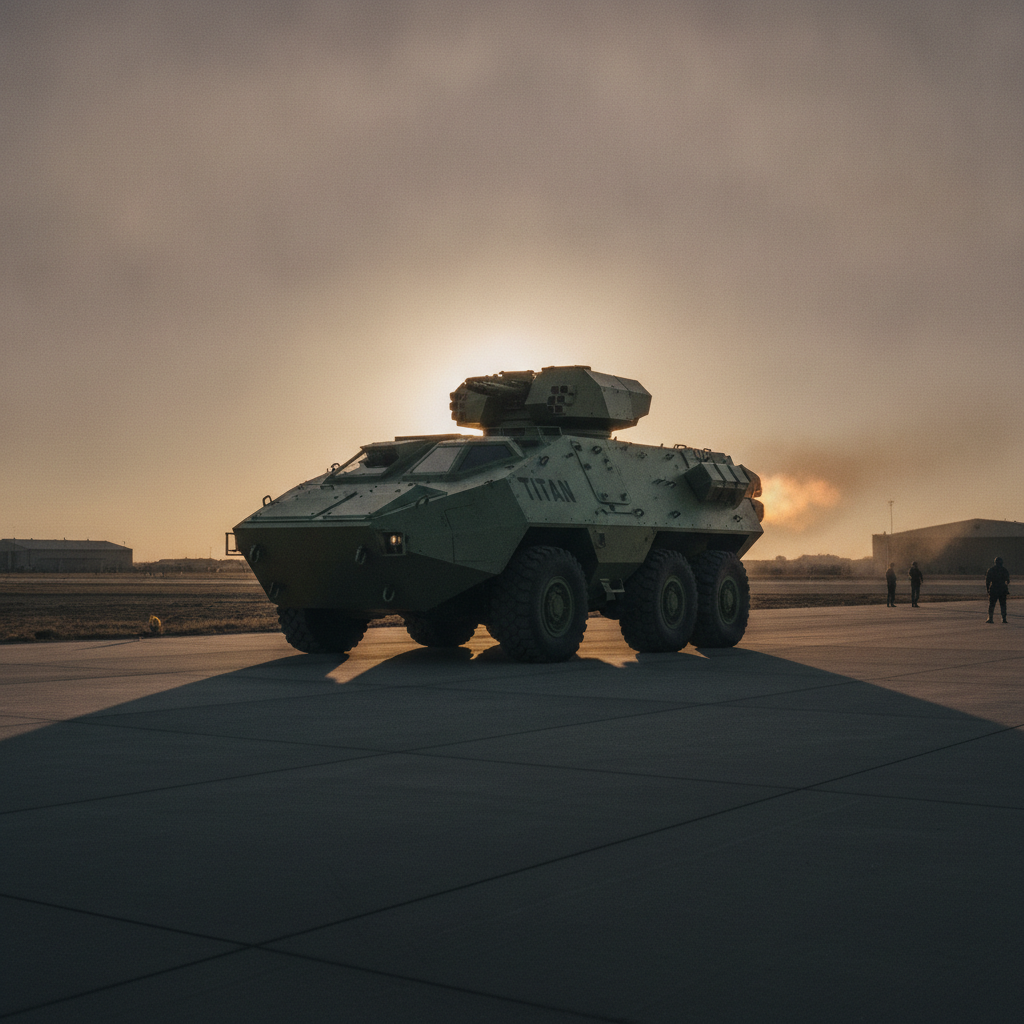
The U.S. Army awarded $192 million in production contracts to Palantir and Anduril on Tuesday, moving the Tactical Intelligence Targeting Access Node — TITAN — from years of field experimentation into the hands of soldiers. [1] Eight systems, comprising four advanced and four basic variants, will be delivered within 18 months. [1] The program is the Army's most ambitious attempt to collapse the gap between raw sensor data and a targeting decision.
Palantir, which became TITAN's prime contractor in 2024, received the larger share: $127 million to lead overall production. [1] L3Harris Technologies, Sierra Nevada, Strategic Technology Consulting, and World Wide Technology will provide additional, as-yet-unspecified capabilities. [1]
The split is instructive. Software intelligence and physical durability are treated here as co-equal problems — neither subordinate to the other. That pairing reflects a broader shift in how the defense procurement world thinks about fielding technology at the edge.
TITAN is the Army's next-generation ground system designed to collect and disseminate intelligence by synthesizing data from joint and national assets based both on Earth and in space. [1] The program has been in development for several years, with pre-prototypes deployed to the Pacific and Europe in 2022.
Not all the lessons were comfortable. [1] Col. Jonathan Lipscomb, the Army's project manager for intelligence systems and analytics, said at a demonstration at Aberdeen Proving Ground in Maryland on Aug. 27 that service leaders believe they resolved the climate concerns through more rigorous environmental engineering. [1]
Humidity sounds like a footnote. It is not. Tactical hardware that fails in tropical air fails the soldiers who need it most. The discipline of designing for actual operating conditions — not theoretical ones — is what separates a prototype from a fielded system.
"This effort is the result of Soldier feedback we have received over the past four years of prototyping from units utilizing TITAN prototypes in multiple configurations across diverse operating environments," Lipscomb said in the Army's release. [1] "TITAN is a key solution that enhances the speed of target recognition and geolocation from multiple sensors. It drastically reduces sensor-to-shooter timelines through automated target nominations while fusing the common intelligence picture." [1]
The eight systems being procured come in two configurations. [1] The advanced variant will be a corps-level, military intelligence brigade theater-level and multi-domain command asset mounted on the Family of Medium Tactical Vehicles. [1] Units will only be allocated two basic and one advanced, meaning they must be highly protected from being targeted on the battlefield. [1]
Lipscomb framed that capability in pointed terms. "If you're in that [Denied, Degraded, Intermittent, and Limited] environment and you don't have access to the cloud, you don't have access to the pristine, I'll call it 'intelligence community data sources,' then you can pull in local sensor data direct," he said. [1] "So you can maneuver on the battlefield to place yourself in position to be within range of those sensors, to be able to receive that data, process it, and then continue to target, dominate, and then also enhance the situational understanding." [1]
The denied-environment clause is the telling detail. Every battlefield intelligence system works when connectivity is good. TITAN is being built for the moment when connectivity collapses — the scenario every serious military planner treats as the base case, not the edge case.
Beyond the production contract, the Army will continue prototyping and integration work onto the JLTV and the ISV-U, according to Maj. Dell Barnes, assistant program manager for TITAN. [1] That ongoing development track suggests the program is not treating production as a destination — the architecture is meant to absorb new capabilities as sensors, software, and space-based assets evolve.
There is a governance model embedded in that decision. Separating procurement from experimentation allows the fielded system to improve without waiting for the next contract cycle. Speed of iteration, not scale of initial order, becomes the metric that matters.
Anduril's role in the program is worth examining beyond the dollar figure. The company's mandate — ruggedized, vehicle-mounted systems and integration of power and operator subsystems — covers the physical layer that determines whether any software running above it can function in the field. [1] Palantir's data fusion and targeting logic depends on Anduril delivering systems built to perform in the demanding environments the Army operates. [1]
Palantir's elevation to prime contractor in 2024 after the prototyping phase positioned the company as the integrating authority across a group that also includes L3Harris Technologies, Sierra Nevada, Strategic Technology Consulting, and World Wide Technology. [1] The structure mirrors how commercial technology primes manage complex supply chains — one company owns the software architecture and system integration; specialist vendors own discrete subsystems. The difference is that the end customer operates in environments where failure is measured in lives, not downtime.
Eight systems. Eighteen months. Two variants calibrated to different layers of command. TITAN is not a concept paper or a demonstration — it is a production program with delivery dates, and soldiers who provided four years of feedback across diverse operating environments, including the Pacific and Europe, telling the Army what does and does not survive contact with the real world. [1] The sensor-to-shooter timeline has been the Army's primary friction point in multi-domain operations. TITAN is the Army's answer, and the clock is now running.
TITAN is a key solution that enhances the speed of target recognition and geolocation from multiple sensors. It drastically reduces sensor-to-shooter timelines through automated target nominations while fusing the common intelligence picture.Col. Jonathan Lipscomb