Troublemaker Takes Flight From North Dakota
An 88-year-old navigation test firm debuts a swarm-capable, recoverable attack drone with a Navy sponsor and eyes on affordable mass.
By The Defense Desk
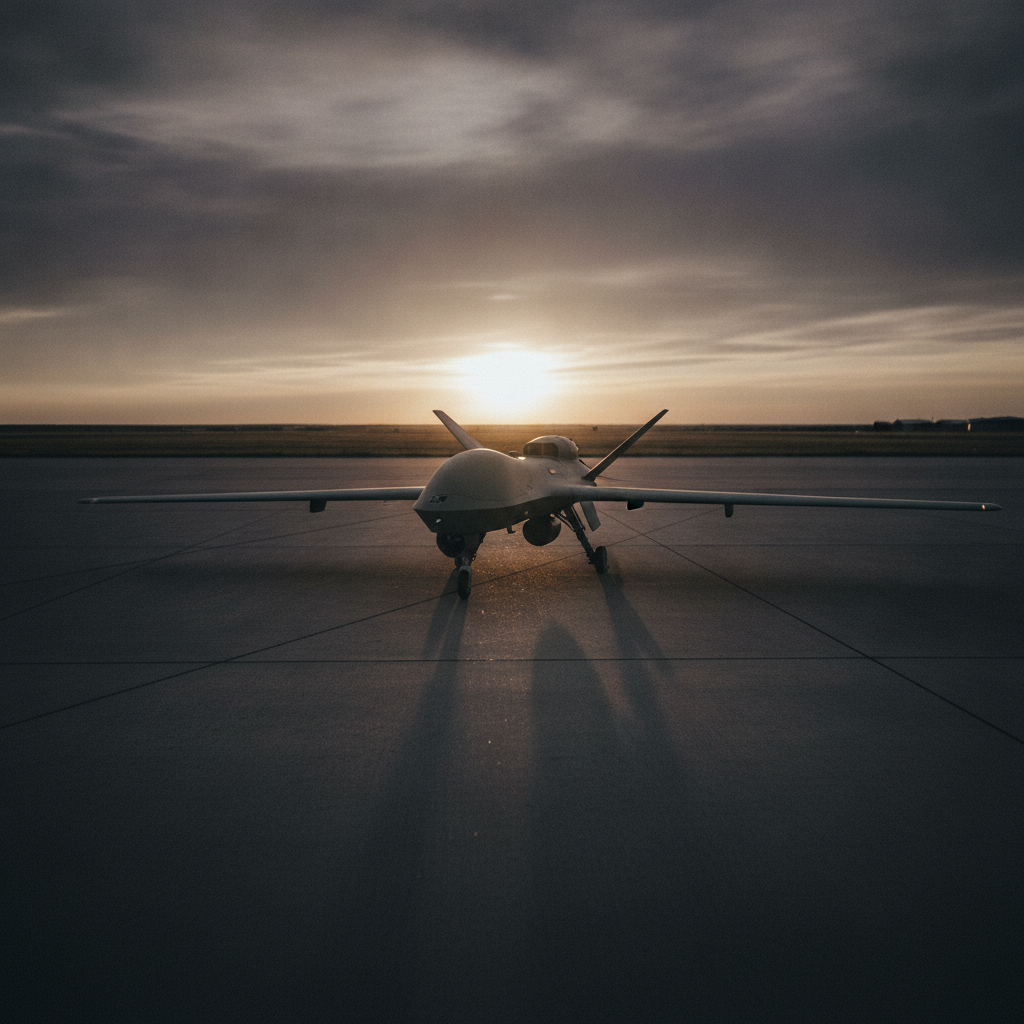
Ideal Aerosmith has spent most of its decades-long life building precision test equipment for inertial navigation systems — the kind of hardware that sits in labs, not on battlefields. That calculus changed about three years ago. This month, the North Dakota firm publicly unveiled Troublemaker, a one-way attack drone it developed in-house and is already producing for a Department of the Navy sponsor. [1]
Troublemaker is a Group 3 system with a 15-foot wingspan. It can launch from a catapult or truck, fly in swarms, cover more than 750 nautical miles (863 miles), stay airborne for over 10 hours, and carry a 30-pound payload for missions ranging from attack to reconnaissance. [1] Unlike a cruise missile, it can also come home: recovery is via skid landing, leaving the door open for post-flight reuse. [1]
The company has built 26 Troublemakers so far and is currently manufacturing at two units per week. David Markert, Ideal Aerosmith's senior vice president and general manager of government systems, says the firm could scale to 20 per week within its existing infrastructure if demand warrants. [1]
The timing is not accidental. Defense procurement appetites have been shifting away from bespoke, high-cost platforms toward affordable, attritable systems that can be fielded at scale — and smaller firms with precision manufacturing backgrounds are finding the gap between test equipment and weapons is narrower than it once appeared.
Markert is direct about the market logic. "We felt that was a sweet spot in the market," he told Breaking Defense. "And as the market turned away from exquisite systems to low-cost, affordable mass, it seemed like the ideal time to go after that." [1] The firm's background in flight motion simulation, centrifuges, and rate table systems — used for inertial testing across a wide range of operational environments and applications — gave it a manufacturing foundation it could redirect toward drone production. [1][2]
Ideal Aerosmith is positioning Troublemaker against the crowded low-cost cruise missile segment rather than within it. The distinction Markert draws is operational flexibility: "drones give you post-flight options that missiles don't give you." [1] A recoverable airframe that needs no specialized launch aircraft or palletized infrastructure occupies a different logistics footprint than a single-use missile — a meaningful consideration for distributed maritime operations.
Recoverable, truck-launched, swarm-capable: the specification sheet reads like a checklist assembled directly from the lessons of recent conflicts, where attrition rates and supply chain fragility have reshaped what militaries actually want from unmanned systems.
Troublemaker is not the company's only defense ambition. Markert confirmed that Ideal is working on additional systems with greater range and payload capacity, though details remain sparse. [1] The more pressing obstacle right now is bureaucratic: a continuing resolution that began October 1 freezes new-start programs and holds funding at prior-year levels. Ideal has submitted bids for relevant solicitations but, as Markert put it, "clearly, the CR has impact." [1]
Founded in 1938, Ideal Aerosmith has navigated multiple reinventions — from aircraft instrument test equipment to motion simulation services to, now, attack drones. Its Inertial Test Laboratory still offers testing-as-a-service for manufacturers needing motion simulation without the cost of ownership. [2] The defense pivot does not erase that legacy; it tries to cash in on it.
Whether Troublemaker finds its market depends partly on congressional budget politics and partly on whether the Navy's interest translates into a real program of record. For now, a firm that spent decades testing the navigation systems inside other people's weapons is betting it can build the weapon itself — two units a week, truck-launched, skid-landed, and ready to fly again. [1]