Two Tanks Walk Into Fort Hood
The Army's XM30 Bradley replacement is in soldiers' hands. Wolf and Lynx are bigger, smarter, and cooler — literally.
By The Defense Desk
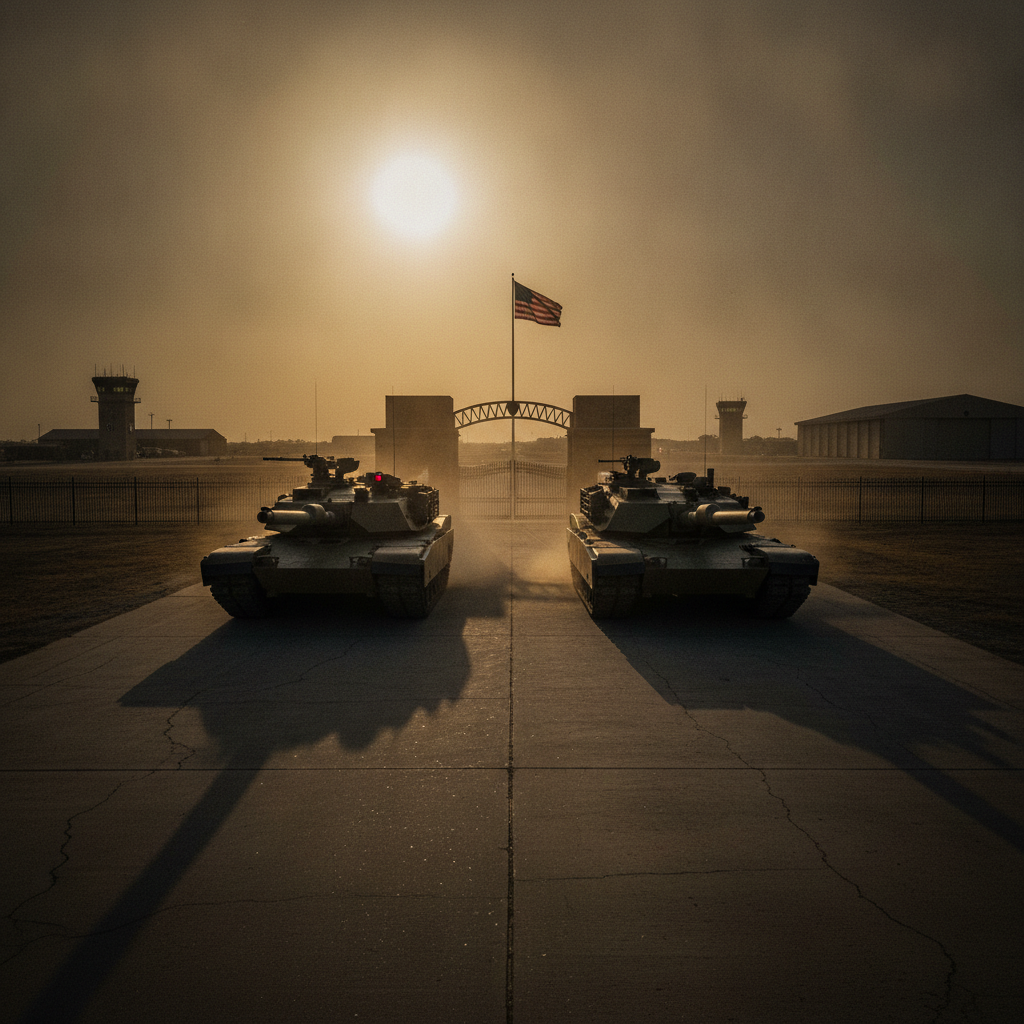
A few hundred miles south at Fort Hood, Texas, three Wolf prototypes are undergoing safety checks before being put in soldiers' hands for evaluation, while passengers at a late September Aberdeen demonstration praised the rival Lynx's air conditioning. The U.S. Army's XM30 Mechanized Infantry Combat Vehicle competition is no longer a PowerPoint exercise — it is steel on concrete, and the two companies building these machines are competing for what may be the most consequential armored vehicle contract of the decade. [1]
General Dynamics Land Systems and American Rheinmetall each delivered their first XM30 prototypes to Aberdeen Proving Ground in late August, along with an additional hull and turret each for ballistics testing. [1] The Army has been gaining hands-on experience with both machines ever since. American Rheinmetall, a U.S. subsidiary of Germany's Rheinmetall, is competing with a version of the extended Lynx family. [1]
According to both competitors, each will deliver seven prototypes to the Army's 1st Brigade Combat Team, 1st Cavalry Division at Fort Hood, Texas, where soldier touchpoints and field evaluations are expected to wrap up in the February–March 2027 timeframe. A previously planned rotation to the National Training Center at Fort Irwin, California is no longer on the schedule. [1] Three of GDLS's Wolf prototypes are already at Fort Hood undergoing safety checks, according to Geoffrey Norman, GDLS's director for U.S. Strategy and Growth. American Rheinmetall has delivered one Lynx prototype to Fort Hood; another sits at the Army's Joint Forces Training Center at Camp Shelby, Mississippi, where the company is conducting its own internal testing. The remaining Lynx vehicles are being assembled in Slidell, Louisiana. [1]
What is being evaluated at these facilities goes well beyond armor plate and cannon caliber. The Army is asking a harder question: what does an armored fighting vehicle need to be in a war where drones hunt tanks from above, electronics can be fried by directed energy, and a three-soldier crew is now considered one soldier too many?
Both prototypes carry the XM913 50mm automatic cannon as their main weapon — a meaningful step up from the 25mm M242 on the Bradley. Both tip the scales at combat weights in the 50-ton region, heavier than the 40-ton Bradley. [1] Wolf has already put its 50mm cannon into action on the live-fire range at Aberdeen, and Norman reports GDLS is getting "good feedback" on both the weapon and the vehicle's automotive performance. He adds that Wolf's 32-speed SAPA transmission and composite rubber track have drawn favorable comparisons to the Bradley's ride quality. [2]
American Rheinmetall's Lynx drew praise of a different kind at a late September demonstration for congressional staffers and Army VIPs at Aberdeen. Passengers highlighted the two-man crew station layout, the roominess of the six-man squad compartment, and the air conditioning system. [1] Jim Schirmer, the company's senior vice president of programs, put the AC in context. He reflected on the value of greater environmental comfort for squad members who sweltered inside the Bradleys used in Iraq, recalling that, "When it was 125 degrees outside in Iraq with additional solar loading, inside the Bradley the temperature got to 138 degrees. It actually felt refreshing to step out into the Iraqi air." [1]
The crew architecture of both vehicles marks a deliberate break from the Bradley. Where that platform requires a three-man crew, Wolf and Lynx each operate with two. Left and right crew positions are identical, so either crew member can drive or fire. [1] "Because we have a reduced crew from the Bradley there has to be greater efficiency in how those soldiers execute their tasks," Norman says. "The software and menu logic are very intuitive." [1] Lynx crews work with three configurable displays and a large center screen showing a common operating picture with feeds from aerial drones. "You can shoot the gun from the left or right, you can drive the vehicle from the left or right," Schirmer confirms. [1]
Both companies are reaching for AI to close the gap left by that missing third crewman. [1] GDLS has drawn lessons from soldier touchpoints with early prototypes of the M1E3 Abrams tank (for which it is the prime contractor), which Norman says shares its graphical user interface with Wolf. American Rheinmetall has developed its own AI assistant for Lynx crews. Schirmer characterizes it as a "third crewman" helping two soldiers do the work of a trio. [1]
Both Wolf and Lynx feature hybrid-electric drivetrains with silent-watch capability, which can temporarily suppress thermal signatures. Each vehicle routes its exhaust from the rear rather than the front, eliminating the heat plume that made the Bradley detectable at the right-front quarter. [1] The hybrid architecture also creates a surplus of exportable power. Wolf produces more electricity than it currently needs, and its internal distribution system delivers charging capacity to each squad member in the rear compartment — with cyber-hardened charge ports designed to prevent plug-in exploits. [1] Norman is explicit about where the Army's priorities lie: "We're not seeing XM30s in use-cases where they're used to power command posts or other things. The emphasis from the Army has really been about having margin on the vehicle for future requirements — directed energy, counter-UAS systems or fill-in-the-blank." [1]
That fill-in-the-blank language keeps surfacing around counter-drone capability. A September report from the Congressional Research Service flagged a potential oversight issue, questioning whether the XM30 would have an organic counter-UAS capability — a conspicuous gap given what aerial drones have done to armored vehicles in Ukraine. [1] GDLS's Norman calls counter-UAS "fundamental" to armored vehicle viability and says GDLS is working with expert partners in the space. Schirmer says Lynx already has some counter-UAS capability, though he declined to disclose specifics. [1] Both vehicles can launch loitering munitions: Wolf will carry Aerovironment's Switchblade 300, while Lynx will carry a version of Raytheon's Coyote Block 3. [1]
Wolf can also act as a controller for unmanned ground vehicles, with an in-house interface demonstrated to the Army more than a year ago. Its open software architecture allows a different control suite to be swapped in if the Army chooses. [1] American Rheinmetall has not yet attempted UGV control but Schirmer says the architecture is close enough that it would require primarily a software modification. The Lynx can also be remotely operated via tablet by dismounted crew who can use the same device to view the vehicle's camera feeds or pull up maps for mission planning. [1] Norman frames Wolf's identity with a phrase that captures the design philosophy: "software with a vehicle around it," noting that GDLS is "continually dropping new software" into the XM30 on a weekly basis. [1]
The program's future is not guaranteed. Schirmer acknowledges that large islands and the Korean Peninsula offer plausible terrain for a MICV, but concedes that an island campaign presents a less obvious role. [1]
That strategic ambiguity — a heavy vehicle built for European land war being evaluated against the prospect of Pacific island campaigns — sits at the center of every design trade-off Wolf and Lynx represent. More capability, more weight, more cost: the arithmetic that has frustrated armored vehicle programs for a generation has not gone away.
With evaluations at Fort Hood ramping up and the 2027 deadline on the horizon, the Army will soon have enough data to decide whether it has found its Bradley successor — or whether the XM30 joins the long list of programs that promised transformation and delivered delay. Schirmer, for all the software and sensors and AI assistants aboard his Lynx, keeps returning to a simpler argument: "The purpose of [Lynx] is really to carry infantrymen around the battlefield…to move them faster than they can walk on foot, to protect them in transit from threats — drones, anti-tank guided missiles, from artillery fire — and to [provide] fires support." [1] In a competition full of technical claims, that sentence might be the most clarifying one either contractor has said.
When it was 125 degrees outside in Iraq with additional solar loading, inside the Bradley the temperature got to 138 degrees. It actually felt refreshing to step out into the Iraqi air.Jim Schirmer