Ultrasound Wants to Give Robots a Sense of Touch
UltraSense Systems is betting that acoustic sensing below the skin surface can solve the durability problem plaguing robotic tactile systems.
By The Robotics Desk
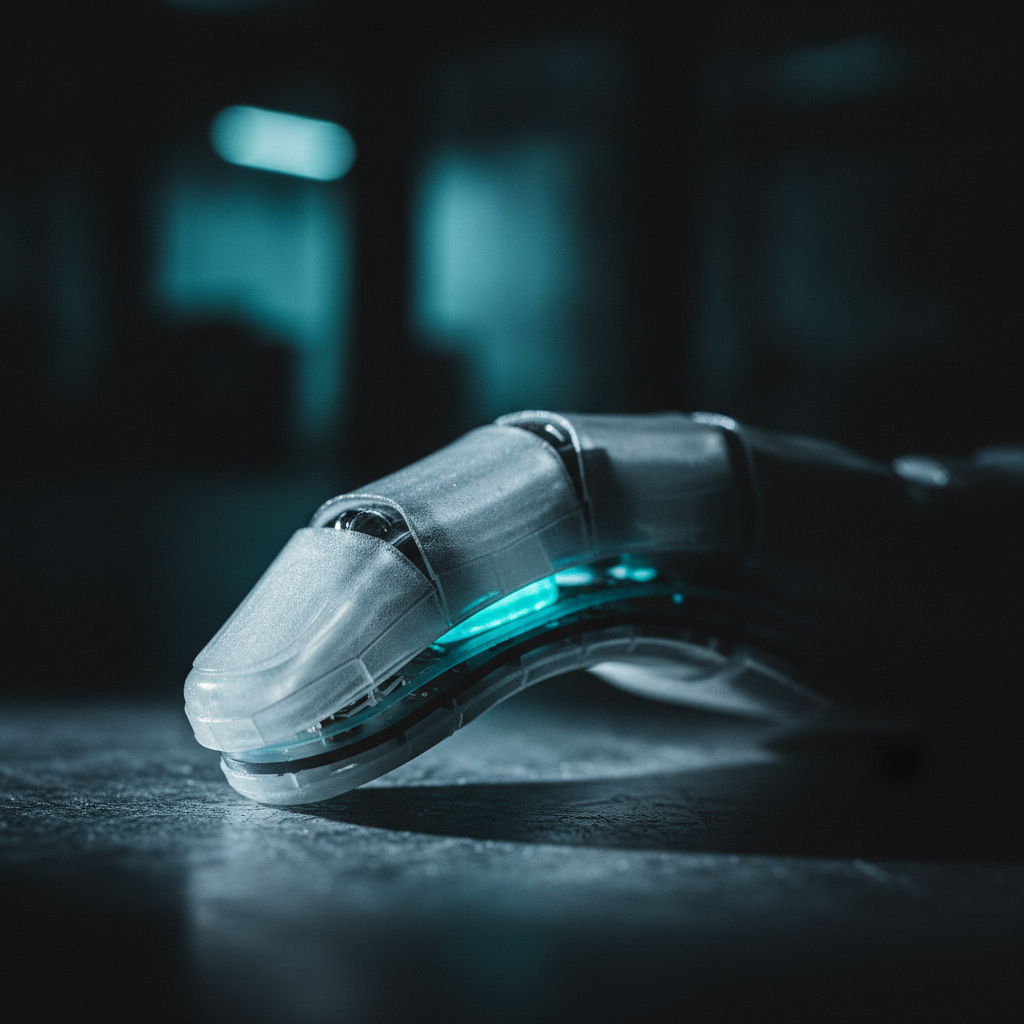
Robots can see, plan, navigate, and move with sophistication. The part they still struggle with is feeling. For humanoid hands, dexterous grippers, logistics robots, service robots, and industrial systems, touch must detect contact, map force, sense shear and slip, and understand material interaction — and it must do all of that reliably over millions of contact cycles, not just in a lab. [1]
The dominant approach to robotic touch — electronic skin built from capacitive, piezoresistive, piezoelectric, triboelectric, or impedance-based layers — places the sensing element close to the contact surface. That is exactly where the damage happens. Repeated compression, abrasion, contamination, humidity, temperature variation, and cleaning exposure all degrade the sensing layer over time, introducing wear, hysteresis, creep, delamination, baseline drift, and recalibration burden. [1]
The issue, as UltraSense Systems frames it, is not visible wear — it is lifetime signal integrity. A sensor that works on Day 1 must still provide useful contact data after months or years of operation. For a commercial robotic hand operating over millions of contact cycles, that distinction becomes central to product viability. [1]
The trade-off between surface sensitivity and long-term durability has haunted tactile sensing for years. Every design choice that protects the sensor from the environment tends to degrade the quality of what the sensor actually measures — a tension that no amount of materials engineering has fully resolved.
UltraSense's proposed solution moves the sensor below the damage zone entirely. Instead of embedding a functional layer in the mechanical load path, the company's platform uses acoustic waves that propagate through the material stack from below, reflect from internal boundaries, and change in response to contact-induced deformation. The outer surface — elastomer, polymer, glass, metal, leather, fabric — handles friction, compliance, and abrasion. Ultrasound reads what is happening at the contact interface from behind it. [1]
That acoustic interrogation yields more than a single force value. Time-of-flight, reflection amplitude, attenuation, frequency response, phase, and acoustic impedance mismatch together provide information about contact, deformation, force distribution, shear, and material interaction. UltraSense has demonstrated 500 µm spatial resolution through an elastomer layer and localized compressive force profiling with approximately 1.25 mN precision. Shear-force inference has been shown with an approximately 5 mN noise floor. [1]
Material classification is another capability the approach unlocks acoustically. Every material presents a different acoustic impedance based on density and sound velocity. By analyzing reflection amplitude, echo signature, attenuation, and frequency response, a subsurface ultrasound system can infer whether it is touching metal, glass, plastic, rubber, fabric, skin, or foam — information that matters when a robot hand needs to adapt its grip strategy in real time. [1]
The ability to classify what a robot is touching — not just how hard it is pressing — represents a qualitative shift in what tactile systems can offer. Binary contact detection was the first rung. Force mapping was the second. Material awareness is where robotic hands start to resemble something more considered.
Manufacturability is the other part of UltraSense's pitch. The company has shipped more than 4 million units into automotive human-machine interface applications, building production experience in ultrasound sensing, mixed-signal ICs, firmware, calibration, test, and integration. Its ASIC roadmap applies those same platform principles to tactile intelligence, with the goal of creating a local tactile intelligence layer that can detect touch, estimate force maps, infer shear and slip, classify contact state, detect material response, and provide actionable information to the robot controller. [1]
The automotive heritage also shaped UltraSense's material flexibility. Conventional capacitive touch struggles with solid metal interfaces, where electric fields are shielded or distorted. Because ultrasound senses through acoustic propagation rather than surface electric-field modulation, the same platform can work through whichever outer material a designer specifies. [1]
Tactile sensing has long been the capability that separates a robot that can pick from one that can handle. UltraSense is not the only company trying to close that gap, but its argument — that the outer surface should handle mechanics while the sensing element remains protected below — is structurally sound. Whether the acoustic approach can deliver at the scale and cost humanoid robotics demands is the question the next few production years will answer. [1]
The issue is not visible wear; it is lifetime signal integrity. A tactile system must remain accurate, repeatable, and calibrated over time.UltraSense Systems