Voyager 1 Is One Light-Day Away
On November 18, 2026, humanity's farthest spacecraft crosses a distance milestone 49 years in the making.
By The space-quantum Desk
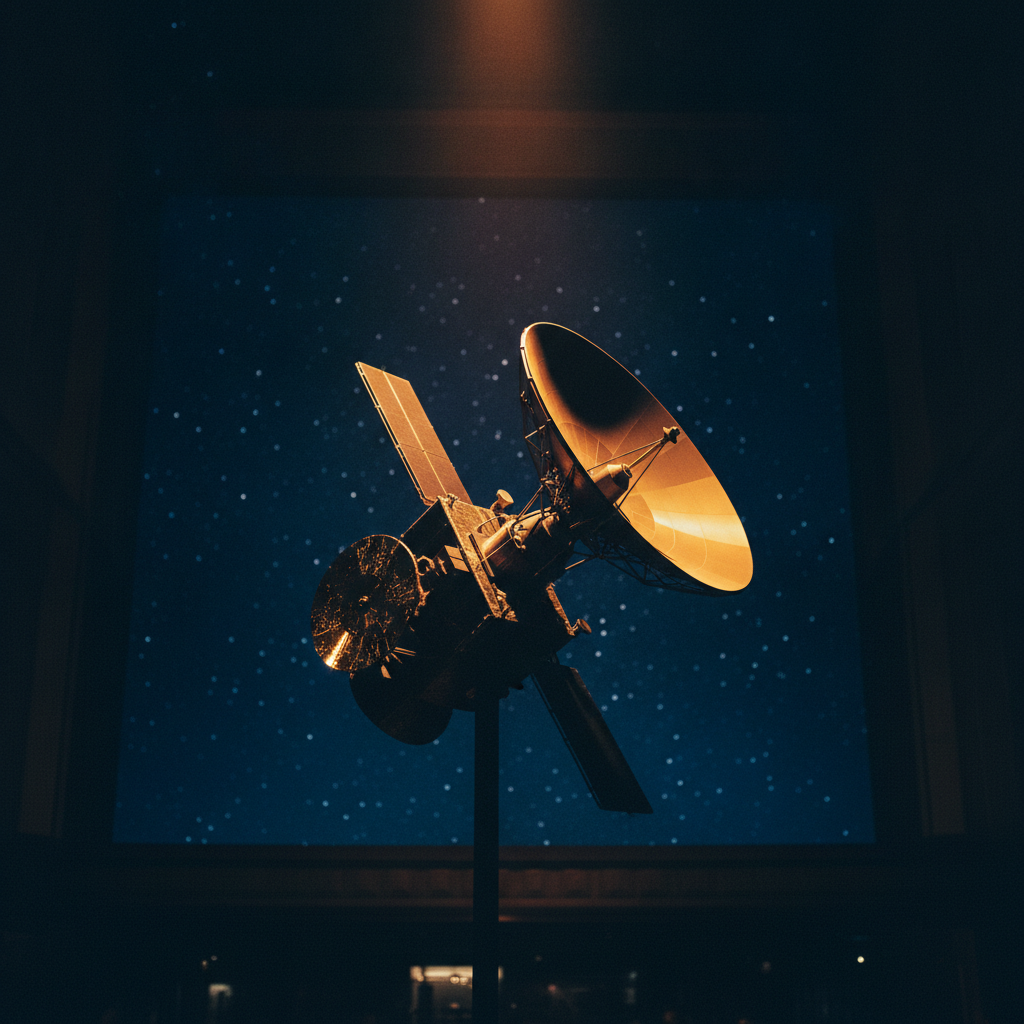
On November 18, 2026, Voyager 1 will cross the one-light-day mark — 16.1 billion miles from the Sun — 49 years after its launch, made possible by a once-every-175-year alignment of Jupiter, Saturn, Uranus, and Neptune. [1]
The probe didn't get there alone. Six gravity assists across two spacecraft gave both Voyagers their speed, producing the Grand Tour: up-close views of the solar system's gas and ice giants, including several moons. [1]
Both craft carry the Golden Record — a 12-inch phonograph record holding spoken greetings in 55 languages, 27 musical tracks, and 116 images, and other sounds from Earth. 468 billion years. [1]
[1][2] The Canberra antenna recently tracked Voyager 1 at 25.80 billion km — just over 16 billion miles. [1] A signal sent from Earth today takes more than a day to arrive.
Distance, in space, is not a number you feel until you measure it in light. One light-day is the kind of scale that quietly rearranges your sense of what far means.
[1] It has been moving through interstellar medium ever since, and it is still talking to us.
Hello from the children of planet Earth.NASA