Vulcan's Second Chance Lands on Friday the 13th
Nine months after a nozzle failure grounded ULA's flagship rocket, Vulcan returns to flight carrying 40 Amazon Leo satellites — with the Pentagon watching closely.
By The space-quantum Desk
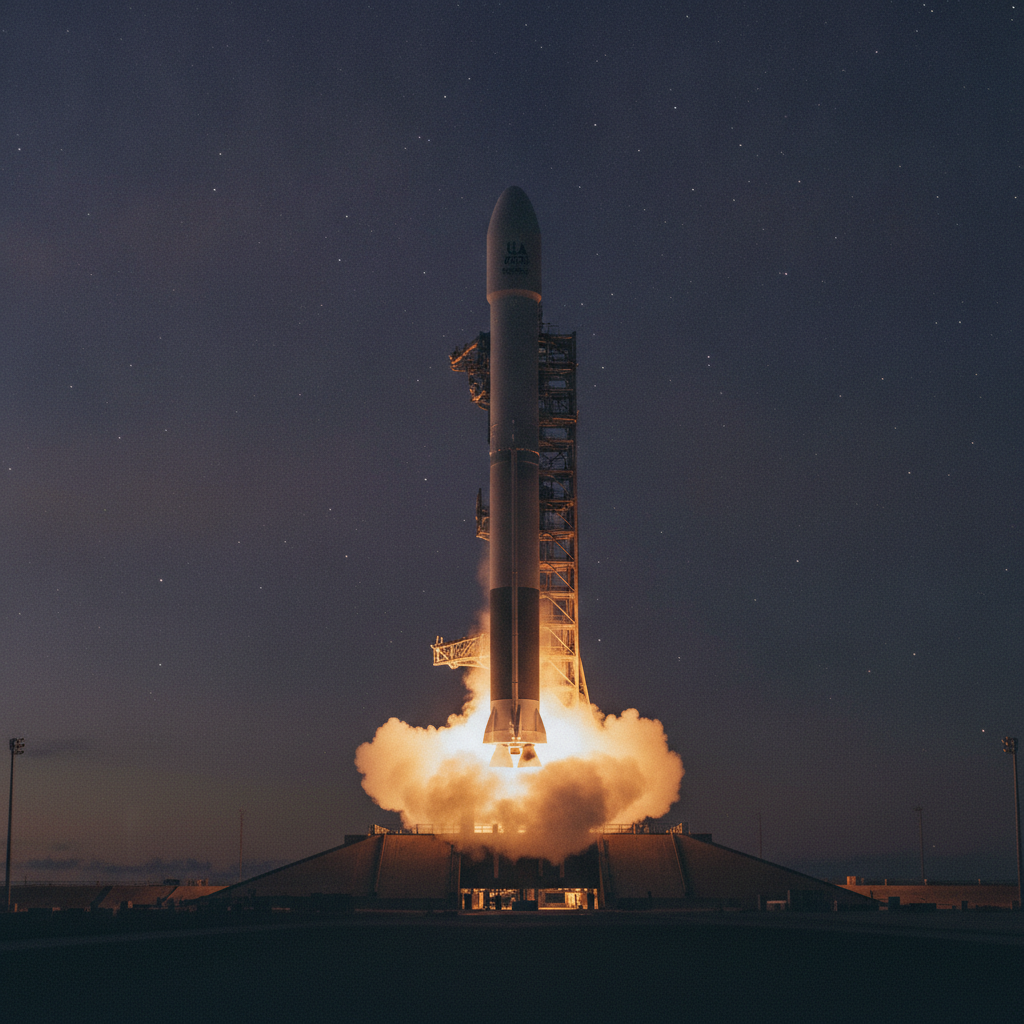
United Launch Alliance has scheduled November 13 as the date its Vulcan rocket returns to service — nine months after a solid rocket booster anomaly threw the company's 2026 launch schedule into oblivion. [1] The mission is anything but routine: it carries 40 satellites for Amazon's Leo broadband constellation and marks the first of 38 Vulcan flights Amazon has booked to deploy the bulk of its network. [1]
The stakes are high for a rocket that has stumbled out of the gate. Vulcan suffered nozzle failures on two of its first four missions, most recently during a flight in February. [1] The Space Force certified Vulcan for national security launches in 2025, flew two missions on it, then grounded it after the February incident. [1]
Investigators traced the first occurrence, in 2024, to a manufacturing defect in an insulator meant to protect the nozzle's metallic structure from the rocket's superheated exhaust. [1] ULA and booster manufacturer Northrop Grumman have not publicly identified the root cause of the February failure. [1]
The November flight will be the first to carry a full complement of six solid rocket boosters and will debut an extended payload fairing designed to accommodate Amazon's satellite stack, alongside a shortened Centaur upper stage optimized for low-Earth orbit missions. [1] It lifts off from Cape Canaveral Space Force Station, Florida, pending range approval. [1]
What makes this moment unusual is the layered scrutiny bearing down on a single launch. Military certification, commercial contracts, and a rival constellation's timeline are all contingent on what happens when those boosters ignite.
The Pentagon has entrusted Vulcan with roughly half of its major launches through the early 2030s — a backlog of communications, navigation, missile warning, and surveillance satellites. [1] The swaps included three GPS satellites that moved to SpaceX Falcon 9s, while Space Systems Command completed a separate swap to move a large strategic missile warning satellite from Vulcan to Falcon Heavy, and the Air Force Research Laboratory's Oracle-M lunar mission will now fly on SpaceX's Falcon Heavy rocket instead of ULA's Vulcan. [1]
Brig. Gen. Eric Zarybnisky, the chief rocket buyer at Space Systems Command, said the military wants to see data from commercial flights on the Vulcan rocket before clearing ULA to resume national security launches. [1] At least two Amazon Leo missions are on the Vulcan launch schedule before it flies another national security mission, perhaps early next year. [1] "Those flights will have a significant number of solids," Zarybnisky said. "It'll depend a lot on what we see, not only on the engineering and tests that we're doing on the ground, but also what we see from the flight data from the commercial missions they fly." [1]
On the commercial side, Amazon Leo — a potential competitor to SpaceX's Starlink network — has an inventory of broadband satellites sitting in storage, waiting for Vulcan to fly. [1] The November 13 launch is the first of 38 Vulcan flights Amazon has contracted, meaning ULA's recovery arc and Amazon's constellation timeline are now tightly coupled. [1]
Two customers, one rocket, and a booster problem that still lacks a fully public explanation: Vulcan's return-to-flight is less a triumphant restart than a carefully managed data-collection exercise dressed up as a launch.
If the nozzle holds on November 13, ULA gets a path back to the military launches that define its business. If it doesn't, the six-mission swap with SpaceX may start to look less like a contingency and more like a preview. [1]